

2 years unopened
Tightly capped, cool and dry at 65 to 70°F
Not needed
Opened, 12 months on a cupboard shelf
No figure
None of the sources we opened covers freezing vinegar
Has your white wine vinegar gone bad?
See all 5 stages ↓ Use itClear, sharp white wine vinegar
 Still fineCloudy white wine vinegar
 Throw it outMoldy or fizzing white wine vinegar
White wine vinegar barely goes bad. Unopened it keeps about 2 years in the pantry, and about 12 months once opened, tightly capped somewhere cool, dry and dark. Cloudiness and a little sediment are harmless. Throw a bottle out only if it grows mold or starts to fizz.
On this page
What should you look for on a white wine vinegar label?
Check the acidity, because 5% is the figure that matters. Tested pickling and canning recipes assume vinegar at 5% acidity, while anything weaker is not recommended for preserving. So read the number before you buy, and keep the strong bottle for the jars. Note too that white wine vinegar and plain white vinegar are different things, even though people often reach for one and mean the other.

Five percent acidity, and a cap that seals.
Five percent acidity, and a cap that seals.
5% acidity for preserving. Tested recipes assume that strength, so weaker vinegar is not recommended for a safe jar.
A commercially produced bottle. Commercial vinegar is what keeps the acidity reliable, which is why the preserving guidance asks for it by name.
Glass, free of cracks or nicks. The bottling instructions call for glass sealed with a screw cap or a cork, rather than anything that reacts.
A cap that seals. A tightly closed bottle keeps the air out, and that is what every chart asks for.
How to store white wine vinegar so it lasts
To store white wine vinegar so it lasts, keep it tightly capped in a cool, dry, dark cupboard. It is an acidic food, so its own acidity does most of the preserving, and it asks for no fridge at all.
Where should you store white wine vinegar?
Store white wine vinegar in a cool, dry, dark cupboard at 65 to 70°F, with the cap screwed down. Keep the bottle away from the cooker and out of bright light, because heat and light are the conditions that age it. So a pantry shelf suits it better than a windowsill, however good the bottle looks there.

Capped, cool and dark, and nowhere near the cooker.
Capped, cool and dark, and nowhere near the cooker.
How long does white wine vinegar last after opening?
An opened bottle of white wine vinegar is given 12 months, while an unopened one gets 2 years. The charts are not unanimous, though: one pantry factsheet gives vinegar 30 months in a tightly sealed container, and another source calls its shelf life almost indefinite. So treat 12 months after opening as the point to taste it rather than the point to bin it.
So write the date you opened it on the label. The Worcestershire sauce guide sits on the same pantry shelf, and on the same 30-month line of the same chart.
Does white wine vinegar need to be kept in the dark?
Yes, a dark cupboard is the right place for white wine vinegar. Heat and light are what age a bottle, which is why the advice is always cool, dry and dark rather than a spot on the counter. The sharpest warning on the subject is about homemade flavored vinegar: a bottle left in bright light, or above 65°F for more than a few weeks, should be treated as a decorative item and not eaten.
Can you use old white wine vinegar for pickling?
Use fresh vinegar for pickling rather than an old bottle. The guidance for preserving is that fresh is best, and tested recipes assume a known 5% acidity, so a part-used bottle of uncertain age is the wrong one to reach for. Keep the old one for dressings and cooking instead, where the exact acidity does not decide whether a jar is safe. The Dijon mustard guide covers the jar that usually goes into that dressing.
Can white wine vinegar sit out overnight?
Yes, white wine vinegar can sit out overnight safely. It is a shelf-stable acidic food that lives at room temperature anyway, so a night on the counter changes nothing that matters. Put the cap back on and move it out of the light, though, since that is what the storage advice is really about. The food left out overnight guide covers the foods where the answer is no.
Does white wine vinegar need to be refrigerated?
No, white wine vinegar does not need refrigeration. Its acidic nature is self-preserving, so a cool, dry, dark cupboard is all a commercial bottle asks for. Homemade flavored vinegar is the exception, however, because refrigeration is what keeps its freshness and flavor.
Can you freeze white wine vinegar?
None of the sources we opened gives a freezer time for vinegar, so we will not invent one. There is no obvious gain either, since an unopened bottle already gets about 2 years in the cupboard and the acidity is doing the preserving. So keep white wine vinegar in the pantry, and save the freezer for food that needs it.

The cupboard, not the freezer, for a sealed bottle.
The cupboard, not the freezer, for a sealed bottle.
How do you store homemade flavored white wine vinegar?
Homemade flavored vinegar keeps 6 to 8 months in the fridge, or 3 months in a cool dark place at 65°F or below, and it should be refrigerated once opened. Keep the bottles tightly sealed, because that is what reduces the risk of spoilage. One set of instructions is tighter still, giving flavored vinegar 4 to 6 months for best quality. Wine vinegars need the extra care, since they carry some proteins that encourage bacteria to grow, which is also why only commercially produced vinegar should go into the bottle.
What is the cloudy stuff in white wine vinegar?
Haze in an opened bottle comes from harmless bacteria that get in once the seal is broken, and it does not affect the flavor or the quality. A slightly cloudy appearance is called out in the storage charts as something to ignore. Unfiltered vinegar can also settle into a sediment layer over time, which is the same story. Homemade flavored vinegar is the one exception, because there cloudiness counts as a sign of spoilage rather than a harmless haze.
How to tell if white wine vinegar has gone bad
White wine vinegar hardly ever spoils, and that is the honest headline. Four of the five stages below are quality changes rather than safety ones, because the acidity keeps most bacteria from growing. Mold and fermentation are the two signs that end a bottle, though. Here is what each stage means.

Verdict: use it
Clear, sharp white wine vinegar
Bright and clear in the bottle, with the sharp acidic bite it had the day you opened it. This white wine vinegar is fine for dressings, for cooking and for pickling.

Verdict: still fine
Cloudy white wine vinegar
A haze through the glass, usually in a bottle that has been open a while. Harmless bacteria get in once the seal is broken, and a slightly cloudy appearance does not affect quality, so the bottle carries on as normal.

Verdict: strain it and use it
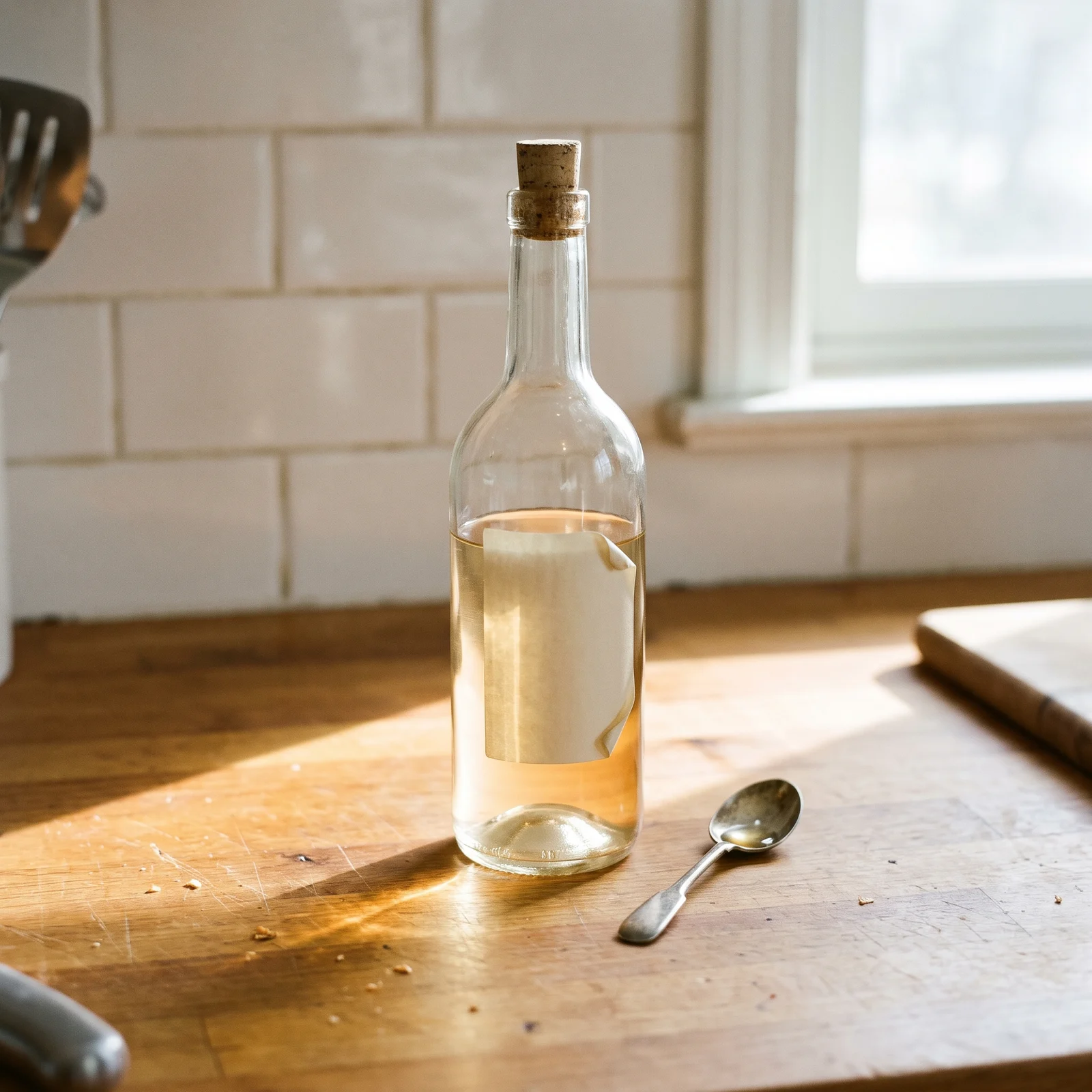
White wine vinegar with sediment
A soft deposit settled at the bottom of the bottle. Unfiltered vinegar forms a sediment layer over time, so pour it through a coffee filter if the look bothers you, or simply leave the last inch behind.
Verdict: cook with it, do not pickle with it
Flat-tasting white wine vinegar
A bottle that has lost its edge, often one kept warm or in the light. Flavor is the thing to check once a vinegar is past six months, and a flat one still earns its place in a dressing or a pan sauce. Keep it out of the pickling jar, though, because preserving wants fresh vinegar at a known 5%.

Verdict: throw it out
Moldy or fizzing white wine vinegar
Mold on the surface, gentle bubbling, or a slimy strand in the liquid. Mold or signs of fermentation mean the bottle is thrown away without tasting it, and that goes double for a flavored vinegar made at home. So bin it rather than straining it.
Is white wine vinegar safe past the date on the bottle?
Yes, white wine vinegar is generally safe past the date on the bottle. Its shelf life is described as almost indefinite, because the acidity preserves it, so the date marks quality rather than safety. Taste it before you use it, and keep an old bottle out of the pickling jar. The honey guide covers another pantry jar that outlives its own label.
White wine vinegar substitutes
Out of white wine vinegar, or did the bottle finally grow something? Then one of these will stand in.
Substitute
Works best in
What changes
Champagne vinegar
Dressings and sauces
The closest match, from the same family of wine vinegars.
Distilled white vinegar
Pickling and cleaning
Clear and sharper, so delicate herbs still come through.
Red wine vinegar
Heartier dressings
Darker, so it tints a pale dressing.
Apple cider vinegar
Fruit and marinades
Milder, and it pairs nicely with fruit. The apple cider vinegar guide covers how long a bottle keeps.
Mistakes people make when they store white wine vinegar
These are the ways people store white wine vinegar that cost them the most, so each one has an easy fix.
Keeping the bottle on a sunny windowsill, when light and heat are what age it fastest.
Leaving the cap loose, which lets in the air that clouds a bottle.
Throwing out cloudy vinegar, when a haze in a plain bottle does not affect its quality.
Pickling with a part-used bottle, when preserving recipes want fresh vinegar at 5% acidity.
Buying vinegar under 5% acidity for canning, which is not recommended for a safe jar.
Standing it beside the cooker, rather than in a cupboard at 65 to 70°F.
Leaving homemade flavored vinegar in the cupboard once it is opened, instead of in the fridge.
Sources
Food Storage Guide FN579, Julie Garden-Robinson, NDSU Extension, reviewed January 2023, on vinegar keeping 2 years unopened and 12 months opened, keeping it tightly covered, and a slightly cloudy appearance not affecting quality.
Vinegar and its Shelf Life, Karen Blakeslee, Kansas State University Research and Extension, June 2021, on vinegar's almost indefinite shelf life, its self-preserving acidity, cool dry dark storage without refrigeration, cloudiness after opening, sediment, and using fresh vinegar for preserving.
Food Storage: Pantry, Pamela Schmutz and E.H. Hoyle, revised by Faith C Isreal, Clemson Cooperative Extension factsheet HGIC 3525, revised March 2020, on vinegar keeping 30 months in a tightly sealed container and on a cool, dry pantry at 65 to 70°F.
Safety Concern with Vinegar Acidity Level in Home Canning, Curtis Braun, SDSU Extension, updated July 2024, on checking the label for 5% acidity, on weaker vinegar not being recommended for canning, and on tested recipes assuming 5%.
Flavored Vinegars, Nellie Oehler, Oregon State University Extension Service publication SP 50-736, revised December 2025, on wine vinegars carrying proteins that promote bacterial growth, using only commercially produced vinegar, tightly sealed bottles, refrigeration for freshness, 4 to 6 months for best quality, tasting after six months, and discarding moldy or fermenting vinegar.
Making Flavored Vinegar, D. Grubb, E. Shackelton and M. Bunning, Colorado State University Extension factsheet 9.340, January 2021, on white wine vinegar as a base, commercially produced vinegar for reliable acidity, glass bottles free of cracks, 6 to 8 months refrigerated or 3 months below 65°F, and discarding vinegar that molds or ferments.
Food Storage for Safety and Quality, Elizabeth L. Andress and Judy A. Harrison, University of Georgia Cooperative Extension publication FDNS-E-119, June 2011, on clean, cool, dry cupboards and on throwing out food that shows mold growth, bubbling, bulging lids or unpleasant odors.
Every storage time, temperature and verdict on this page comes from the sources listed above, and none of it is made up. Food safety still depends on conditions we cannot see, so read the Disclaimer, and if in doubt, throw it out.
Other ingredient guides
Browse all guides


Share this guide
Never miss a guide
New ingredient guides when they go up, plus one storage tip worth knowing. Anything sponsored is labelled.

Emilly White