
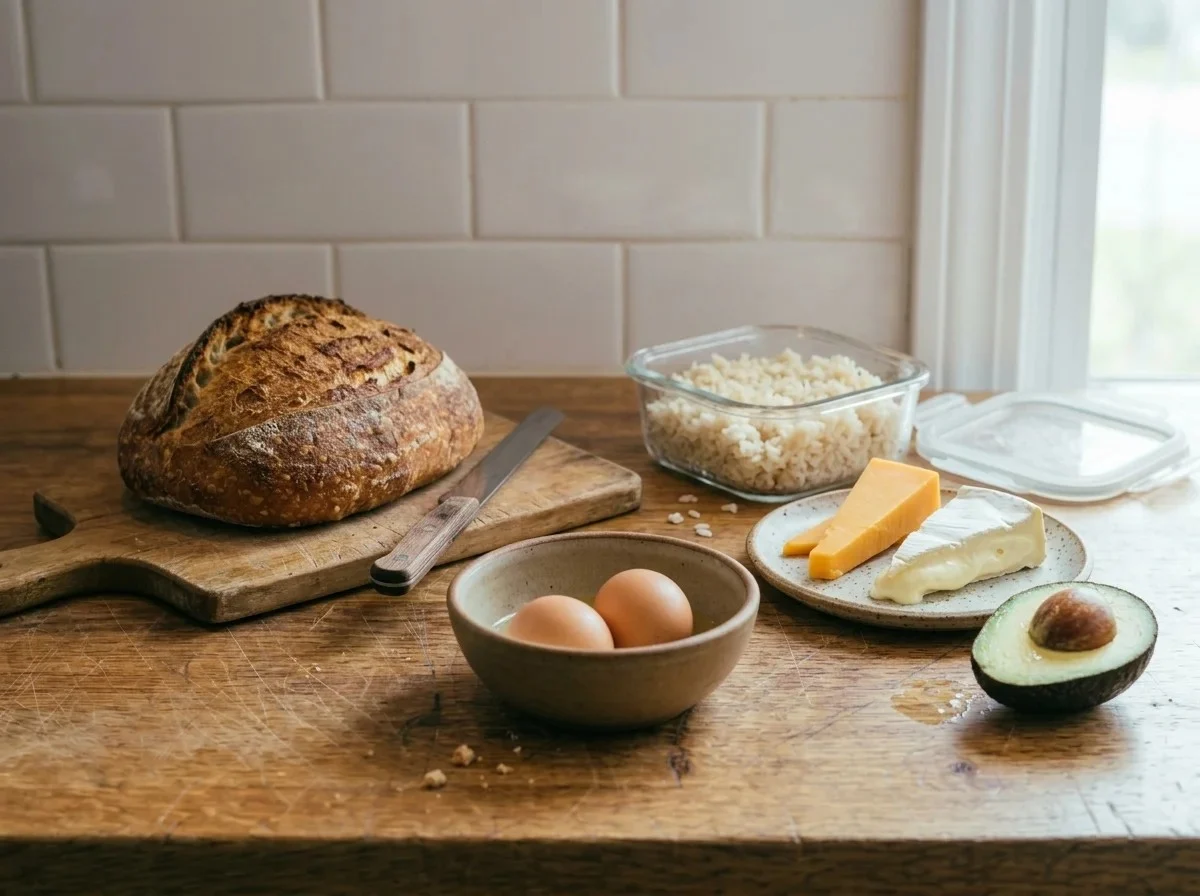
2 hours
The most perishable food should sit out
1 hour
Picnics, hot cars and summer kitchens
Toss it
If it is perishable, reheating will not fix it
The short version: food left out overnight is only safe if it normally lives at room temperature, such as bread or whole onions. So anything perishable, including cooked rice, cut fruit, eggs and soft cheese, goes in the bin, however it looks.
Guidance from the USDA Food Safety and Inspection Service, Nebraska Extension and University of Maine Cooperative Extension.
On this page
The 2-hour rule for food left out
The rule comes from the USDA: never leave perishable food between 40 and 140°F for more than 2 hours, and only 1 hour when it is above 90°F, such as at a picnic or in a hot car. That range is called the Danger Zone, because bacteria can double in as little as 20 minutes there.
In fact, overnight is far past either limit. So the real question is not how long the food sat out, but whether it was perishable in the first place, which is what the list below sorts out.
Food left out overnight: keep or toss
In general, these verdicts assume a normal room for a whole night, roughly 8 to 12 hours. Also, each food links to its full guide, and if you are unsure, throw it out.
Food
Left out overnight?
Why
Raw eggs in the shell
Throw them out
Once chilled, eggs should not sit out more than 2 hours, since a cold egg can sweat and let bacteria in. See the egg guide.
Hard-boiled eggs
Throw them out
Because they are cooked, they belong in the fridge within 2 hours of cooking.
Hard cheese, such as cheddar or Parmesan
Usually keep, for cooking
Hard cheese may still be safe, although it dries and cracks, so wrap it, chill it and cook with it. See the cheese guide.
Soft cheese, such as brie or fresh mozzarella
Throw it out
Unlike hard cheese, soft and fresh cheeses left out overnight should be discarded.
Cream cheese
Throw it out
Since it is a soft cheese, it goes too, even though it can look and smell normal after hours out. See the cream cheese guide.
Bread and bagels
Keep
Because they are meant to be stored at room temperature, a night out does no harm. See the bread and bagel guides.
Whole onions, garlic, potatoes, bananas, apples and tomatoes
Keep
They keep on the counter anyway, as long as they are whole. See the onion and tomato guides.
Whole strawberries
Keep, but eat them today
Warmth dulls their color and flavor, so it is a quality problem rather than a safety one. See the strawberry guide.
Cut fruit and vegetables, such as a cut avocado, onion or tomato
Throw them out
However, cut and peeled produce should not be at room temperature for more than 2 hours. See the avocado guide.
Bagged spinach and salad greens
Throw them out
They are cut produce, so the same 2-hour limit applies. See the spinach guide.
Cooked rice
Throw it out
That is because its bacteria make toxins that reheating does not remove.
Cooked potatoes and other cooked vegetables
Throw them out
Cooked vegetables are perishable, and so they follow the 2-hour rule.
Whole mushrooms
Keep, cook them soon
Although they are fine at room temperature, they dry out within a day or two. See the mushroom guide.
Specifically, the cheese verdicts come from U.S. Dairy, the eggs from Iowa State University Extension, and cut produce from the USDA.
Why reheating food left out overnight does not help
Because some bacteria leave toxins behind. Nebraska Extension explains that when food sits out too long, staph bacteria can form a heat-resistant toxin that cooking cannot destroy, so the food can still make you sick after it is piping hot.
Similarly, cooked rice has its own version. University of Maine Cooperative Extension says Bacillus cereus spores survive cooking, then grow and produce heat-stable toxins in rice left at room temperature. In other words, heat kills the bacteria but not what they have already made, which is also why smell and look are no guide.
Common questions about food left out overnight
Does a lid make food left out overnight safe?
No, because the 2-hour rule is about temperature, not air. So a lid or a sealed container keeps dust out but does nothing to slow bacteria between 40 and 140°F. As a result, covered leftovers follow the same rule as uncovered ones.
Is the 2-hour rule real?
Yes, since it is the USDA's own limit, set with a margin because bacteria can double every 20 minutes in the Danger Zone. So food at 2 hours is not suddenly toxic, but food left out overnight has had many hours of growth.
What about food left out overnight in a cold room?
The rule applies whenever food is between 40 and 140°F, and most rooms stay well above 40°F even in winter. Unless you know the spot stayed at 40°F or below all night, treat it like room temperature. For food in a fridge that lost power, see food after a power outage.
Is rice left out overnight safe to eat?
No, because University of Maine Cooperative Extension says to refrigerate cooked rice within 2 hours, or 1 hour above 90°F, and then eat it within 3 to 4 days. So rice left out overnight should be thrown out, even if you plan to reheat it.
Sources
"Danger Zone" (40°F - 140°F), Food Safety and Inspection Service, U.S. Department of Agriculture, on the 2-hour and 1-hour limits.
How should I store cut fruit and vegetables?, Food Safety and Inspection Service, U.S. Department of Agriculture, May 2024, on cut and peeled produce.
Will Reheating Food Make It Safe If You Forget to Refrigerate It?, Nebraska Extension, on heat-resistant staph toxins.
Is Your Leftover Rice Safe?, Alex Gayton, University of Maine Cooperative Extension, March 2026, on Bacillus cereus in cooked rice.
How Long Can Cheese Sit Out?, U.S. Dairy, on hard and soft cheese left out.
Egg Safety Q&As, AnswerLine, Iowa State University Extension, on eggs at room temperature.
Storage times and safety advice on this page come from the sources above. Food safety depends on conditions I cannot see, so read the Disclaimer, and if in doubt, throw it out.
Other ingredient guides
Browse all guides
Share this guide
Never miss a guide
New ingredient guides when they go up, plus one storage tip worth knowing. Anything sponsored is labelled.

Emilly White