
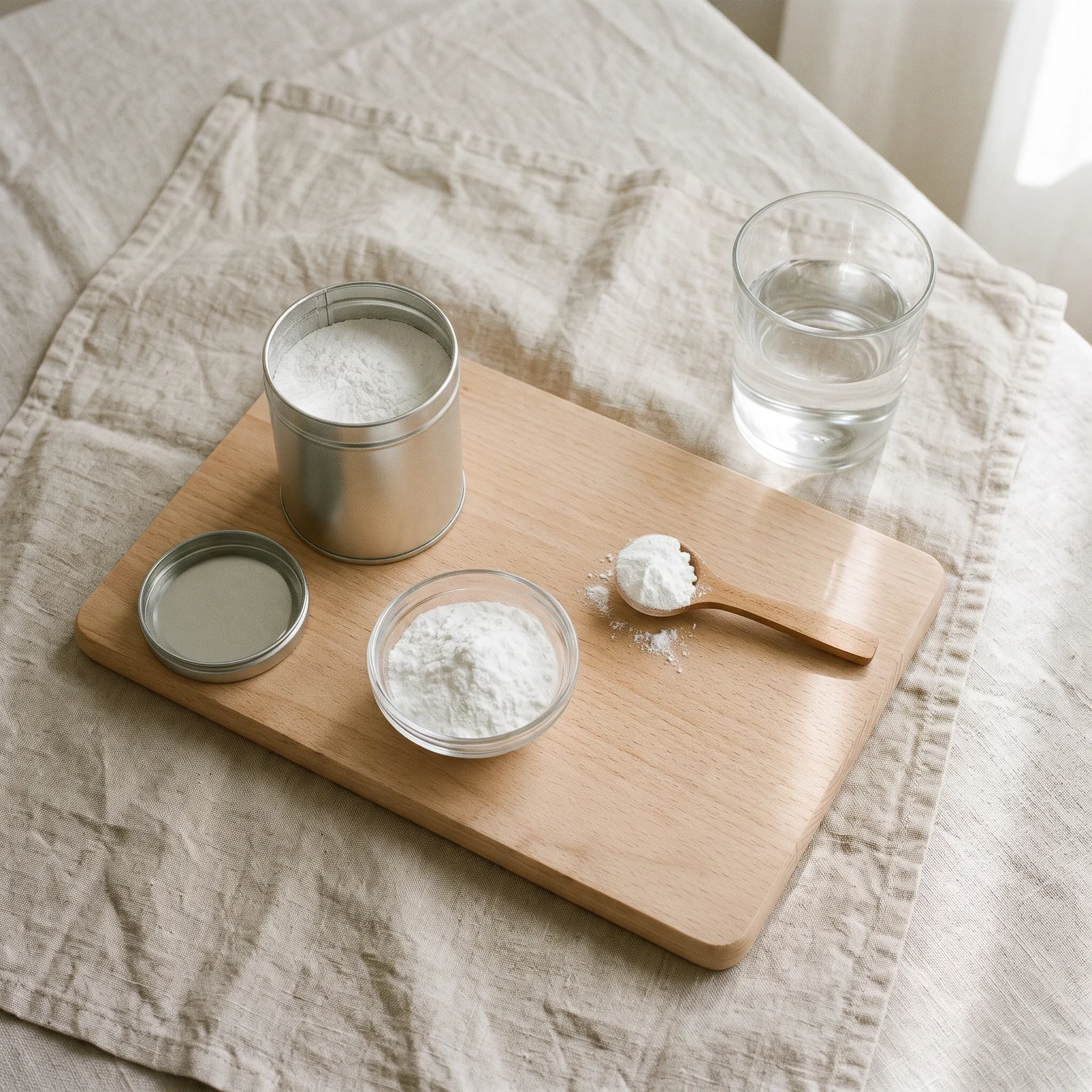
6 to 18 months
Dry and covered, in a cool, dark cupboard
3 to 6 months
Dry and covered, with the opening date on the lid
Not needed
No storage chart gives it a freezer time
Has your baking powder gone bad?
See all 5 stages ↓ Use itFresh baking powder
 Use it for something forgivingBaking powder that foams slowly
 Throw it outBaking powder opened more than six months ago
Baking powder does go bad, and it goes quietly, by losing the lift rather than by spoiling. An unopened tin keeps 6 to 18 months, while an opened one is worth 3 to 6 months. The answer to how to store baking powder is a cool, dry cupboard with the lid shut.
Is it baking powder or baking soda?
Baking powder holds sodium bicarbonate, an acid and a drying agent together in one tin, so it raises a batter without any acid from the recipe. Baking soda is pure sodium bicarbonate, which does nothing at all until buttermilk, yogurt, lemon or vinegar reaches it. That difference is also why the tin runs on the shorter clock, because the acid it needs is already sitting beside the bicarbonate.

One tin brings its own acid, while the other waits for the recipe.
Baking powder works on its own, since the acid and the drying agent are already in the tin with the bicarbonate.
Baking soda is sodium bicarbonate and nothing else, so a recipe built on it has to supply the acid itself.
Double-acting powder is the one to reach for in a batter you mean to freeze, because part of its rise waits for the oven.
The tin carries the date that decides it, and the cupboard charts point straight at that date rather than at a fixed shelf life.
How to store baking powder so it lasts
To store baking powder so it lasts, keep the tin dry, covered and somewhere cool and dark, because damp is the one thing that undoes a powder holding its own acid. Heat pushes the same way, so the cupboard above the stove is the wrong cupboard for it.
Where should you store baking powder?
Keep baking powder in a cool, dry, dark cupboard with the lid shut, away from the stove and any other appliance that gives off heat. That is nearly all there is to how to store baking powder, and the same cupboard that suits flour suits the tin. Check that the spoon going in is dry as well, since a damp one carries moisture straight into the powder. Then write the date you opened it on the lid, because that date turns out to matter more than the printed one.
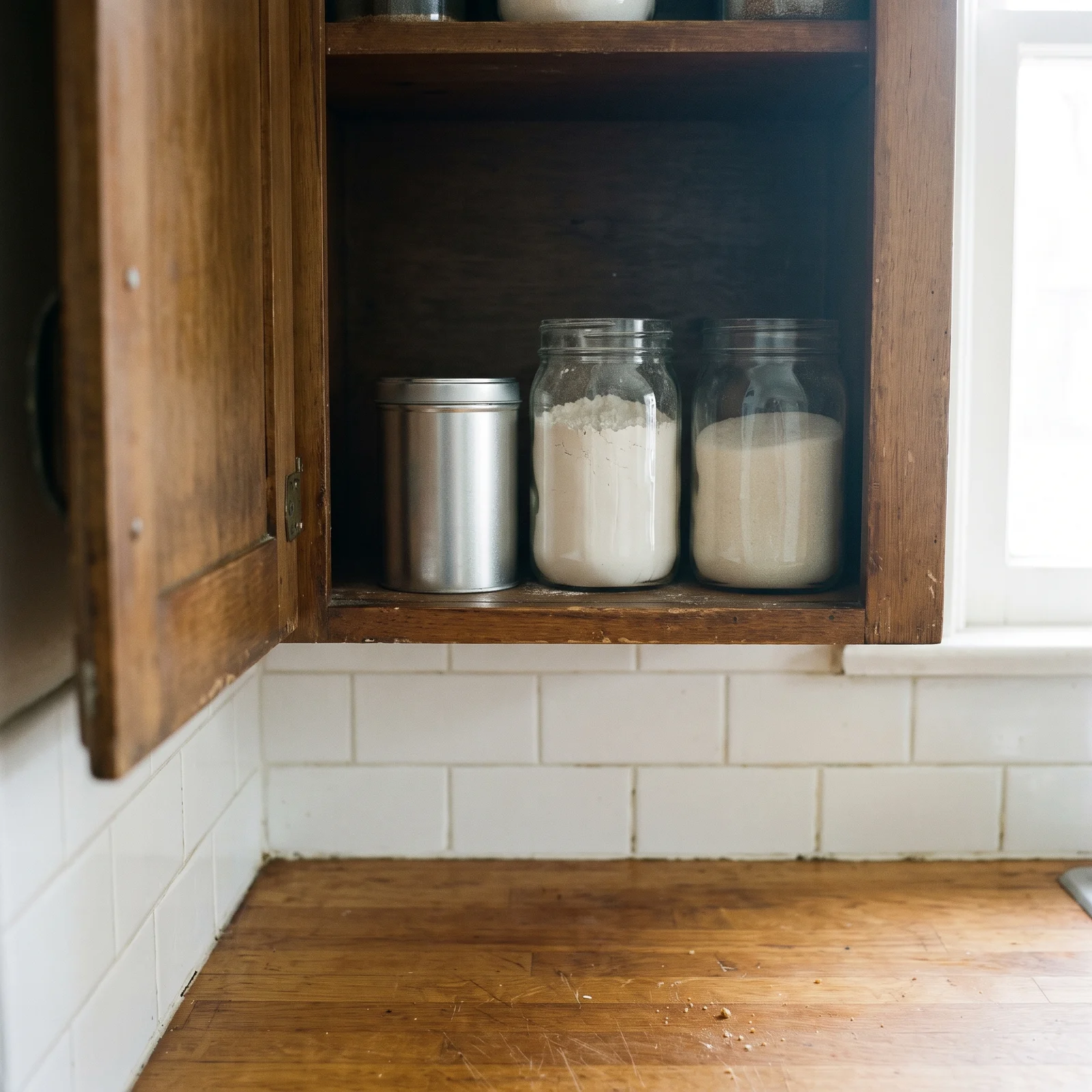
A closed tin in a cool, dark cupboard, dated the day it was opened.
How long does baking powder last?
An unopened tin of baking powder lasts 6 to 18 months, and an opened one gets 3 to 6 months. The charts pull in different directions here, however. One gives 18 months or whatever date is stamped on the tin, another gives 6 to 18 months unopened and 3 to 6 months open, and a third is far stricter at 6 months unopened and 3 months open. So plan around the short figures, and treat the opened tin as the one on a real clock.
In other words, the printed date describes a sealed tin. Once the lid has come off, the clock that counts is the one that started the day you opened it.
Does baking powder need to be refrigerated?
No, baking powder does not need the fridge, and no chart we opened sends it anywhere cold. Every one of them keeps it dry and covered at cupboard temperature instead, and the maker asks for a cool, dry place in the same words. Damp is the thing to guard against here, so a cupboard shelf beats any cold shelf.
Why does baking powder stop working?
Baking powder loses its lift because it holds its acid in the same tin as the bicarbonate, with a drying agent in there to keep the two of them dry. Damp is what undoes that arrangement, which is why every chart says to keep the tin dry and covered. Heat works in the same direction, so a tin stood near the oven is in the wrong place. The loss is gradual rather than sudden, though, and that is the part most people get wrong, because a tired tin still bubbles in water long after it has stopped raising a biscuit.
Can baking powder sit out overnight?
Baking powder can sit out overnight without becoming unsafe, since it is a dry powder rather than a food that spoils. An open tin left on the counter still has something to lose, however, because kitchen air carries moisture and the charts keep it covered for that reason. So put the lid back on and return it to the cupboard. The food left out overnight guide covers the things on the counter that really do matter.
Can you freeze baking powder?
There is no reason to freeze baking powder, and no storage chart we opened gives it a freezer time at all. Every one of them keeps the tin dry and covered in a cupboard, while the maker asks for a cool, dry place. An opened tin runs on a 3-to-6-month clock in any case, so the cold has nothing to add.
Where does baking powder actually belong?
A closed tin belongs on a cool, dark cupboard shelf, away from the stove, the kettle and the dishwasher. Dry and covered is the whole instruction in every chart, and the maker's wording comes to the same thing. Keep it clear of cleaning products as well, which the cupboard charts warn about for every food. Then check that the measuring spoon is dry each time, because that is the most ordinary way damp gets in.

A cool, dark shelf and a dry spoon, because damp is what undoes it.
How do you test baking powder for freshness?
Stir 1 teaspoon of baking powder into a third of a cup of hot water, then look for vigorous foaming. Bubbles that arrive straight away mean the tin still has rising power, while a slow, thin reaction means it is going. The same test appears with warm water instead of hot, described there as a rough check rather than proof.
Does the bubble test prove baking powder still works?
No, the bubble test is a floor rather than proof, and that is the most useful thing on this page. In a year-long test where a new tin was opened every month, every powder bubbled in warm water, including one that had been open for 12 months. The biscuits told another story, because rise began to drop with powder opened 6 months earlier, and by 10 months the biscuits stood half the height of fresh ones and did not rise properly. So the test catches a dead tin, while it passes a tired one happily, and that is why the date on the lid beats the bubbles.
Does baking powder go bad?
Baking powder fails in one direction, and that is a gradual loss of lift rather than anything resembling spoilage. Mold and bacteria never come into it, so nothing below is a safety call and what you lose is the rise. Here is what each stage means.

Verdict: use it
Fresh baking powder
The powder is loose and dry, and a teaspoon of it in hot water foams up hard within a second or two. A tin like that suits anything that has to rise, including biscuits and cakes where the height is the point. So keep the lid shut, and use it within 3 to 6 months of opening.

Verdict: use it for something forgiving
Baking powder that foams slowly
The water fizzes, but thinly, and the bubbles take a moment to arrive. Rise starts dropping off at around 6 months from opening, although biscuits made with powder of that age were still acceptable. So keep this tin for pancakes, muffins and anything where a little less lift will not show.

Verdict: throw it out
Baking powder opened more than six months ago
The date on the lid is the giveaway here, because the powder itself may look and foam perfectly fine. By 10 months from opening, biscuits came out half the height of fresh ones and did not rise properly, which is the sharpest number in any of the sources. So replace the tin at six months rather than waiting for the oven to tell you.

Verdict: throw it out
Caked or hardened baking powder
The powder has set into lumps, or a crust has formed across the surface in the tin. Damp has reached it, and damp is the one thing a tin holding its own acid cannot take, which is exactly why a drying agent sits in there with it. So let this tin go, unlike a lumpy box of baking soda, which still works perfectly well.

Verdict: throw it out
Baking powder that will not foam at all
A teaspoon goes into hot water and nothing happens, or barely anything does. The rising power has gone completely, and piling more of it into the bowl does not bring the lift back. So open a fresh tin, and write the day you opened it on the lid before it goes in the cupboard.
Does unopened baking powder go bad?
An unopened tin keeps 6 to 18 months, and the date stamped on it is what the cupboard charts point to. The charts do not agree, however, since one gives 18 months or the printed date, another gives 6 to 18 months, and the strictest gives only 6 months. So go by the printed date, and treat anything much older than 18 months as a tin to test before you trust it with a cake.
Baking powder substitutes
Out of baking powder, or did the tin turn out older than the recipe deserves? Then one of these will stand in.
Substitute
Works best in
What changes
Baking soda and cream of tartar
Cakes and cookies
Use 1/4 teaspoon of soda with 1/2 teaspoon of cream of tartar for each teaspoon of powder.
Baking soda and lemon juice
Pancakes and muffins
The same 1/4 teaspoon of soda, with 1/2 teaspoon of lemon juice as the acid instead.
Self-rising flour
Biscuits and scones
Flour with the leavening already in it, and the self-rising flour guide covers it.
Yeast
Bread and rolls
A different kind of lift, since it needs time rather than heat, so the yeast guide covers that one.
Mistakes people make when they store baking powder
These are the ways people store baking powder that cost them the most, so each one has an easy fix.
Keeping an opened tin for a year, when biscuits made with 10-month-old powder came out half the height of fresh ones.
Trusting the bubble test on its own, although every tin in a year-long test bubbled, including one open for 12 months.
Never writing the opening date on the lid, which is the one number that really predicts the rise.
Dipping a damp spoon into the tin, since moisture is what undoes a powder that holds its own acid.
Keeping it in the cupboard above the stove, where the heat works against it.
Putting the tin in the fridge, when no chart sends baking powder anywhere cold at all.
Treating a caked tin the way you would treat a caked box of baking soda, because this one has had the damp it cannot take.
Sources
Food Storage Guide, Julie Garden-Robinson, NDSU Extension publication FN579, reviewed January 2023, on baking powder keeping 6 to 18 months unopened and 3 to 6 months opened, baking soda keeping 2 to 3 years unopened and 3 to 6 months opened, keeping both dry and covered, and using double-action baking powder in a batter that is frozen.
Safe Food Storage: The Cupboard, Karen Blakeslee, Kansas State University Research and Extension publication MF3131, revised June 2026, on baking powder keeping 18 months or until the date on the can and baking soda keeping 2 years at 70°F, keeping both dry and covered, storing foods in a cool, dry, dark place away from heat sources and away from chemicals, and throwing food out when in doubt.
Food Storage for Safety and Quality, Elizabeth L. Andress and Judy A. Harrison, University of Georgia Cooperative Extension publication FDNS-E-119, June 2011, on baking powder keeping 6 months unopened and 3 months opened, and baking soda keeping 18 months unopened and 6 months opened.
Storing Staple Ingredients in the Kitchen, Martha Zepp, Penn State Extension, updated August 2024, on testing baking powder with 1 teaspoon stirred into a third of a cup of hot water and looking for vigorous foaming, checking the expiration date on the container, testing baking soda with 1½ teaspoons and 1 tablespoon of vinegar, and making sure measuring spoons are dry before dipping them in.
Home Bakers FAQs, Clabber Girl, on an unopened can typically lasting up to 18 months and an opened one being best used within 6 months for the best rise, storing baking powder in a cool, dry place, stirring 1 teaspoon into a third of a cup of warm water and looking for immediate bubbling while calling that test not definitive, baking powder containing sodium bicarbonate, an acid and a drying agent while baking soda is pure sodium bicarbonate needing an acidic ingredient, and replacing 1 teaspoon of baking powder with ¼ teaspoon of baking soda plus ½ teaspoon of cream of tartar, lemon juice or vinegar.
Baking Powder Shelf Life, America's Test Kitchen, on opening new cans at monthly intervals over a year, every powder bubbling in 1 teaspoon to half a cup of warm water including the 12-month-old can, biscuit rise beginning to decrease with 6-month-old powder and falling to half the height of fresh by 10 months, biscuits from 10-month-old powder not rising properly, and writing the opening date on the can and discarding it after six months rather than relying on the bubble test.
Every storage time, temperature and verdict on this page comes from the sources listed above, and none of it is made up. Food safety still depends on conditions we cannot see, so read the Disclaimer, and if in doubt, throw it out.
Other ingredient guides
Browse all guides



Share this guide
Never miss a guide
New ingredient guides when they go up, plus one storage tip worth knowing. Anything sponsored is labelled.

Emilly White