
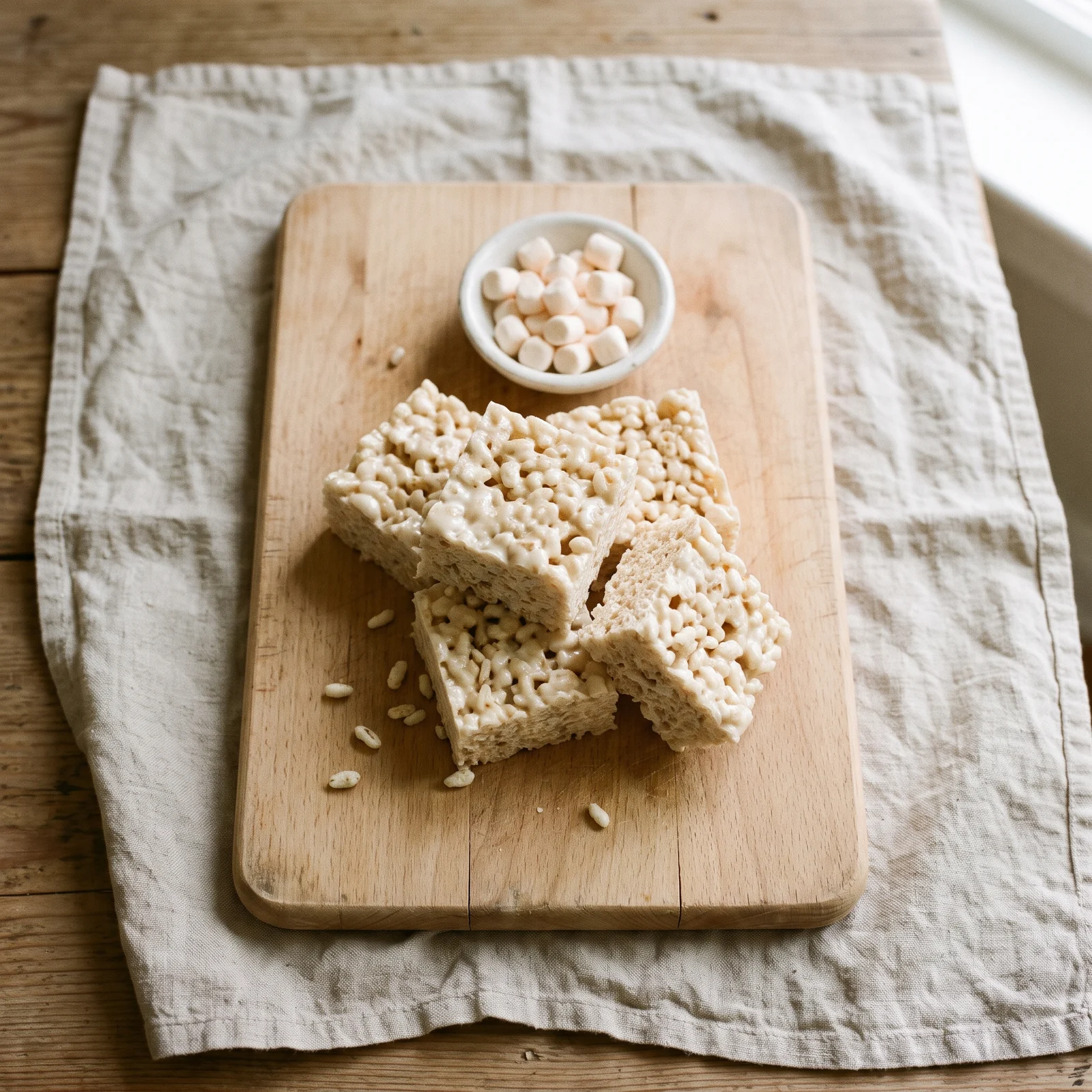
Best choice
Airtight, 65 to 70°F, away from the cooker (Clemson)
Not needed
Cold air makes cakes go stale faster (Clemson)
About 3 months
Wrapped and sealed at 0°F, the cookie figure (MU Extension)
The short version: how to store Rice Krispie treats comes down to an airtight container at room temperature. Leave the tray whole until you serve it. Then skip the fridge, because Clemson Cooperative Extension says cold storage makes bread and cakes go stale faster. Also freeze whatever you cannot eat, wrapped piece by piece.
Storage guidance here comes from NDSU Extension, Clemson Cooperative Extension and Illinois Extension. The freezing method comes from MU Extension, while the moisture limit comes from the USDA Agricultural Marketing Service.
On this page
Which Rice Krispie treats keep best?
How to store Rice Krispie treats starts in the pan, so think about storage before you cut them. A whole tray holds up better than a box of squares. Every cut face is bare marshmallow meeting the air.

A fresh bag of marshmallows starts the tray off soft.
Glass, a lid that seals, and a spoon that is properly dry.
Fresh marshmallows rather than an open bag. NDSU Extension gives opened marshmallows about 1 month in an airtight container, against 1 year unopened. So an old bag starts the bars off dry.
Butter or margarine, either one. The USDA commercial item description allows toasted rice cereal, marshmallow, and margarine or vegetable oil in the commercial product. NDSU Extension then gives butter 1 to 2 months in the fridge, and 6 to 9 months in the freezer.
A box of cereal that is not stale already. NDSU Extension gives opened ready-to-eat cereal 2 to 3 months. It also asks you to refold the package liner tightly, since crispness goes first.
A tray you can keep whole. Cut squares only when you serve them, because NDSU Extension wants marshmallow kept in an airtight container. A cut face cannot be sealed.
How to store Rice Krispie treats so they last
The whole of how to store Rice Krispie treats is a fight against air. There is very little free water in a bar, since the sugar binds what little there is. Illinois Extension puts it that way: sugar binds with available water and creates a product with a lower water activity. So the container matters more than the room does.
Where should you store Rice Krispie treats?
Keep Rice Krispie treats in an airtight container at room temperature, somewhere cool and dry. That is the 65 to 70°F pantry Clemson Cooperative Extension builds its chart around. Clemson also warns that high temperature or humidity may reduce storage time considerably. Then avoid the spots it rules out, namely storage areas near oven ranges, hot water pipes or heating ducts. NDSU Extension puts the same rule in one line. It asks you to store foods in cool cabinets, away from appliances that produce heat. Press a sheet of parchment against the cut face before you close the lid, since that face dries first.
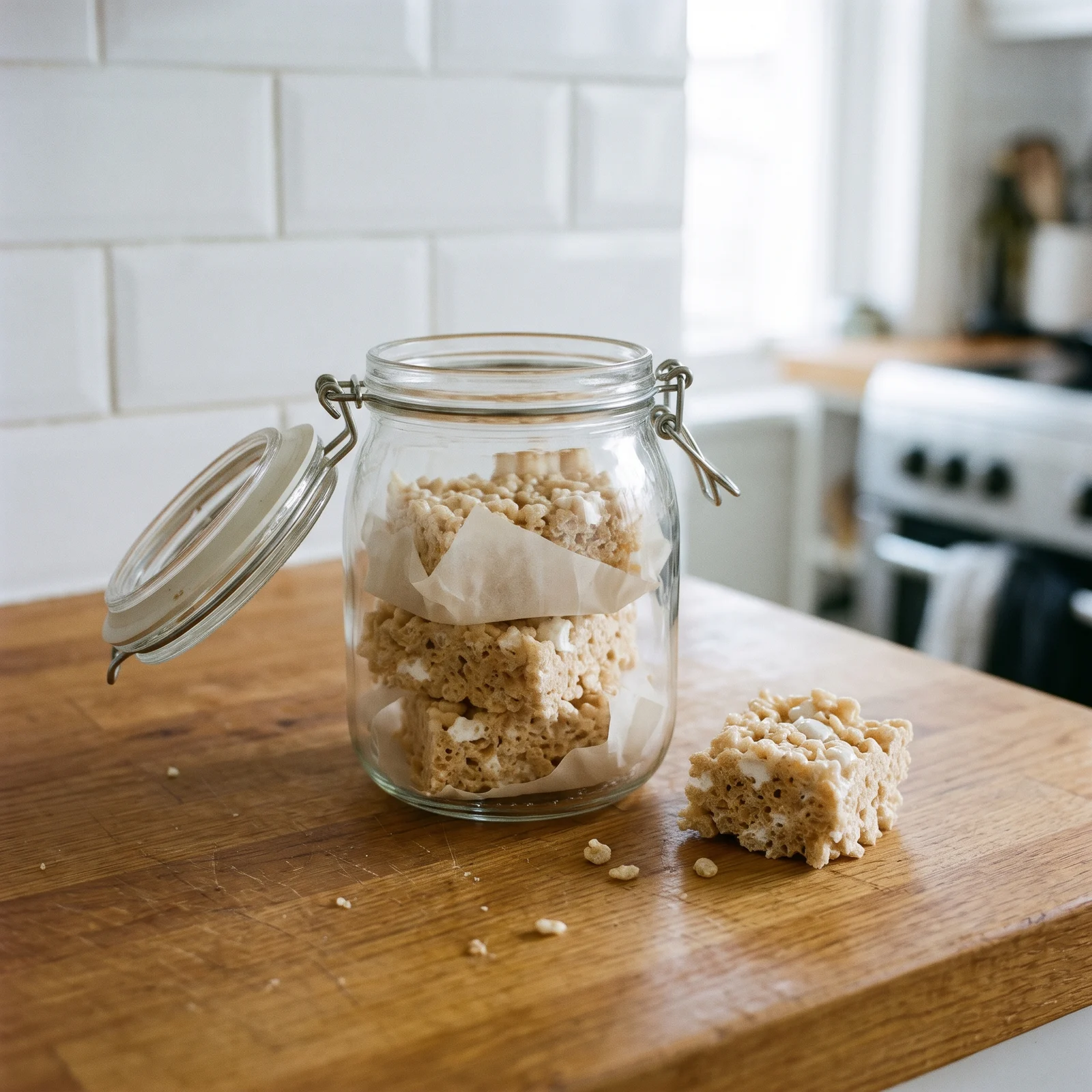
Airtight, cool and dry, with parchment against the cut face.
Sealed, cool and dark, and nowhere near the cooker.
How long do Rice Krispie treats last?
No extension service times the finished bars, so the nearest figures belong to their parts. NDSU Extension gives opened marshmallows about 1 month, and opened ready-to-eat cereal 2 to 3 months. Butter sits between the two, at 1 to 2 months in the fridge. The USDA commercial item description comes at it from the factory end instead. It requires marshmallow cereal treats to be processed and packaged not more than 90 days before delivery. So a shop-bought bar can be three months old when it arrives. At home, though, how to store Rice Krispie treats is measured in days of good texture.
At home, texture runs out long before safety does. NDSU Extension puts it plainly. Foods stored longer than the recommended times may change quality, color and flavor, it says. The recipe pages that rank for this question offer anything from 2 days to 2 weeks. Nothing sits behind those numbers. In other words, judge the bars by the bite and keep them sealed from day one.
Should you keep Rice Krispie treats in the fridge?
No: Rice Krispie treats belong at room temperature, because Clemson Cooperative Extension says refrigerating bread and cakes makes them go stale faster. Cold, dry air pulls moisture out of the marshmallow, so the bars set hard in a day. In other words, how to store Rice Krispie treats never involves the fridge. There is one exception. A tray finished with a perishable topping follows the cake rule instead. NDSU Extension refrigerates cakes with buttercream, whipped cream or custard frostings or fillings.
Why do Rice Krispie treats go hard?
Rice Krispie treats go hard because the marshmallow dries out, and NDSU Extension asks for marshmallows to be kept airtight for that reason. Air does the work, whether the marshmallow sits in a bag or in a bar. That is why a sealed tin beats a plate under foil, and why the cut edges stiffen first. Heat speeds it up. Clemson Cooperative Extension warns that heat and moisture can cause food to lose quality more rapidly. A hard bar is still perfectly safe, though.
Can you make Rice Krispie treats ahead of time?
Yes, a day or two ahead, as long as the Rice Krispie treats stay whole and sealed. NDSU Extension's rule for marshmallow is an airtight container, after all. Make-ahead is where how to store Rice Krispie treats pays off. Make the tray, let it cool, then cover the whole thing. Cut it on the day you serve it. For anything longer, freeze them instead, because Illinois Extension says freezing does not refresh baked goods. It only maintains whatever quality the food had before freezing.
Can you freeze Rice Krispie treats?
Yes, and about 3 months is the sensible limit, which is what MU Extension gives for home-baked cookies. That is the nearest thing any extension service times. Nobody times the bars themselves. Even so, the freezer is how to store Rice Krispie treats for anything longer than a couple of days. Illinois Extension is far more generous with the same cookies, at 8 to 12 months, so the two sources disagree. Take the shorter figure, because quality rather than safety is the question here.
How do you freeze Rice Krispie treats?
Cut the tray first, then wrap Rice Krispie treats one square at a time and seal them in a container. That is how MU Extension packs baked cookies, with freezer paper between the layers. Keep the freezer at 0°F or lower, which NDSU Extension gives as the rule for all frozen food. Also freeze them the day you make them. Illinois Extension is clear that freezing can only maintain the quality a food already had.

Wrap each square, then seal the box and date it.
Below 41 degrees it keeps for years, but it barely pours.
How do you thaw frozen Rice Krispie treats?
Leave frozen Rice Krispie treats wrapped on the counter, which is how MU Extension thaws baked cookies and unfrosted cake. The wrapper takes the condensation rather than the bar. MU Extension wraps baked goods for that reason, to limit drying and moisture condensing on the surface. So unwrap them once they reach room temperature. Then eat them that day instead of freezing them again.
Do Rice Krispie treats taste the same after freezing?
Mostly, although frozen Rice Krispie treats come out only as good as they went in. Illinois Extension says the same of every baked good. Cold cannot rescue a bar that was already dry. The cereal also loses a little snap, so wrap each square tightly and freeze the batch fresh. Even so, a frozen bar beats a stale one from the tin.
How can you tell if Rice Krispie treats have gone bad?
Rice Krispie treats hardly ever spoil, so four of the five stages below are quality calls rather than safety ones. That is the useful thing about how to store Rice Krispie treats: almost nothing you do makes them unsafe. The bars dry, then harden, and in a damp kitchen they go soft and sticky instead. Only the last stage is a throw-out, and that one is about water getting in rather than about age. Here is what each stage means.

Verdict: use it
Soft, chewy Rice Krispie treats
Squares that give under a thumb and pull apart in strands. That is how to store Rice Krispie treats working as intended. Clemson Cooperative Extension wants pantry food exactly like this, cool, dry and sealed. So use them for anything, lunchboxes included.

Verdict: use it
Dry-edged Rice Krispie treats
Pale, firm edges on the cut faces, with a soft middle. Air did that, since a cut face is marshmallow in open air. NDSU Extension gives an opened bag about a month in an airtight container. Nothing is wrong with them, though. So trim nothing, and move the rest into a sealed tin. The muffins guide covers the same drying problem in a crumb.

Verdict: use it, warmed
Rock-hard Rice Krispie treats
A bar that resists the knife and snaps rather than bends. NDSU Extension's general warning covers this, since foods stored longer than recommended times may change quality, color and flavor. So it is a quality change rather than spoilage. Warm a square briefly to loosen the marshmallow, or crumble the batch over ice cream. The honey guide covers another pantry sugar that stiffens without going bad.

Verdict: eat them today
Soggy, limp Rice Krispie treats
Cereal with no snap left and a tacky surface. Damp air causes it, and Clemson Cooperative Extension warns that high temperature or humidity may reduce storage time considerably. NDSU Extension makes the same point about the cereal box. It asks you to refold the package liner tightly after opening. They are still safe. So eat them today, then keep the next batch away from the kettle and the sink.

Verdict: throw it out
Damp or moldy Rice Krispie treats
Wet patches, a sour smell, or any fuzzy spot at all. This is the one stage with a line under it. NDSU Extension puts bread and cake among the moldy foods to discard. The visible mold may not be all the mold that developed. Its threadlike hyphae may have penetrated the food. So bin the bar instead of cutting round it. NDSU Extension also asks you to wrap the food or bag it before discarding, so spores do not spread. Then check the squares that touched it, as the sourdough bread guide does for a moldy loaf.
Can Rice Krispie treats be left out overnight?
Yes, a plain tray of Rice Krispie treats keeps safely overnight, because NDSU Extension applies its two-hour limit only to potentially hazardous foods. A cereal-and-sugar bar is not one of those. The reason sits in the water. Illinois Extension explains that sugar binds with available water and creates a product with a lower water activity. University of Minnesota Extension then sets the non-hazardous threshold at a water activity of 0.85 or lower, or a pH of 4.6 or lower. The USDA commercial item description also caps commercial bars at 9.0 percent moisture. So cover them and leave them out. A tray topped with cream cheese or whipped cream is a different food, though. NDSU Extension says potentially hazardous foods should not remain in the 40°F to 140°F range for longer than two hours. Our food left out overnight hub covers the rest of a forgotten counter.
Rice Krispie treat substitutes
Out of marshmallows, or holding a tray that has gone hard? Then one of these will stand in.
Substitute
Works best in
What changes
Marshmallow creme
A softer, stickier batch
NDSU Extension gives an opened jar about 1 month, served at room temperature.
Another puffed or flaked cereal
The same method, a new flavour
NDSU Extension gives opened ready-to-eat cereal 2 to 3 months.
Home-baked cookies
Keeping longer on the counter
NDSU Extension gives them 2 to 3 weeks in an airtight container.
Packaged cereal bars
A lunchbox with a date on it
The USDA description allows up to 90 days between packing and delivery.
Mistakes people make when they store Rice Krispie treats
These are the ways people get how to store Rice Krispie treats wrong, and each one has an easy fix.
Cutting the whole tray at once. Every cut face is bare marshmallow, and NDSU Extension wants marshmallow kept in an airtight container.
Putting the tin in the fridge. Clemson Cooperative Extension says to keep bread and cakes at room temperature, because cold makes them go stale faster.
Covering the tray with a loose sheet. NDSU Extension asks for moisture- and vapor-proof packaging, so a lidded box beats foil draped over the top.
Keeping them above the cooker. Clemson Cooperative Extension rules out storage near oven ranges, hot water pipes or heating ducts.
Stacking squares with nothing between them. They stick together, so lay paper between the layers, as MU Extension does for frozen cookies.
Trusting a date you read on a blog. No extension service times the finished bars, so go by the bite rather than by a number.
Freezing a tray that had already gone hard. Illinois Extension says freezing does not refresh baked goods and only maintains the quality they had before.
Sources
Food Storage Guide, Julie Garden-Robinson, NDSU Extension publication FN579, reviewed January 2023, on marshmallows keeping 1 year unopened and 1 month opened in an airtight container, marshmallow cream keeping 2 to 5 months unopened and 1 month opened served at room temperature, ready-to-eat cereal keeping 2 to 3 months once opened with the liner refolded tightly, homemade cookies keeping 2 to 3 weeks in an airtight container, butter keeping 1 to 2 months refrigerated and 6 to 9 months frozen, storing foods in cool cabinets away from appliances that produce heat, using moisture- and vapor-proof packaging, keeping the freezer at 0 F or lower, refrigerating cakes that have buttercream, whipped cream or custard frostings or fillings, and foods stored longer than recommended times changing quality, color and flavor.
Is Food In My Kitchen a Safety Hazard?, Julie Garden-Robinson, NDSU Extension publication FN492, reviewed October 2026, on discarding visibly moldy bread and cake, the visible mold not being all the mold that developed, threadlike hyphae penetrating the food, wrapping or bagging moldy food before discarding it, and potentially hazardous foods not remaining between 40 and 140 F for longer than two hours.
Food Storage: Pantry, Pamela Schmutz and E.H. Hoyle, revised by Faith C Isreal, Clemson Cooperative Extension fact sheet HGIC 3525, revised March 2020, on a cool, dry pantry at 65 to 70 F, high temperature or humidity reducing storage time considerably, avoiding storage areas near oven ranges, hot water pipes or heating ducts, heat and moisture causing food to lose quality more rapidly, and storing bread and cakes at room temperature because refrigeration makes them go stale faster.
Freezer Storage, Illinois Extension, on freezing not refreshing baked goods and only maintaining the quality a food had before freezing, home-baked cookies keeping 8 to 12 months, and 0 F as the safe temperature for frozen food.
How to Freeze Home-Prepared Foods, Susan Mills-Gray and Barbara Willenberg, MU Extension publication GH1505, reviewed August 2026, on baked cookies keeping about 3 months in the freezer, packaging them with freezer paper between the layers, thawing baked cookies and unfrosted cake in their wrapping at room temperature, and keeping baked goods in their original wrapping to limit drying and moisture condensing on the surface.
Cereal Treats, Marshmallow, Commercial Item Description A-A-20301A, USDA Agricultural Marketing Service, December 2004, superseding A-A-20301 of September 1998, on marshmallow cereal treats containing toasted rice cereal, marshmallow and margarine or vegetable oil, their moisture content not exceeding 9.0 percent, and their being processed and packaged not more than 90 days before delivery.
2024 Cottage Food Guide, University of Illinois Extension, October 2024, on sugar binding with available water to create a product with lower water activity, buttercream frosting without eggs generally being a stable product, and cream cheese frosting always being transported and sold under 41 F.
Frosting and dessert fillings, University of Minnesota Extension, Cottage Food Connection, October 2025, on a non-potentially hazardous product needing a water activity of 0.85 or lower or a pH of 4.6 or lower, uncooked dairy frostings needing a sugar concentration above 65 percent soluble solids, and about 2 ounces of powdered sugar for every 1 ounce of cream cheese.
Storage times and safety advice on this page come from the sources above. Food safety depends on conditions I cannot see, so read the Disclaimer, and if in doubt, throw it out.
Other ingredient guides
Browse all guides





Share this guide
Never miss a guide
New ingredient guides when they go up, plus one storage tip worth knowing. Anything sponsored is labelled.

Emilly White