
No
Cilantro is perishable, so it belongs in the fridge at 40°F or below
Up to 1 week
Stems in water, bag loose over the leaves, fresh water every 2 days
Yes, for cooking
No blanching needed. It thaws limp, so never as a garnish
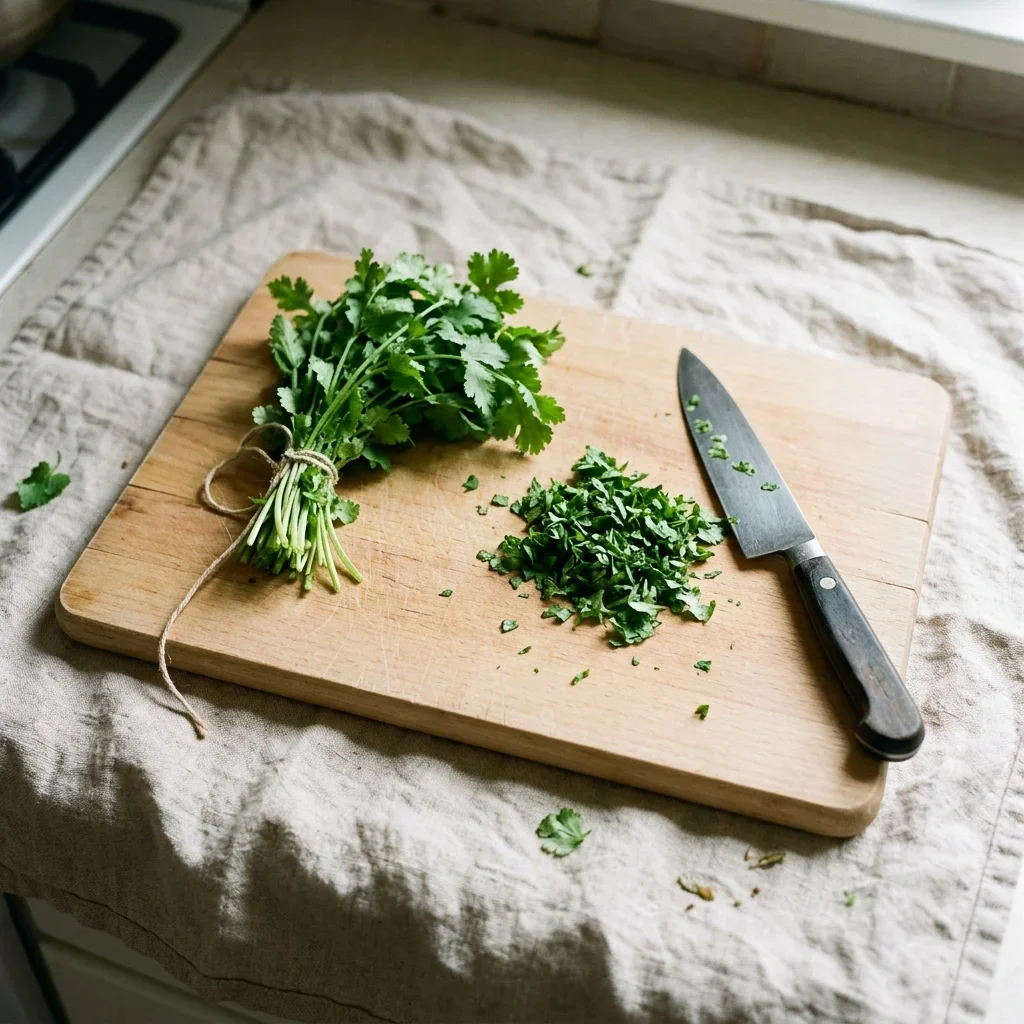
The short version: to store cilantro well, stand the unwashed stems in an inch of water. Then put a bag loosely over the leaves and refrigerate it. Change the water every two days, since that is what Utah State University Extension asks for, and plan on a week.
Storage guidance from Utah State Extension, Penn State Extension, SDSU Extension and the NCHFP.
On this page
What to look for before you store cilantro
A bunch that is already limp or yellow will not come back, so start at the shop. Smell it as well as look at it, since cilantro and flat-leaf parsley look almost the same. The parsley guide stores it the same way, although parsley holds on noticeably longer.
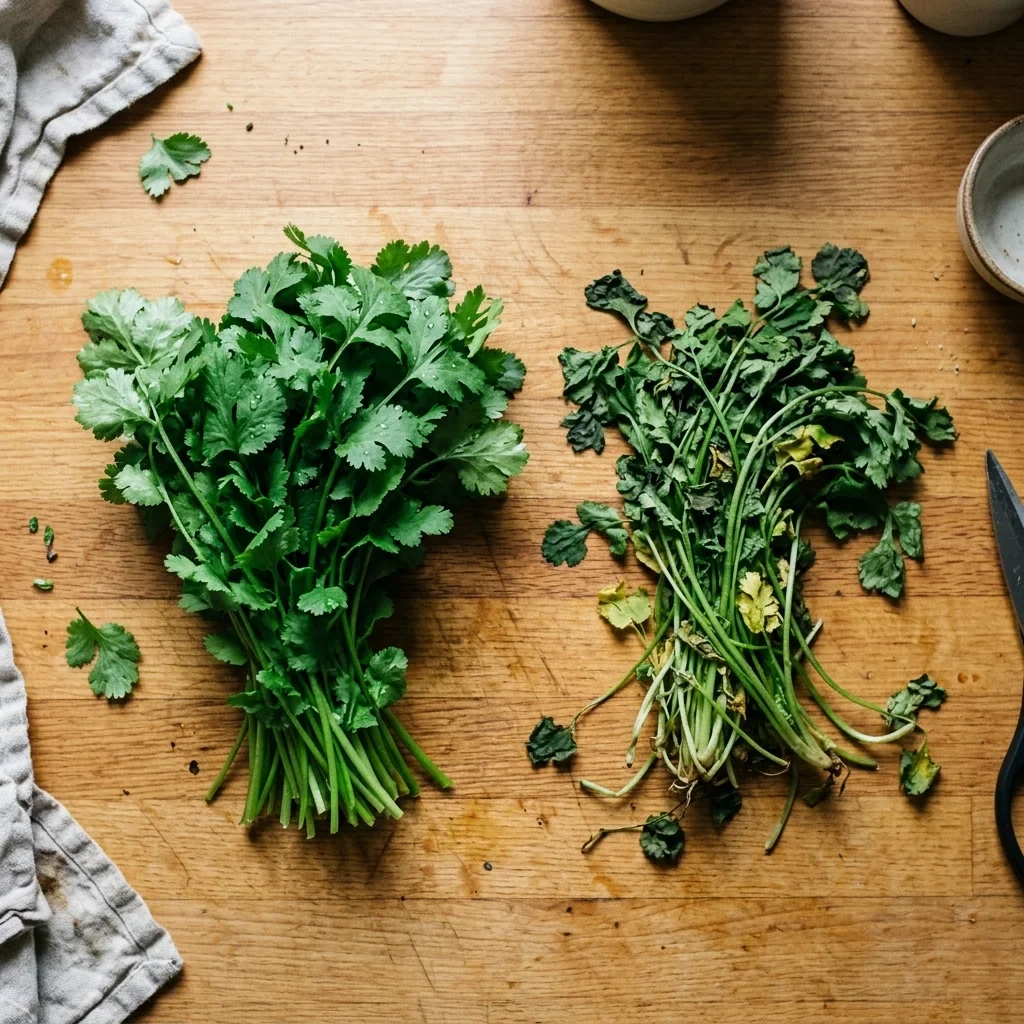
Bright green with stems still standing. Yellow or blackened leaves mean leave it.
Bright color and a strong smell. Utah State Extension says to select bunches that are brightly colored, with fresh, fragrant leaves. So give it a sniff before it goes in your basket.
No wilted, yellowed or blackened leaves. Utah State Extension names all three as reasons to put a bunch back. Each one means the bunch has already started to go, so it will not keep.
Stems with some stiffness. A bunch whose stems still stand up has not lost much water. So it has more days left in it.
A whole bunch rather than a tub of loose leaves. Cut leaves have more damaged surface, and the FDA tells you to cut away damaged areas before eating produce. So a whole bunch gives you more to work with.
How to store cilantro so it lasts
To store cilantro so it lasts, keep the stems wet and the leaves dry. Because cilantro wilts when it dries out, the stems need water. It rots when the leaves sit wet, so they have to stay dry.
How to store cilantro in a jar of water
Stand the unwashed bunch stems-down in a container of water, like a bouquet of flowers. Then cover the top loosely with a plastic bag and refrigerate it. That is the method Utah State Extension gives for longer storage. It also asks you to change the water every two days. Keep the bag loose rather than sealed. Utah State Extension covers the top loosely, and it washes the bunch only at the last minute. Also give it a cold spot. Clemson Cooperative Extension puts herbs, along with lettuce and strawberries, in the fridge at 40°F or below. The leafy-greens side of that is in the spinach guide, since greens want the same cold, damp corner.
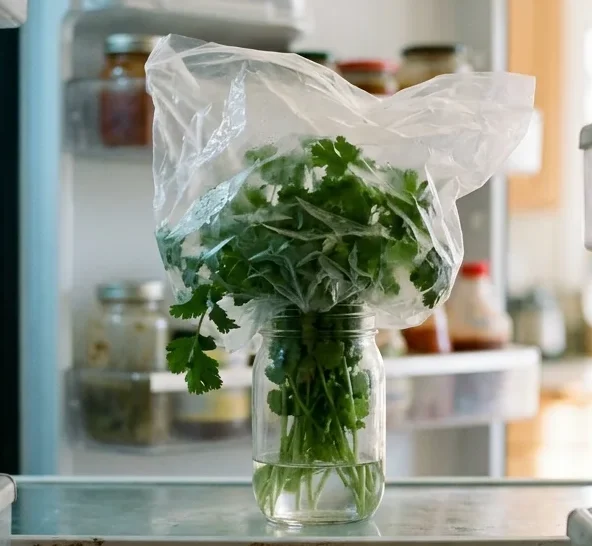
Stems in an inch of water, bag loose on top, fresh water every two days.
How long can you store cilantro in the fridge?
About a week. Utah State Extension says to refrigerate a water-stored bunch up to 1 week, changing the water every two days. The pages that rank above it claim much more. Two of them promise 2 to 3 weeks, while a third gives 7 to 10 days. However, none of those names an extension or USDA source for its figure. So this guide takes the week that an extension service will stand behind.
In other words, the gap is not about cilantro but about evidence. A week is what a source will put its name to. Although a well-kept bunch in a cold fridge may go longer, nobody I opened says so.
Should you store cilantro in a damp towel instead?
It works, but for fewer days. Utah State Extension gives the towel method for storing cilantro several days, while it gives the jar up to a week. So use the towel when you will finish the bunch quickly, and the jar when you will not. For the towel, cover the bunch loosely with a plastic bag over two to three layers of paper towels.
How to store cilantro you have already chopped
Chopped cilantro has far more cut surface, so it goes over faster than a whole bunch. Keep it in a covered container in the fridge, and use it within a day or two. No source I opened puts a day count on chopped cilantro, so the guide gives the condition and not a number. Clemson Cooperative Extension does say to refrigerate cut produce. Penn State Extension also asks for cut produce in the fridge within two hours. When a salsa or chutney has sat out overnight instead, the food left out overnight hub covers the call.
Do you wash cilantro before you store it?
No, wash it just before you use it. Utah State Extension says to wash cilantro just before using and then blot it dry with paper towels. Clemson Cooperative Extension puts the same rule more generally: wash produce under running water just before eating, cutting or cooking. For a gritty bunch, Utah State Extension plunges it into a bowl of cold water and swirls it. Then the grit settles while the leaves float. The two methods differ, so for a sandy bunch the bowl is the one that works.
Can you store cilantro in the freezer?
Yes, for cooking, and you do not need to blanch it. The NCHFP gives a method for fresh herbs. Penn State Extension also says blanching is optional, and that it is only worth it for larger leaves such as basil. However, frozen cilantro is not a garnish, because it comes out limp once it thaws.
How to store cilantro in the freezer
The simplest route comes from the NCHFP: wash, drain and pat dry with paper towels. Then wrap a few sprigs or leaves in freezer wrap, place that in a freezer bag, seal and freeze. For cooking in portions, Penn State Extension fills an ice cube tray half full of water. Then it puts about 1 tablespoon of chopped herbs in each section. Push the herbs under the water, freeze until solid, then top the cubes off and freeze again. SDSU Extension gives the same tray method. It also puts frozen herbs in an airtight container at up to six months. Penn State also offers an oil version, a third to a half cup of oil to 2 cups of chopped herbs. However, it warns never to keep herbs in oil at room temperature.
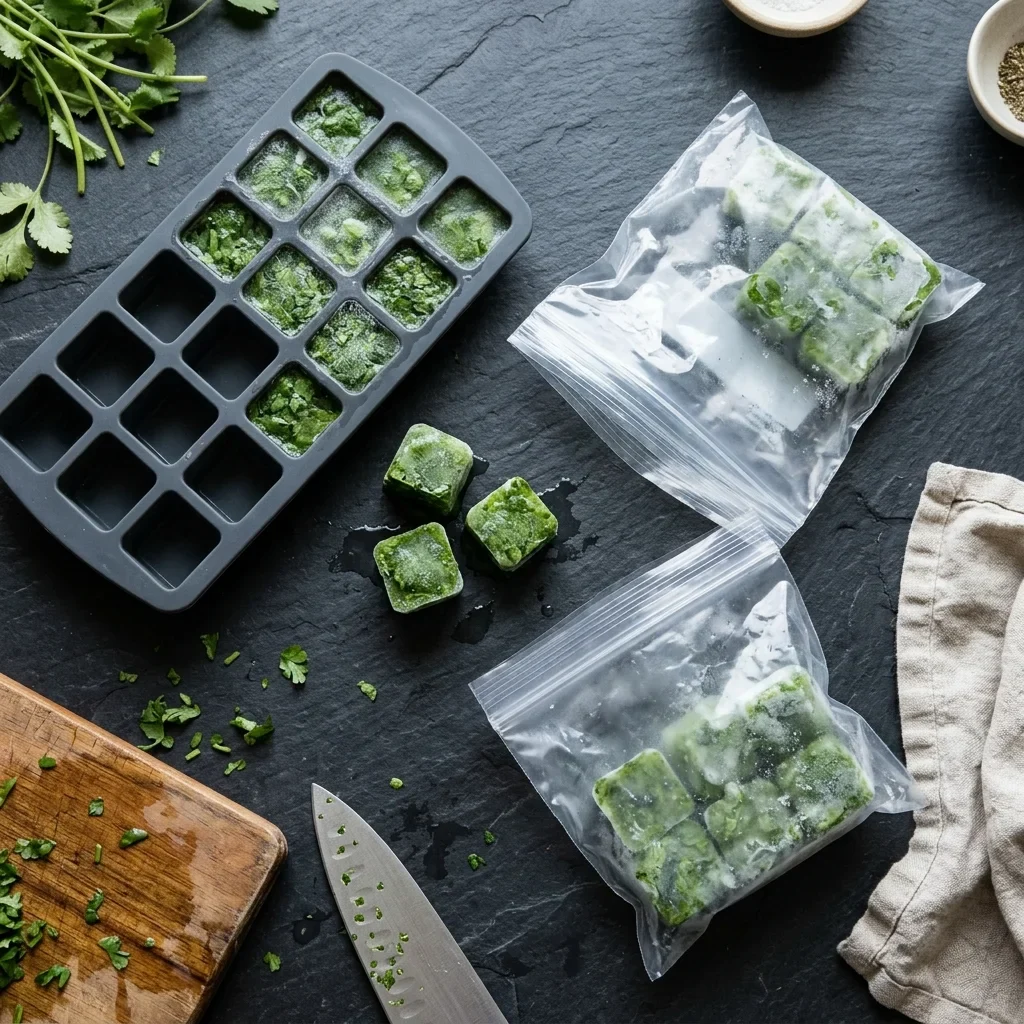
About a tablespoon per section, topped off with water and frozen again.
Why blanching is not part of how you store cilantro in the freezer
Because the leaves are small and soft. Penn State Extension blanches only larger herbs, such as basil, and only for 15 seconds, to stop enzyme reactions. SDSU Extension gives the same 15 seconds for larger herbs. So cilantro goes into the freezer as it is, which also means less handling and less bruising.
What happens when you store cilantro in the freezer
It goes limp. The NCHFP says frozen herbs are usually not suitable for garnish, since the thawed product becomes limp. In fact, the same center lists parsley among the raw salad items that do not freeze well. Those come out limp, water-logged and oxidized in color, aroma and flavor. So treat frozen cilantro as a cooking ingredient, stirred into curries, soups and rice.
How to tell if cilantro has gone bad
In fact, a tired bunch of cilantro is usually a sorting job rather than a bin job. Wilted leaves and a few yellow ones still cook fine, while slime and mold end the bunch. Here is what each stage means, and what to do with it.
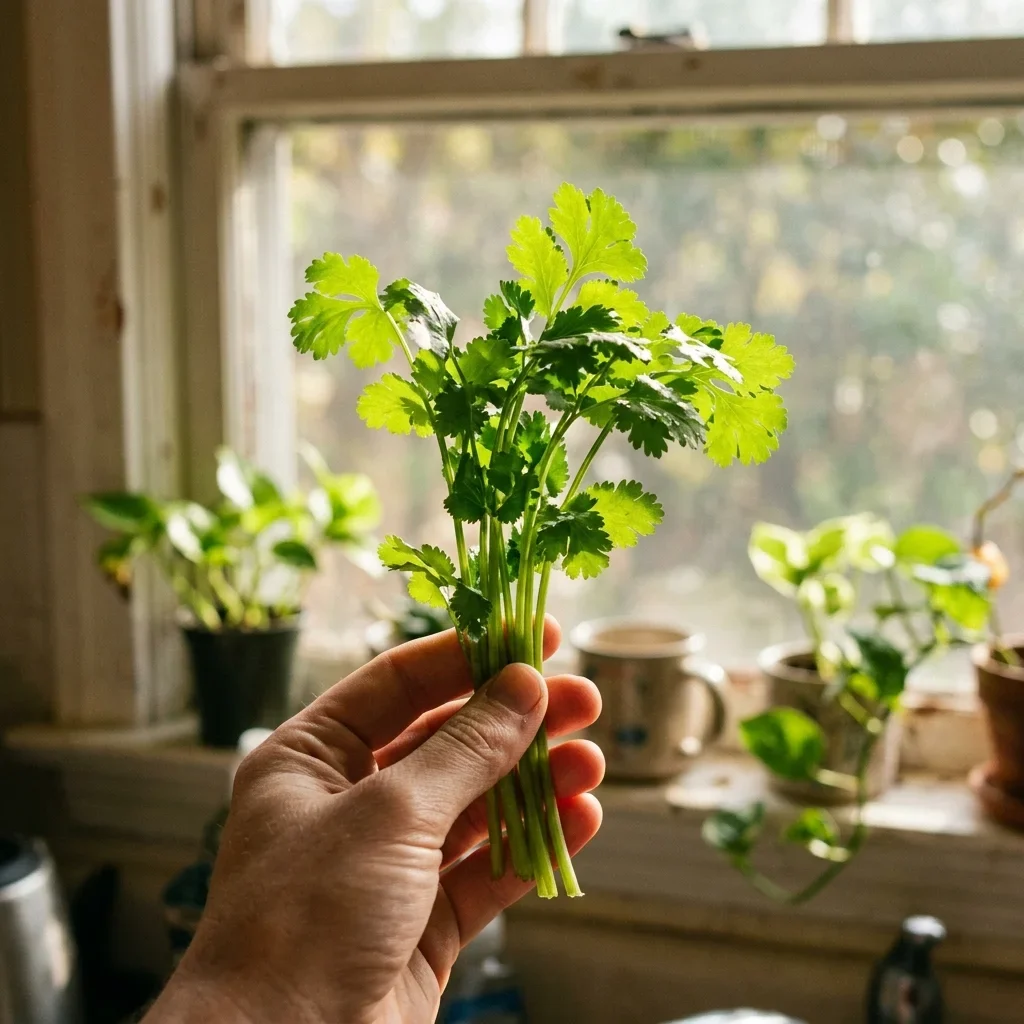
Verdict: use it
Bright green cilantro
Deep green leaves, stems with some stiffness, and that strong citrus smell. This is the bunch Utah State Extension describes as brightly colored with fresh, fragrant leaves. So use it for anything, raw included.
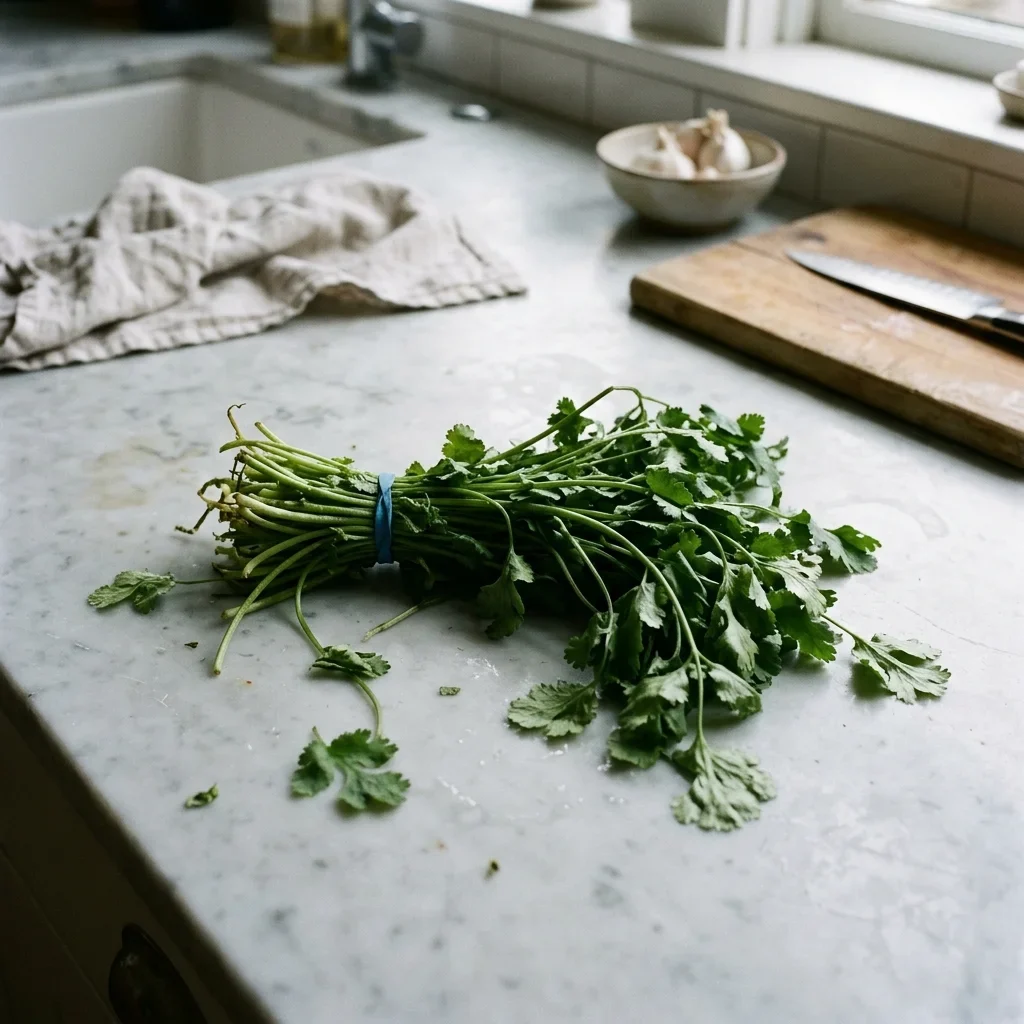
Verdict: cook with it
Wilted cilantro
Limp leaves and stems that flop mean the bunch has dried out. Utah State Extension tells you not to buy a wilted bunch. Although that is about what will keep, it is not about what is safe. Nothing here is what the FDA calls rotten, so chop it into something cooked.
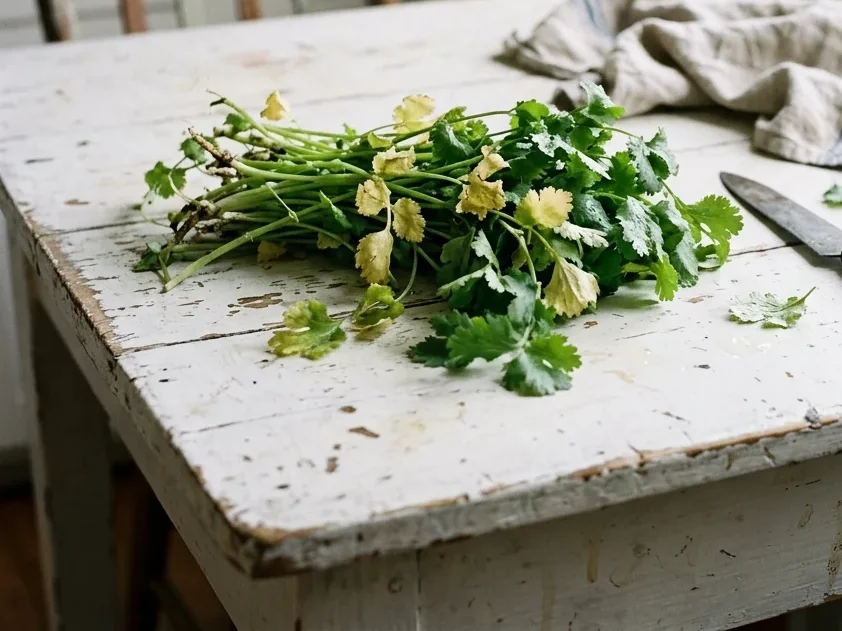
Verdict: pick through it
Yellowing cilantro
In fact, yellow leaves among the green ones are the bunch aging. Utah State Extension names yellowed leaves as a reason to leave a bunch at the shop. So a bunch that yellows at home is on its last days. Pull the yellow leaves out and use the green ones. That is a sorting job, and it is worth the two minutes.
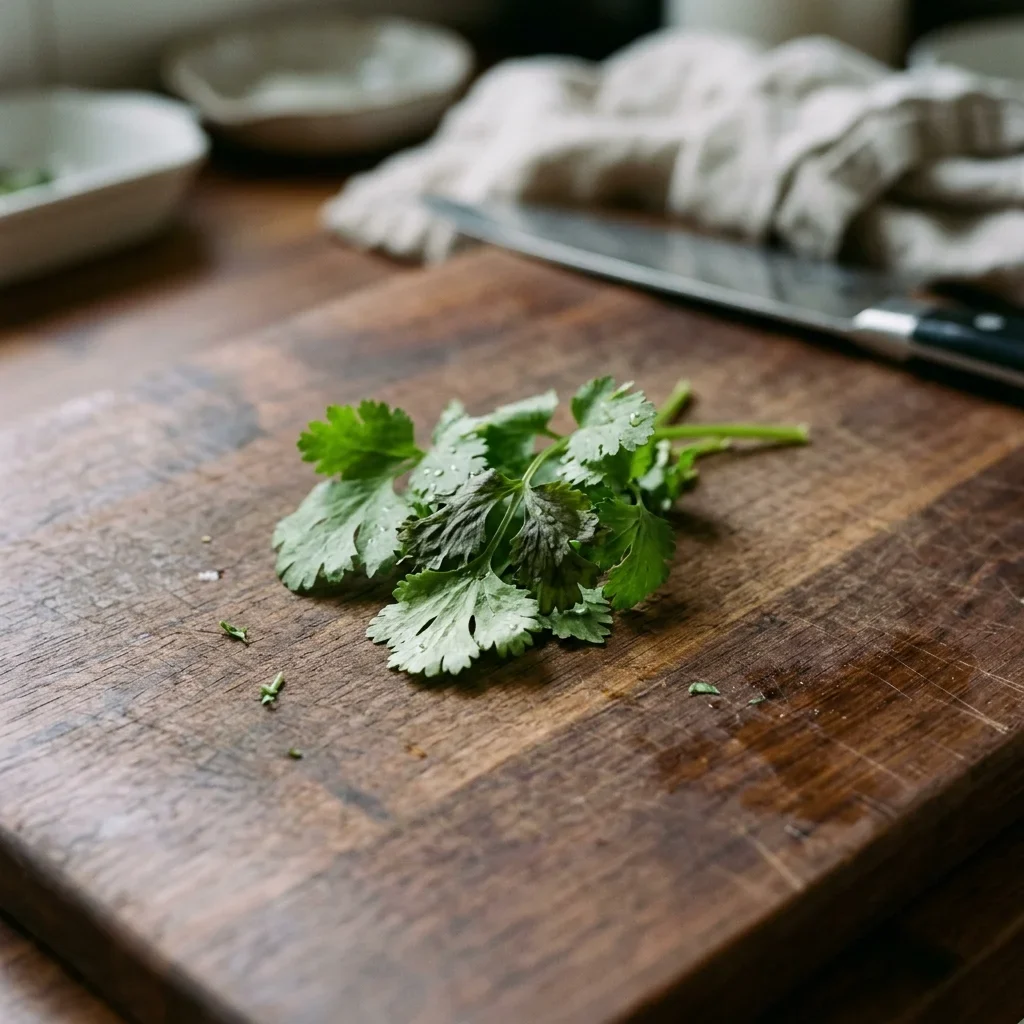
Verdict: strip the black leaves out
Blackened cilantro leaves
Black, collapsed leaves are further along than yellow ones. Utah State Extension lists blackened leaves beside wilted and yellowed ones as a reason to reject a bunch. However, black patches usually sit on some leaves and not others, so strip those off and check what is left. When the stems have gone soft and dark too, the bunch belongs in the next stage. No source I opened explains what turns cilantro leaves black, so the guide stops at what to do about it.
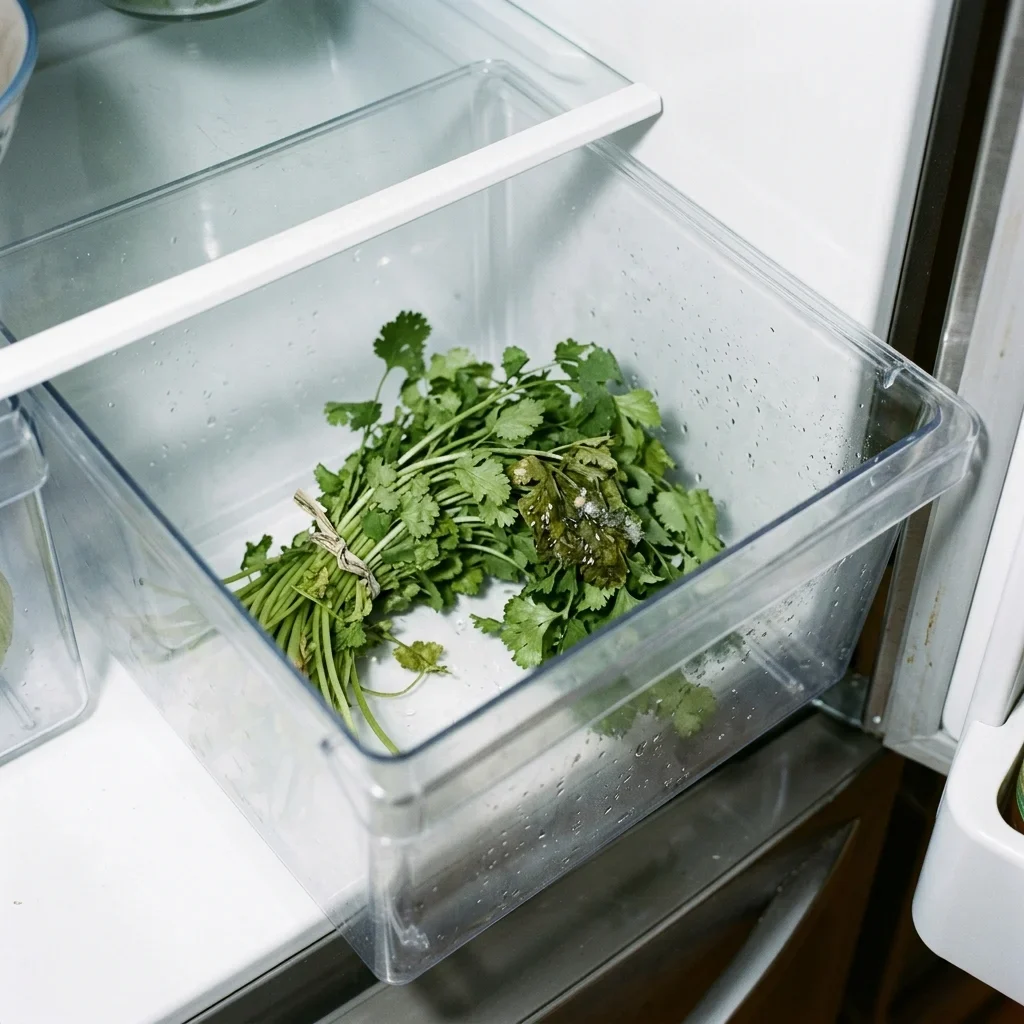
Verdict: throw it out
Slimy or moldy cilantro
Leaves that are slick and sticking together, or any fuzzy mold, and the bunch is done. UConn Extension allows an inch of trimming around mold on firm vegetables such as cabbage, peppers or carrots. However, it discards soft produce whole, which is the rule the strawberry guide follows. A cilantro leaf is about as soft as produce gets, so the whole bunch goes. The FDA and Clemson Cooperative Extension agree on the blunt version: throw away produce that looks rotten or moldy.
Is it bad to eat cilantro you did not wash?
Wash it, although washing is not a guarantee. Penn State Extension points out that fresh herbs are usually eaten raw. There is no cooking step to kill anything on them. It adds that no method is known to completely remove Cyclospora from contaminated produce. Running water cannot guarantee removal either. Even so, rinsing still matters, because it takes off dirt and may reduce other contaminants. Penn State also notes the FDA position that heating to at least 158°F is expected to inactivate the parasite. So wash every bunch, and remember that a cooked salsa carries less risk than a raw one.
Cilantro substitutes
Out of cilantro, or had to bin a bunch? Then these will cover most of what you wanted it for.
Substitute
Works best in
What changes
Flat-leaf parsley
Salsas, salads and garnish
Looks the same, but grassy rather than citrusy.
Thai basil
Curries and stir-fries
An anise note, and it holds up to heat.
Frozen cilantro cubes
Curries, soups and rice
Already limp, so stir them in while cooking.
Mistakes people make when they store cilantro
These are the ways people store cilantro that cost them the most, and each one has a quick fix.
Washing the bunch before it goes in the fridge. Utah State Extension washes cilantro just before using, so store it unwashed.
Sealing the bag tight over the leaves. Utah State Extension covers the top loosely, so leave the bag open.
Forgetting the water. Utah State Extension changes it every two days, so change it on a schedule.
Expecting three weeks. Utah State Extension gives one week, although several ranking pages promise far longer.
Binning a bunch for a few yellow leaves. Pick them out instead, since the green ones are still good.
Freezing it for garnish. The NCHFP says frozen herbs thaw limp, so keep them for cooked dishes.
Leaving cilantro in oil on the counter. Penn State Extension says oil and herbs go in the freezer, never at room temperature.
Sources
Fruit and Vegetable Guide Series: Cilantro, Amanda H. Christensen, Utah State University Extension, March 2023, on selecting, cleaning in a bowl of cold water, the paper-towel and water-bouquet methods, and 1 week in the fridge.
Freezing Fresh Herbs, National Center for Home Food Preservation, University of Georgia, from So Easy to Preserve, 6th edition, 2014, on washing, wrapping sprigs for the freezer and why frozen herbs are not a garnish.
Foods That Do Not Freeze Well, National Center for Home Food Preservation, University of Georgia, 2014, on parsley and other raw salad items thawing limp, water-logged and oxidized.
Freezing Herbs, Martha Zepp, Penn State Extension, updated July 2025, on optional blanching, the ice-cube-tray water method, the oil method and never keeping herbs in oil at room temperature.
Preserving Herbs, Abigail Lambert, Megan Erickson and Hope Kleine, SDSU Extension, updated June 2022, on the tray methods, the 15-second blanch for larger herbs and six months in the freezer.
Ongoing Cyclospora Outbreak Highlights Importance of Safe Produce Handling, Nicole McGeehan and Kaitlin Pander, Penn State Extension, updated July 2026, on raw herbs, the limits of washing, and heating to 158°F.
Safe Handling of Fresh Fruits and Vegetables, Pamela Schmutz, revised by Angela Fraser, Clemson Cooperative Extension, November 2009, on herbs at 40°F or below, washing under running water just before use, and discarding rotten or moldy produce.
Selecting and Serving Produce Safely, U.S. Food and Drug Administration, March 2024, on refrigerating perishable produce at 40°F or below, washing under running water, cutting away damaged areas and discarding anything that looks rotten.
Handling Food with Mold, Austin Goldberg, Daniela Avelino and Valerie Duffy, UConn Extension, April 2024, on the one-inch trim for firm vegetables and discarding soft produce whole.
Storage times and safety advice on this page come from the sources above. Food safety depends on conditions I cannot see, so read the Disclaimer, and if in doubt, throw it out.
Other ingredient guides
Browse all guides



Share this guide
Never miss a guide
New ingredient guides when they go up, plus one storage tip worth knowing. Anything sponsored is labelled.

Emilly White