
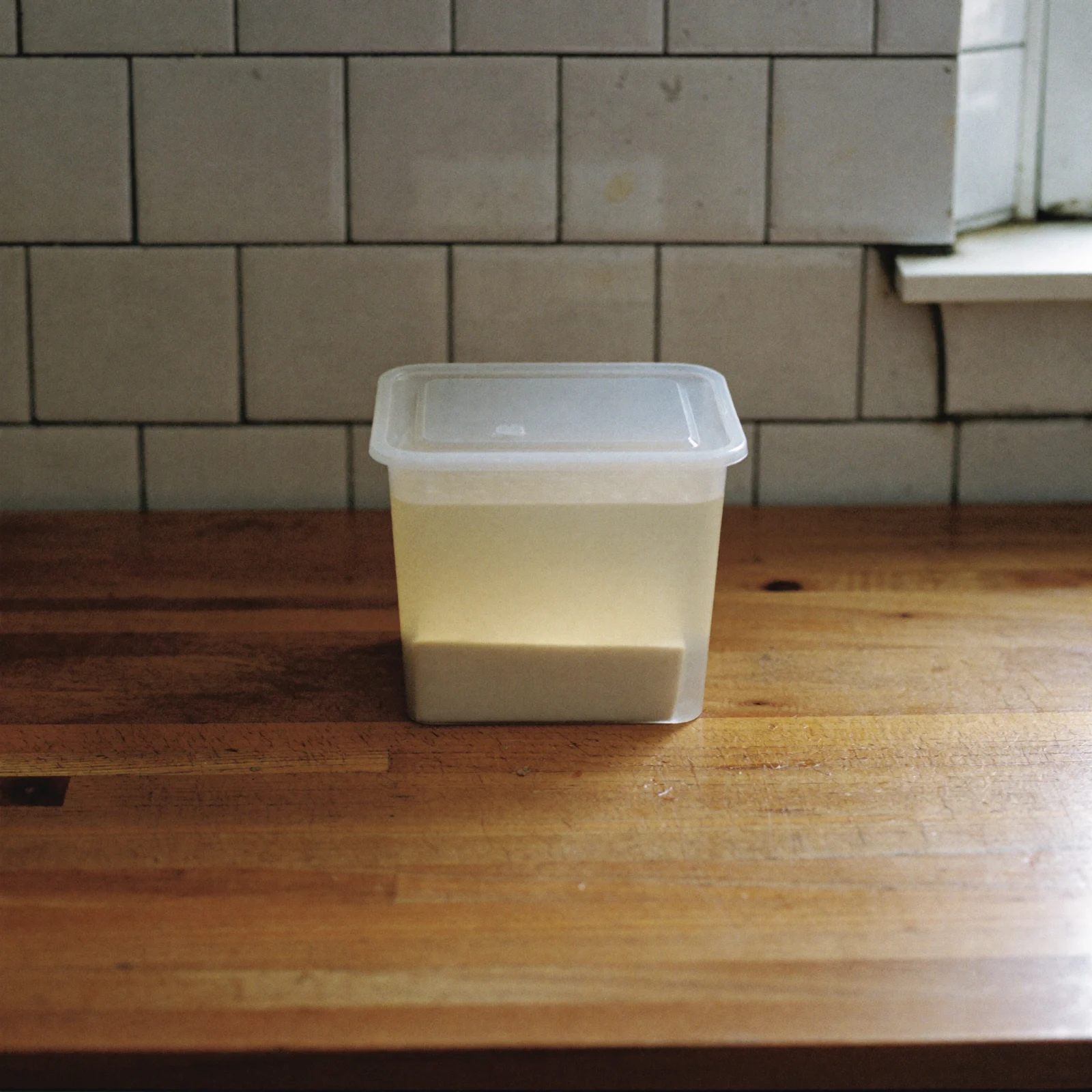
Same day
In the husk and out of the heat. Purdue says eat it the day it is picked
1 to 2 days
In the husk, kept moist, at 34 to 40 degrees F (NDSU and Clemson)
8 to 9 months
Blanched whole ears at 0 degrees F (NDSU and Utah State)
The short version: to store corn on the cob well, get it cold fast and keep the husks on. Then eat it within a day or two. Anything left after that should be blanched and frozen, because the sugar does not wait.
The fridge and freezer times here come from NDSU Extension and Clemson Cooperative Extension. The sugar-loss figures also come from Iowa State Extension and Utah State University Extension. The blanching times then come from the National Center for Home Food Preservation and Utah State's preserving guide.
On this page
How do you pick good corn on the cob?
Pick corn with fresh, green husks that are insect-free, says Purdue Extension FoodLink. If the kernels are visible, also make sure they are plump. So everything about how to store corn on the cob starts at the stand.
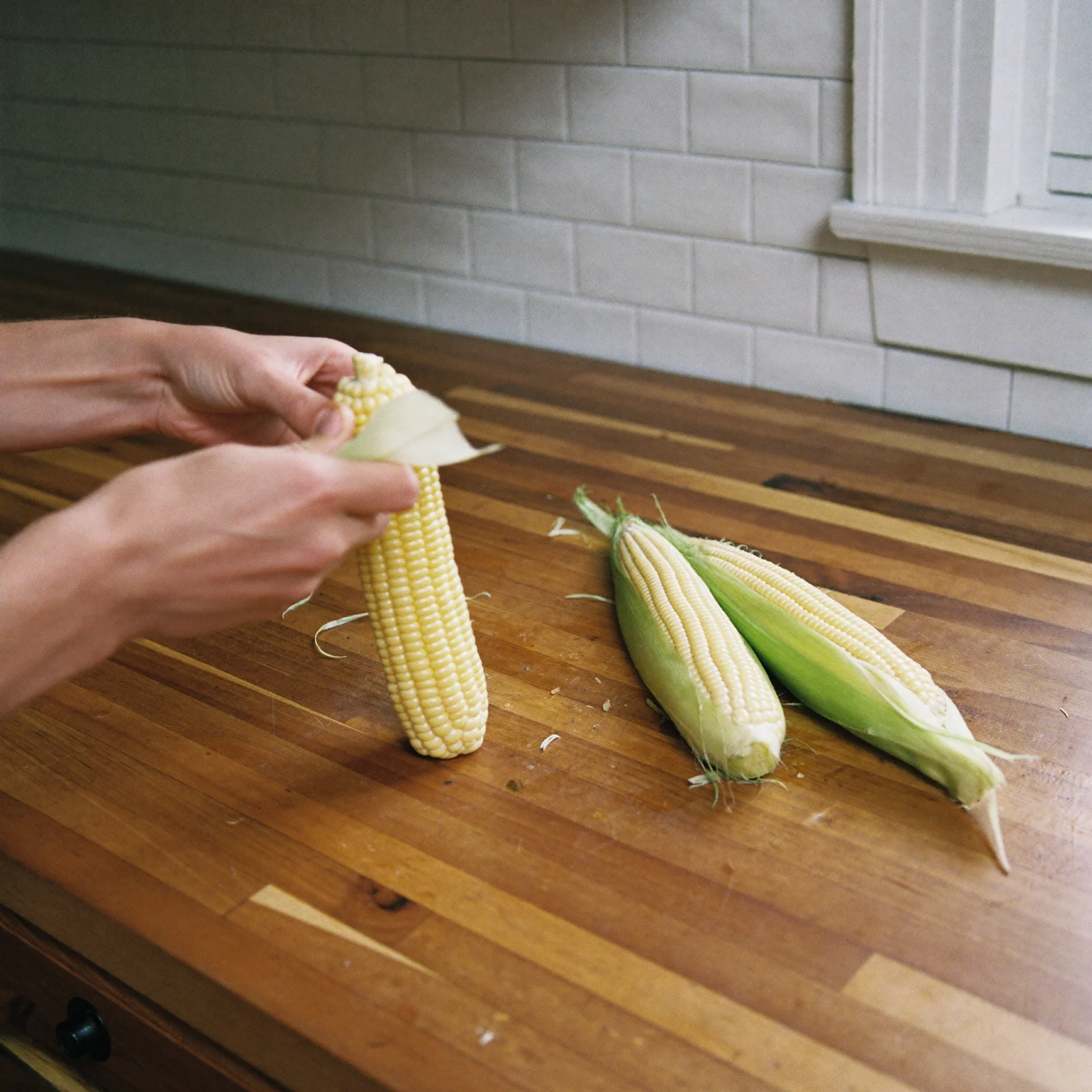
Tight green husks, clean silk, and plump kernels underneath.
Green husks, still tight on the ear. Utah State University Extension asks for fresh husks with good green husk color. Purdue Extension FoodLink says the same, although it also asks for the husks to be insect-free. So a dry, loose husk is the first thing to put back.
Silk ends that are clean, not rotting. Utah State University Extension wants silk ends free from decay or worm injury. Iowa State Extension reads silk differently, because it uses brown, dry silks at the ear tip as the sign of ripeness. So dry silk is good, while slimy or chewed silk is not.
Kernels that are full, although not yet hard. Iowa State Extension harvests at the milk stage, when a punctured kernel gives a milky juice. A clear, watery liquid means the ear is immature, while overmature corn is tough and doughy. Utah State University Extension says to avoid undeveloped kernels, very large kernels and dark yellow ones. Those, it says, can be tough and not very sweet.
Freshness above all, because nothing you do later gets the sugar back. Utah State University Extension tells growers to pick corn and process it within 2 to 3 hours. Purdue Extension FoodLink puts the shop version more simply, since corn is best eaten the day it is picked. So buy from the stand that sold out yesterday.
How to store corn on the cob so it lasts
To store corn on the cob so it lasts, think cold and damp rather than airtight. Corn is not spoiling in those first days. It is losing sugar, which is a different clock. So the whole job is to slow that down, and only cold does it.
How do you store corn on the cob in the fridge?
Store corn on the cob in its husks and use it within 1 to 2 days, says NDSU Extension. Its only instruction for that chart entry is to keep it moist. Clemson Cooperative Extension gives corn the same 1 to 2 days. It also sets the shelf at 34 to 40 degrees F. Purdue Extension FoodLink is relaxed about the husks, because it refrigerates sweet corn with the husks on or off. Shucked corn simply fits better, it notes. So husks on if you have the room, although getting it cold matters more.
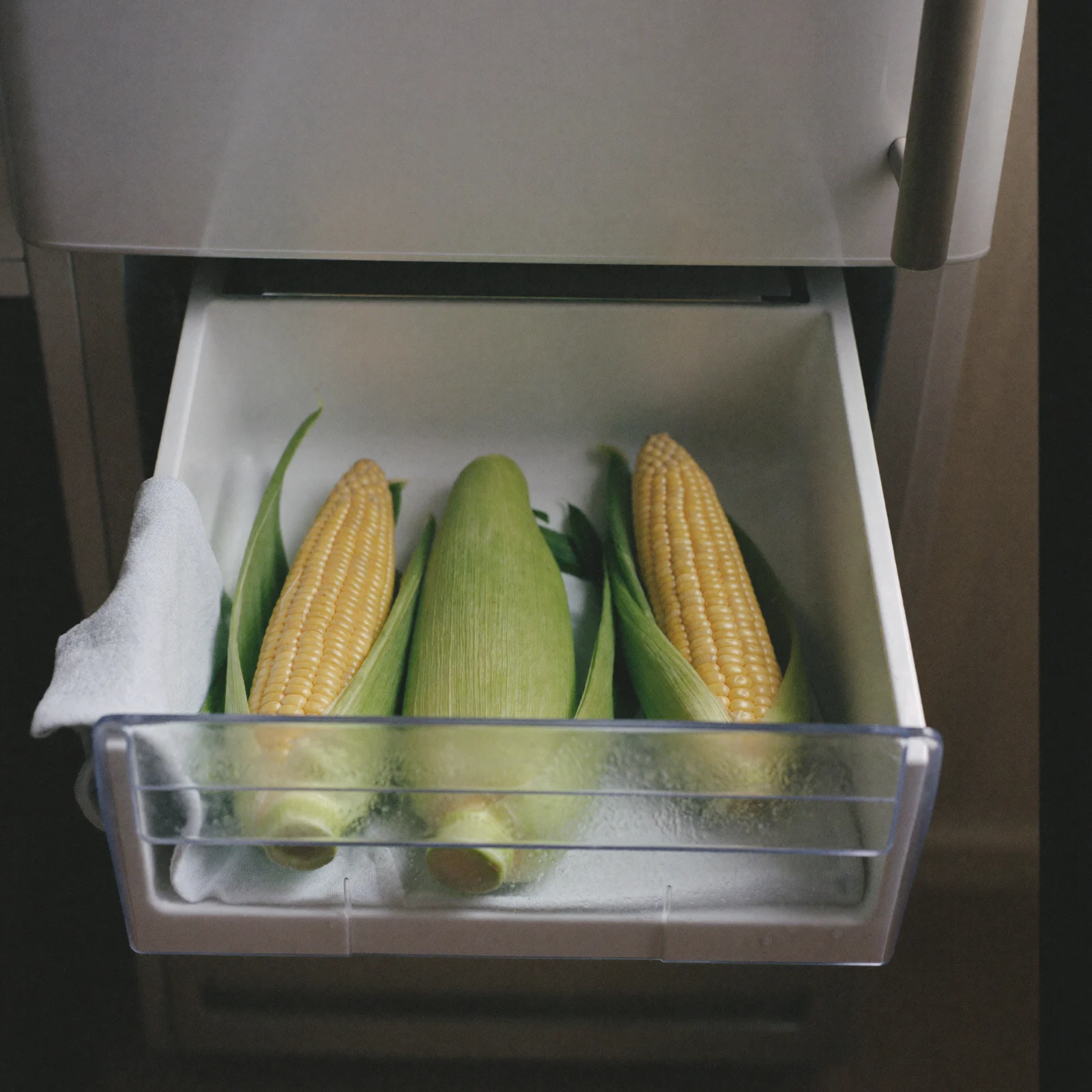
Husks on, kept moist, on a shelf running 34 to 40 degrees.
How long does corn on the cob last in the fridge?
One to two days, if you take the extension charts at their word. NDSU Extension gives corn in husks 1 to 2 days in the refrigerator. Clemson Cooperative Extension gives corn 1 to 2 days too. Iowa State Extension is more generous, because it puts the maximum storage life for sweet corn at 4 to 8 days. That figure comes with conditions, though. It assumes 32 degrees F and 95% relative humidity, which a home fridge does not reach. NDSU's same chart gives asparagus 2 to 4 days, so corn is on an even shorter clock. So treat 1 to 2 days as the plan.
The sweeter varieties buy a little more time. Iowa State says supersweet types convert sugar slowly, so refrigeration can hold them for up to one week. Sugary enhanced types get 1 to 2 days longer than standard ones. You will rarely know which you bought, though. So store corn on the cob for a day or two, and plan around that.
Should you leave the husk on corn on the cob?
The husk helps, although no extension source we opened insists on it. NDSU Extension lists the entry as corn in husks and tells you to keep it moist. Purdue Extension FoodLink is explicit that either way works, since it refrigerates sweet corn with the husks on or off. It only notes that shucked corn fits much more easily. The National Center for Home Food Preservation shucks before anything else, because its instruction is to husk, trim, remove silks and wash well. So leave the husks on while the corn waits, then take them off to cook it.
Does corn on the cob have to be refrigerated?
Yes, refrigerate corn on the cob if you are not cooking it today, since the sugar is the reason. Iowa State Extension says standard sweet corn can lose 50% of its sugar within 12 hours. That is without refrigeration. Utah State University Extension puts a number on the other side. Corn kept near freezing loses only 8% of its sugar each day, it says. It also says standard kernels lose half their sugar within 24 hours above 86 degrees F. So a hot car costs more than a day in the fridge does. Purdue Extension FoodLink agrees in plain words, because corn is best eaten the day it is picked.
How do you store shucked or cut corn?
You can still store corn on the cob once it is shucked, although cut kernels are on a much shorter clock. Purdue Extension FoodLink says raw corn cut off the ears lasts only a day or two before turning sour. Cooked corn cut off the ears does better, since it gives that 4 to 5 days in the refrigerator. So cut what you need, rather than the whole batch. If cooked corn has sat out on the table, the food left out overnight guide covers that call.
Can you freeze corn on the cob?
Yes, and freezing is the honest way to store corn on the cob for months. Purdue Extension FoodLink calls corn one of the best vegetables to freeze, because home-frozen corn is superior to commercial products. The catch is that whole ears are the awkward format. The National Center for Home Food Preservation warns that corn-on-the-cob is likely to become water-logged and mushy. So freeze whole ears if you want to eat them off the cob, although kernels freeze better.
How do you blanch corn on the cob before freezing?
Blanch corn on the cob by ear size: 7 minutes for small, 9 for medium, 11 for large. Those are the National Center for Home Food Preservation's times, measured by diameter. Small is 1 and a quarter inches or less, while medium runs to 1 and a half. Anything over 1 and a half inches counts as large. Utah State University Extension gives the same three times. It starts the clock when the water returns to a boil. It also explains why they run long, since the heat has to inactivate enzymes in the cob. Then cool the ears as long as you blanched them, as Utah State advises. The National Center is blunt here, because cooling promptly and completely prevents a cobby taste. Wrap each ear, label it, and freeze at 0 degrees F. Blanching before freezing is the same step the green beans guide turns on.
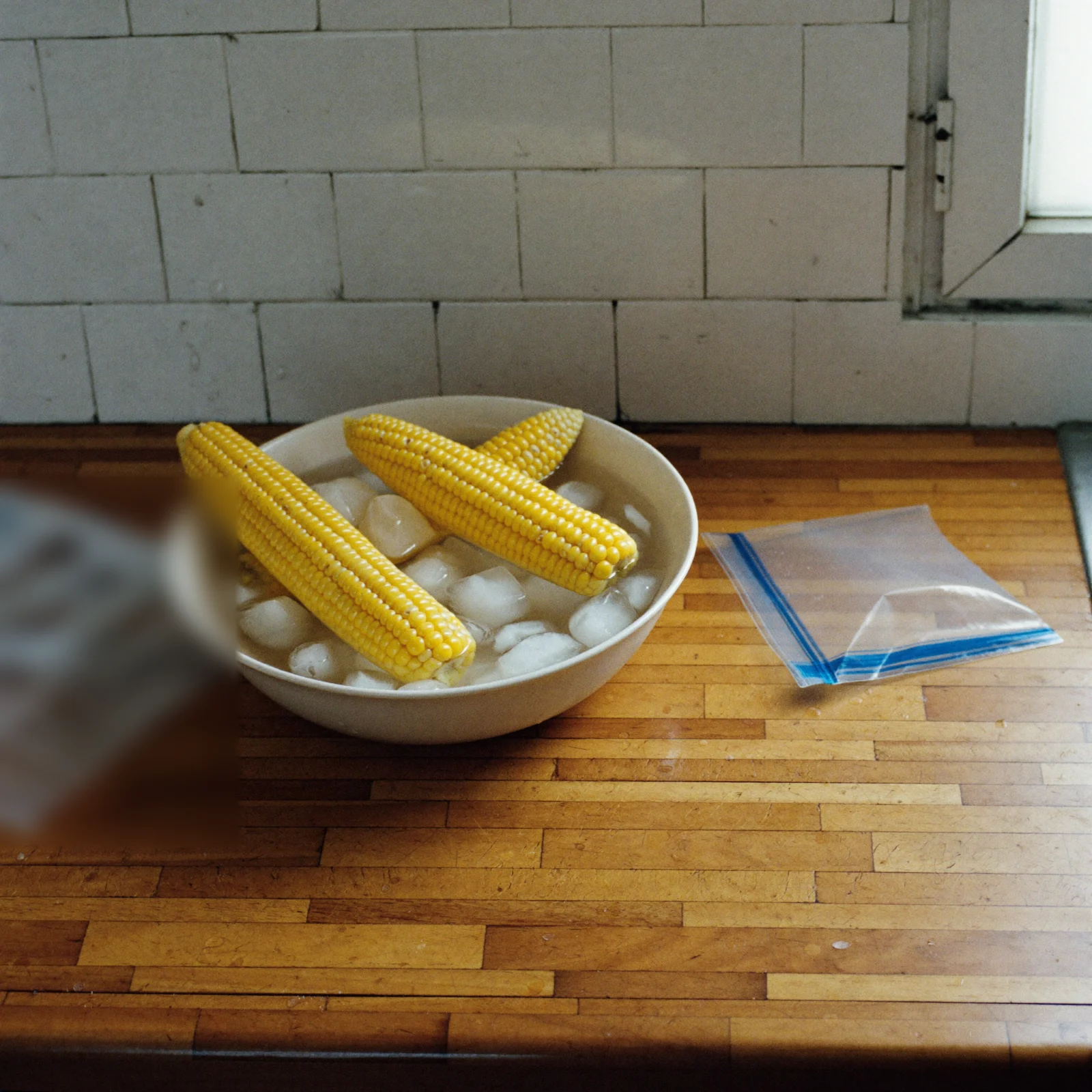
Cool the ears for as long as you blanched them.
Is it better to freeze corn on the cob or off?
Off the cob, if you only care about texture. The National Center for Home Food Preservation blanches whole-kernel corn for 4 minutes instead of 7 to 11. It says that method gives crisper kernels than corn-on-the-cob. The trade is obvious, though. You have to eat it with a utensil or put it in a recipe, as the same page notes. So freeze a few ears for the plate, then freeze the rest as kernels.
How long does frozen corn last?
Frozen corn keeps 8 to 9 months, since the two charts nearly agree. NDSU Extension also gives corn in husks 8 months in the freezer. Utah State University Extension is slightly more generous. Well packaged frozen corn can be held up to 9 months at 0 degrees F, it says. Neither figure is a safety limit, though. Both are quality windows, so corn past them is dull rather than dangerous. Keep the freezer at 0 degrees F or lower, as NDSU asks.
How to tell if corn on the cob has gone bad
Most of what looks wrong with corn is not spoilage. A brown husk, a gap in the kernels or a worm at the tip are all fixable. The real line, however, is slime and mold, and UConn Extension draws it. So here is what each stage means.

Verdict: use it
Green-husked corn
Tight green husks, damp silk and plump kernels underneath. That is the ear Purdue Extension FoodLink tells you to buy, since it asks for fresh, green husks. Utah State University Extension adds good green husk color and silk ends free from decay. So cook it today, while the sugar is still there.

Verdict: use it
Brown, dry corn husks
Husks gone papery and brown at the edges, with the ear still firm inside. Dryness is age rather than rot, and no source we opened calls it a reason to bin an ear. NDSU Extension does want corn in husks kept moist, though. So a dry husk tells you the ear has been sitting, which means the sugar has been going. Pull the husk back and judge the kernels instead.

Verdict: cut the tip off
Wormy corn
A caterpillar at the tip, with chewed kernels and dark crumbs around it. That is the corn earworm, and Purdue Extension Entomology says its larvae usually enter corn ears only through the tip. They feed there, consuming kernels and fouling the ear with excrement. Purdue's advice to homeowners is to tolerate the damage, since you can simply cut off the tips. Utah State University Extension takes the same view at the shop, because it rejects silk ends with worm injury. So cut generously past the damage, then cook the rest.

Verdict: cook it anyway
Tough, starchy corn kernels
Kernels that are chewy and bland, or dark yellow and hard. Iowa State Extension describes overmature sweet corn as tough and doughy. Utah State University Extension also says dark yellow kernels can be tough and not very sweet. This is the sugar-to-starch change finishing, rather than spoilage. So the ear is still food. Cut the kernels off for a chowder, a fritter or a bake, where texture matters less.

Verdict: throw it out
Slimy or moldy corn
Kernels that are wet and slippery, a sour smell, or fuzz anywhere on the ear. UConn Extension puts the rule plainly for produce you cannot identify. Some molds produce toxins that can cause illness, it says. So err on the side of caution and discard the food. Corn sits awkwardly between its two groups, because a cob is firm while the kernels are soft. The one-inch trim rule it gives for firm produce assumes you can cut the mold out cleanly. You cannot do that on a cob of kernels, so bin the ear. Then do not cut anything else with the same knife.
What are the grey lumps on corn?
They are corn smut, and the University of Wisconsin says the fungus is edible. Its plant disease fact sheet calls huitlacoche a culinary delicacy, with a smoky, earthy taste. The galls grow out of the kernels themselves, in fact. Early on they have a streaked, silvery appearance, and later they turn scorched and blackened. Wisconsin harvests them before they begin to dry, but after they have turned dark grey. It also gives one hard rule in capitals, which is not to use galls that are powdery inside. So a grey-lumped ear is not a ruined ear, although it is no longer corn on the cob.
Corn substitutes
Out of fresh corn, or did the ears sit too long? Then one of these will stand in.
Substitute
Works best in
What changes
Frozen corn on the cob
Boiling and grilling
NDSU gives it 8 months at 0 degrees F.
Frozen corn kernels
Soups, salads and sides
The National Center blanches them 4 minutes, so they stay crisper.
Home-canned corn
Chowders and bakes
Utah State gives it 3 years at 70 degrees F.
Dried corn
Soups and stews
Utah State dries kernels at 140 degrees F, then rehydrates them in boiling water.
Mistakes people make when they store corn on the cob
These are the ways people store corn on the cob that cost them the most. Each one has a quick fix, though.
Leaving corn in a hot car. Iowa State says standard sweet corn can lose 50% of its sugar within 12 hours without refrigeration.
Buying a week's worth. Purdue Extension FoodLink says to buy only what you can eat in a few days, because the sugars convert very quickly.
Cutting the kernels off early. Purdue says raw corn cut off the ears lasts only a day or two before turning sour.
Letting the husks dry out. NDSU's chart gives corn in husks 1 to 2 days, and its only instruction is to keep it moist.
Skipping the blanch before freezing. Utah State says the heat has to inactivate enzymes in the cob, so cob blanching runs longer.
Freezing the ears while they are still warm. The National Center cools promptly and completely, since that is what prevents a cobby taste.
Binning a wormy ear. Purdue's entomologists simply cut off the tips of damaged ears instead.
Sources
Sweet Corn, Purdue Extension FoodLink, on fresh green insect-free husks, plump kernels, sugars converting to starch very quickly, refrigerating with the husks on or off, raw cut corn lasting a day or two, cooked cut corn 4 to 5 days, and home-frozen corn beating commercial.
Growing Sweet Corn in the Home Garden, Aaron Steil and Richard Jauron, Iowa State University Extension and Outreach, reviewed July 2025, on the milk stage, brown dry silks, standard corn losing 50% of its sugar within 12 hours, supersweet types holding a week, and a maximum storage life of 4 to 8 days.
Sweet Corn: Harvest and Handling, Utah State University Extension Vegetable Production Guide, on silks dried and brown beyond the husk, standard kernels losing half their sugar within 24 hours above 86 degrees F, only 8% lost each day near freezing, and 32 degrees F beyond 2 to 3 days.
How to Preserve Corn, Charlotte Brennand, Heidi LeBlanc and Paige Wray, Utah State University Extension, on good green husk color, silk ends free from decay or worm injury, processing within 2 to 3 hours, blanching 7, 9 and 11 minutes, cooling as long as you blanched, and 9 months at 0 degrees F.
Corn: On or Off the Cob, National Center for Home Food Preservation, University of Georgia, June 2013, on husking and washing first, blanching by ear diameter, cooling promptly to prevent a cobby taste, whole ears going water-logged and mushy, and whole-kernel corn blanching 4 minutes.
Food Storage Guide, Julie Garden-Robinson, NDSU Extension FN579, reviewed January 2023, on corn in husks keeping 1 to 2 days in the refrigerator and 8 months in the freezer, keeping it moist, and a refrigerator at 34 to 40 degrees F.
Food Storage: Refrigerator and Freezer, Clemson Cooperative Extension HGIC 3522, revised March 2020, on corn keeping 1 to 2 days in the refrigerator, and keeping the refrigerator between 34 and 40 degrees F.
Corn Earworm, Ricky E. Foster, Purdue Extension Entomology publication E-31, March 2016, on larvae usually entering corn ears only through the tip, fouling the ear with excrement, and homeowners simply cutting off the tips of damaged ears.
Huitlacoche, Joe Spraker, University of Wisconsin-Madison Plant Disease Facts D0065, revised March 2024, on the galls being edible with a smoky, earthy taste, their silvery then blackened appearance, harvesting after they turn dark grey, and never using galls that are powdery inside.
Handling Food with Mold, UConn Extension EXT063, April 2024, on discarding moldy soft produce whole, cutting an inch around and below mold on firm produce, and molds producing toxins that can cause illness.
Storage times and safety advice on this page come from the sources above. Food safety depends on conditions I cannot see, so read the Disclaimer, and if in doubt, throw it out.
Other ingredient guides
Browse all guides

Share this guide
Never miss a guide
New ingredient guides when they go up, plus one storage tip worth knowing. Anything sponsored is labelled.

Emilly White