

No
It deteriorates rapidly above 40°F, says Oregon Vegetables at Oregon State
2 to 5 days
Butt ends in water, or wrapped damp, loosely covered and cold
Yes, blanched
2, 3 or 4 minutes in boiling water by thickness, says the NCHFP
The short version: to store asparagus well, treat it like cut flowers and get it cold fast. Stand the spears in an inch or two of cold water, or wrap the butt ends in a damp towel. Then cover the tops loosely and refrigerate. After that, eat it within a few days. The clock on tenderness is much shorter than the clock on safety.
Storage guidance from Penn State Extension, Purdue Extension FoodLink and Oregon Vegetables.
On this page
How to choose asparagus that will store well
With asparagus, the bunch tells you how long it has been in the shop. So it pays to look at the cut ends as well as the tips. A bundle that was cut days ago cannot be rescued by anything you do at home.

Closed tips and moist cut ends mean a recent cut.
Tightly closed tips. WSU Extension looks for deep green, firm but tender stalks with intact, closed tips. Similarly, Utah State University Extension wants them brightly colored and firm with tightly closed tips.
Stems that snap rather than bend. Purdue Extension asks for crisp, firm stems that snap when you bend them. It also wants dark green tips with a hint of purple, because that shows freshness.
Wet-looking cut ends. Utah State University Extension says the cut ends go dry if the bunch has sat in the store a while. So dry butts are an age test you can do through the bag.
No bruises or cuts. Penn State Extension says to check spears for bruising or cuts, because those could harbor bacteria. Utah State also adds that straight stems beat wrinkled ones, and that a smell means it is not fresh.
How to store asparagus so it lasts
To store asparagus so it lasts, keep it cold, keep the butt ends wet and chill it quickly. Penn State Extension sums the whole thing up in three words: clean, cold and covered. The order matters, because the cold is doing most of the work.
How to store asparagus in the fridge
Penn State Extension stands the spears in 2 inches of cold water, then covers the tops with a plastic bag. Purdue Extension and Utah State University Extension instead wrap the butt ends in a damp paper towel inside a bag. Either way the point is the same. Oregon Vegetables at Oregon State says high relative humidity is essential to prevent desiccation, especially at the butt ends. Growers get it by standing the butts on wet pads, so the jar of water is the home version. Keep the bunch on a cold shelf rather than in the door. The same page also calls asparagus highly perishable, and warns that it deteriorates rapidly above 40°F. That cold, damp corner is where the broccoli guide ends up too, so the two can share it.
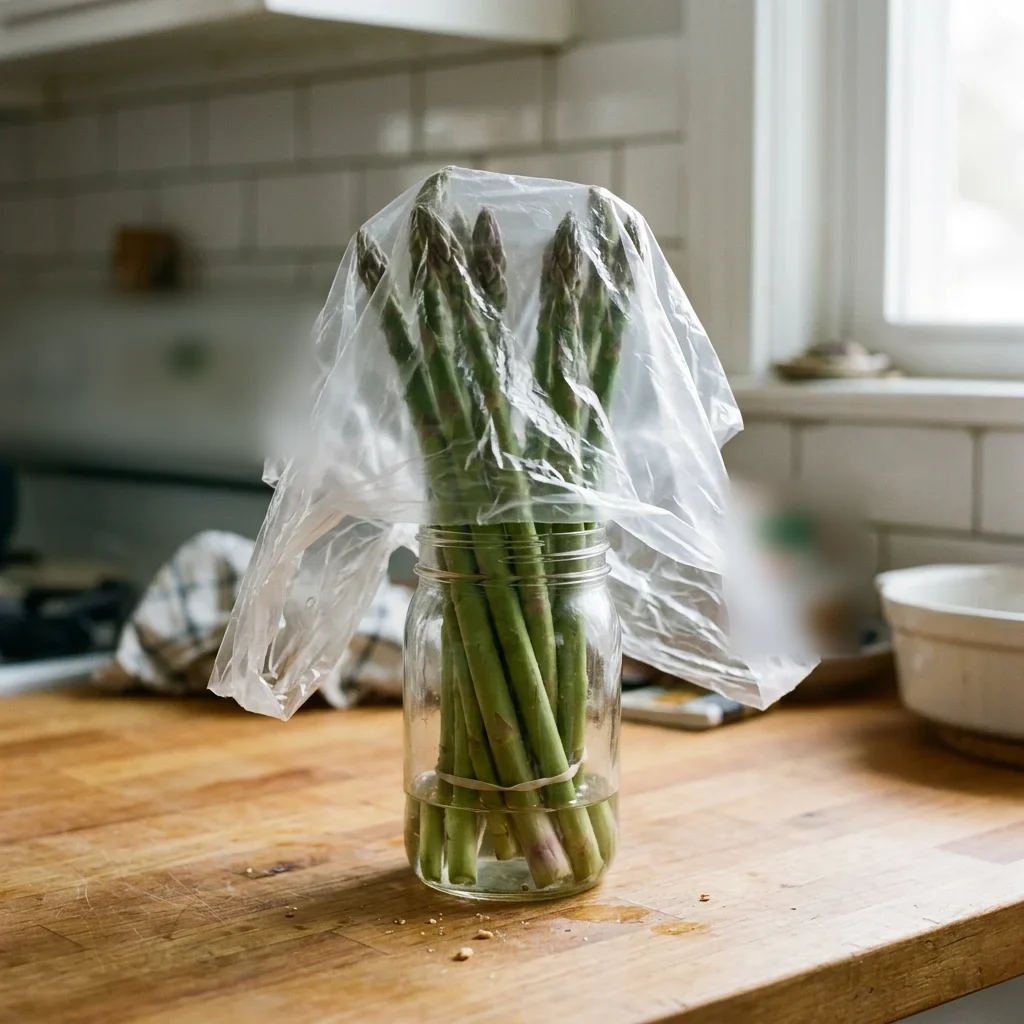
Two inches of cold water, with the tops loosely covered.
How long can you store asparagus?
A few days at home, although the extension services differ on how many. Penn State Extension says asparagus stood in water stays at peak freshness for 2 to 3 days. Similarly, Utah State University Extension gives 2 to 3 days for the damp towel. Purdue Extension, however, is more generous at up to about 5 days for either method. WSU Extension simply says several days, and asks you to eat or preserve it as soon after purchase as possible. So take the shorter figure: plan on 2 to 3 days, and treat day 5 as the outside edge.
Commercial figures look much longer, but they do not transfer. Oregon Vegetables recommends 32°F and 95% relative humidity, with the butts on wet pads. At 34°F it gets about 3 weeks. However, it also says asparagus held at 32°F can only go about 10 days before chilling injury sets in. No home fridge holds those conditions, so the jar of water is your approximation of them.
Should you store asparagus in water or a damp towel?
Both work, and the split between them is smaller than it looks. Penn State Extension stands the spears in 2 inches of cold water, with a bag over the tops. Purdue Extension offers the upright container of water and the damp paper towel as equals. Utah State University Extension wraps the cut ends in a damp paper towel inside moisture-proof wrapping. None of the three published a side-by-side test. So treat the water as the more thorough option, not the only one. Use the jar when you have the fridge space, because it keeps the butt ends properly wet. Use the towel when you do not.
Can you store asparagus next to fruit?
No, and with asparagus the penalty is toughness rather than rot. Oregon Vegetables says asparagus may be damaged by exposure to ethylene. So it should not be stored with apples or other ethylene-generating material. The damage shows up as undesirable elongation, curving and toughening. It also warns against non-perforated film, since enough ethylene can build up inside to toughen the spears. So keep the bunch away from the fruit bowl. The apples guide works the same rule from the other side.
How to store asparagus you have already cooked
Cool it quickly, cover it and keep it to a few days. The USDA mold factsheet asks you to use leftovers within 3 to 4 days, so mold cannot get started. It also says to keep served food covered, because mold spores travel in the air. Perishable food should not sit out of the fridge for more than 2 hours. When that rule has already been broken, food left out overnight covers what to do.
Can you store asparagus in the freezer?
Yes, but it has to be blanched first. The NCHFP selects young tender spears, washes them and sorts them by size. Then it removes the scales with a sharp knife, and cuts the spears into lengths that fit the container. Blanching is not optional here. It is the step that stops the enzymes that would otherwise keep working in the freezer.
How to store asparagus in the freezer
Blanch in boiling water by thickness, then cool and pack. The NCHFP gives 2 minutes for small spears, 3 for medium and 4 for large. Then it says to cool them promptly, drain them and package them leaving no headspace. Penn State Extension lists exactly the same times. Purdue Extension is the outlier, with 30 seconds in boiling water followed by 5 minutes in cold water. Since under-blanching leaves the enzymes working, give the spears the full 2 to 4 minutes. Purdue says they then keep 3 to 4 months in the freezer.

Cool the spears fast, then pack them with no headspace.
Should you wash asparagus before you store it?
Here the sources genuinely disagree. Penn State Extension washes first. It trims about a quarter of an inch off the ends, then washes the spears several times in cool water. After that, pat them dry and refrigerate within 2 hours of washing, since that prevents microorganism growth. Purdue Extension and Utah State University Extension instead put rinsing under preparation, immediately before cooking. The FDA simply says to rub produce gently under plain running water, with no soap and no produce wash. Washing early is only safe if you dry the spears properly and chill them straight away. So if you are not going to do both, leave the washing until you cook.
What happens to asparagus you store in the freezer
It comes out softer, which is why frozen asparagus belongs in cooked dishes. Blanching and freezing both break down the structure that makes a raw spear snap. So expect it in soups, tarts, risotto and stir-fries, rather than on a salad plate. The flavor holds up far better than the texture does. Freezing also stops the toughening clock, which is the one thing the fridge cannot do.
How to tell if asparagus has gone bad
Asparagus has two separate failure modes, and people confuse them constantly. Woody and wrinkled are quality problems you can cook around, whereas slime and a sour smell are the end. Here is what each stage means.
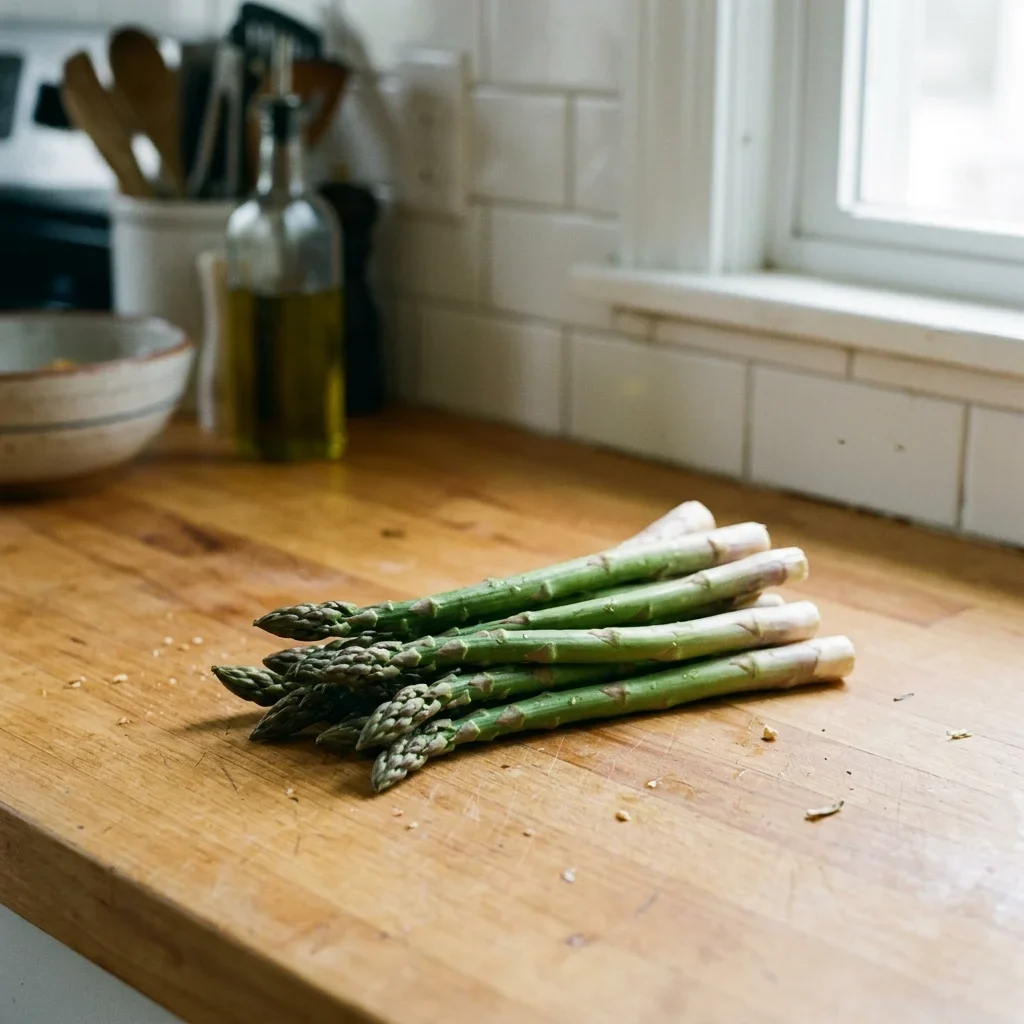
Verdict: use it
Firm asparagus with closed tips
Deep green, firm stalks with intact, closed tips are what WSU Extension tells you to buy. So if that is what is in your fridge, nothing is wrong. Cook it today anyway, since Utah State University Extension says asparagus is best the day you buy it.
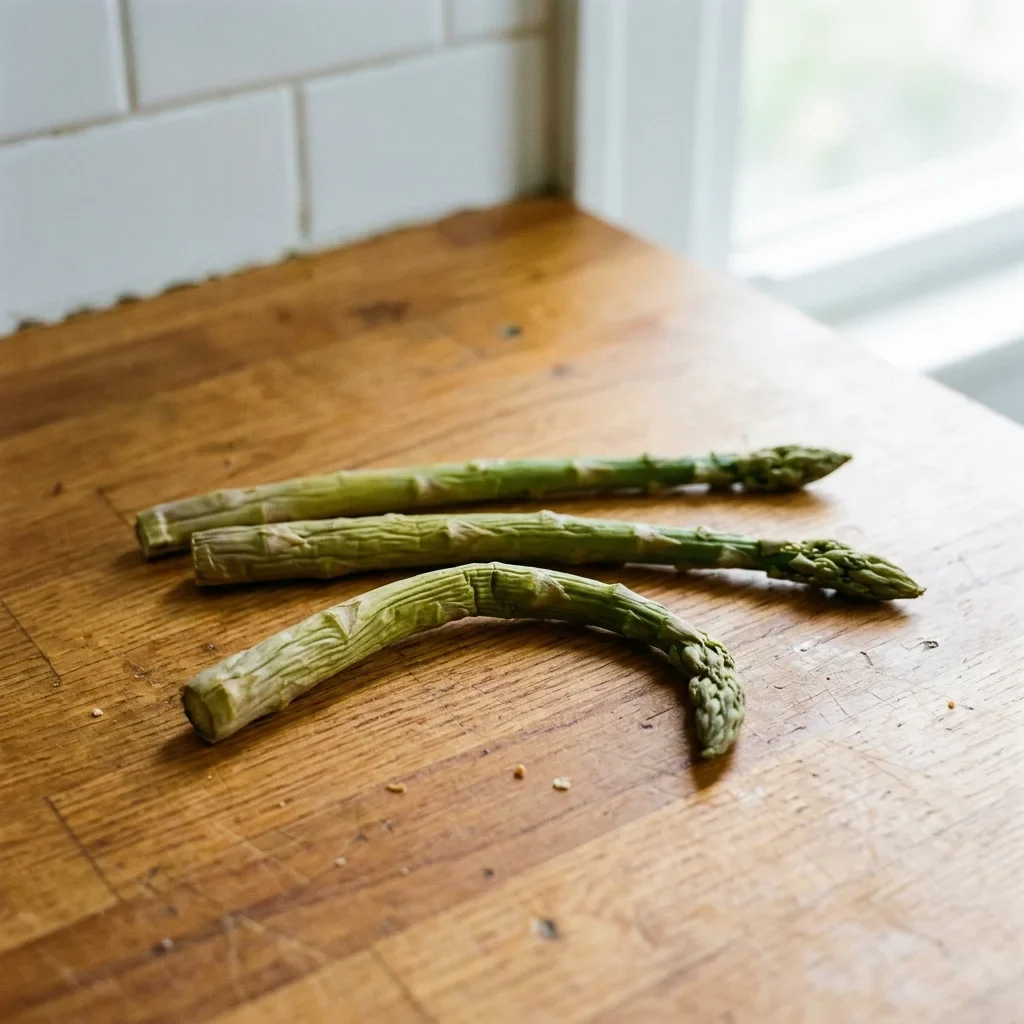
Verdict: use it today
Wrinkled, limp asparagus stalks
Wrinkling is water loss, and it costs you tenderness as well as looks. Oregon Vegetables notes that water loss after harvest increases fiber development. That is the mechanism behind a stalk going both limp and tough at once. Stand the spears in cold water in the fridge, then cook them tonight. If they feel stringy, peel the bottom third, as Utah State University Extension does with large stalks.
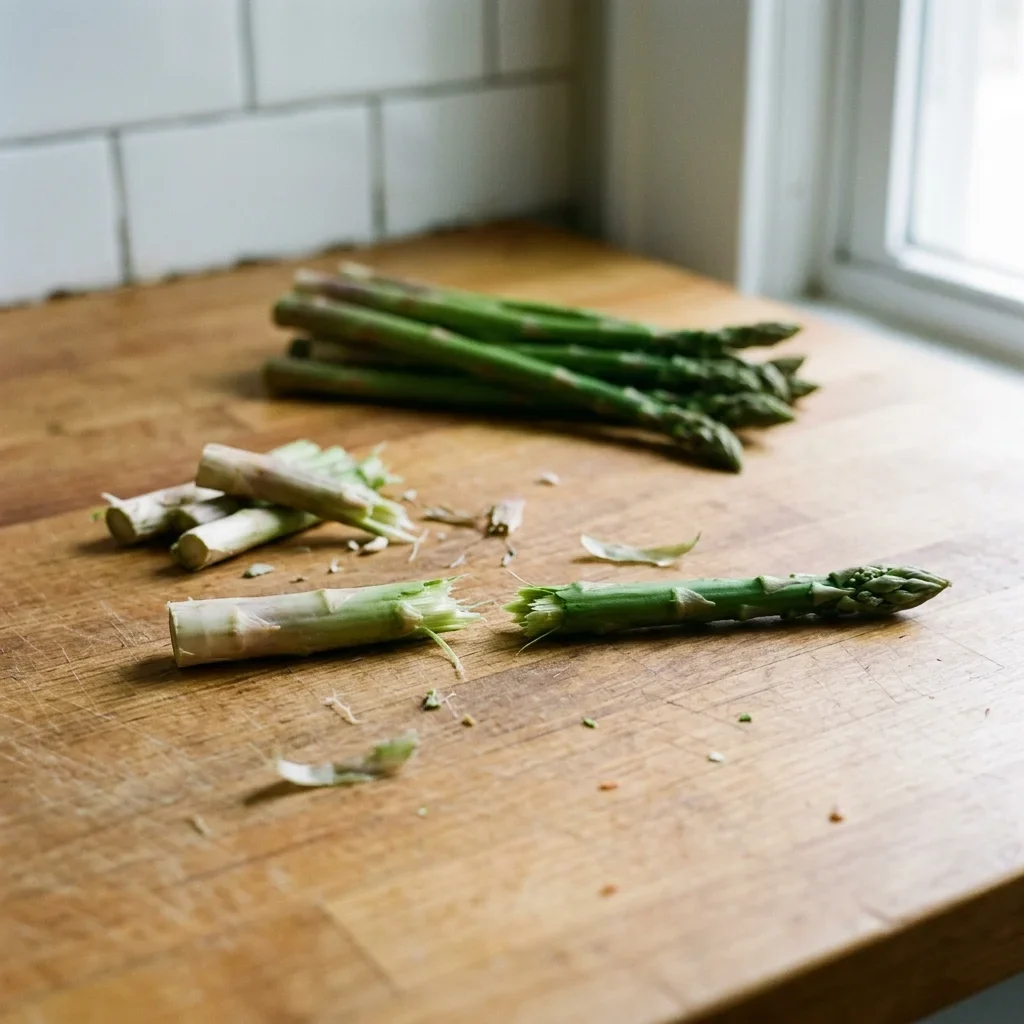
Verdict: trim it
Woody asparagus ends
Tough ends are normal rather than a fault. Oregon Vegetables explains that fiber cells are always more common at the base of the spear than at the tip. Most post-harvest fiber development also happens within 24 hours, slowed dramatically by cooling promptly to 36°F. Snap the ends off instead of measuring. Utah State University Extension says the stalk breaks naturally where the woody part ends and the tender part begins. Purdue Extension then says to discard those bottoms, or save them for vegetable stock.

Verdict: throw it out
Asparagus with slimy or mushy tips
Slimy tips are the clearest stop signal on the spear. Purdue Extension says not to use asparagus if the tips are slimy, yellow, soft or rotten. Oregon Vegetables also names bacterial soft rot as the principal decay of asparagus. It can occur at either the tip or the butt. Since the tip is the part that goes first, judge the bunch there rather than at the cut end.
Verdict: throw it out
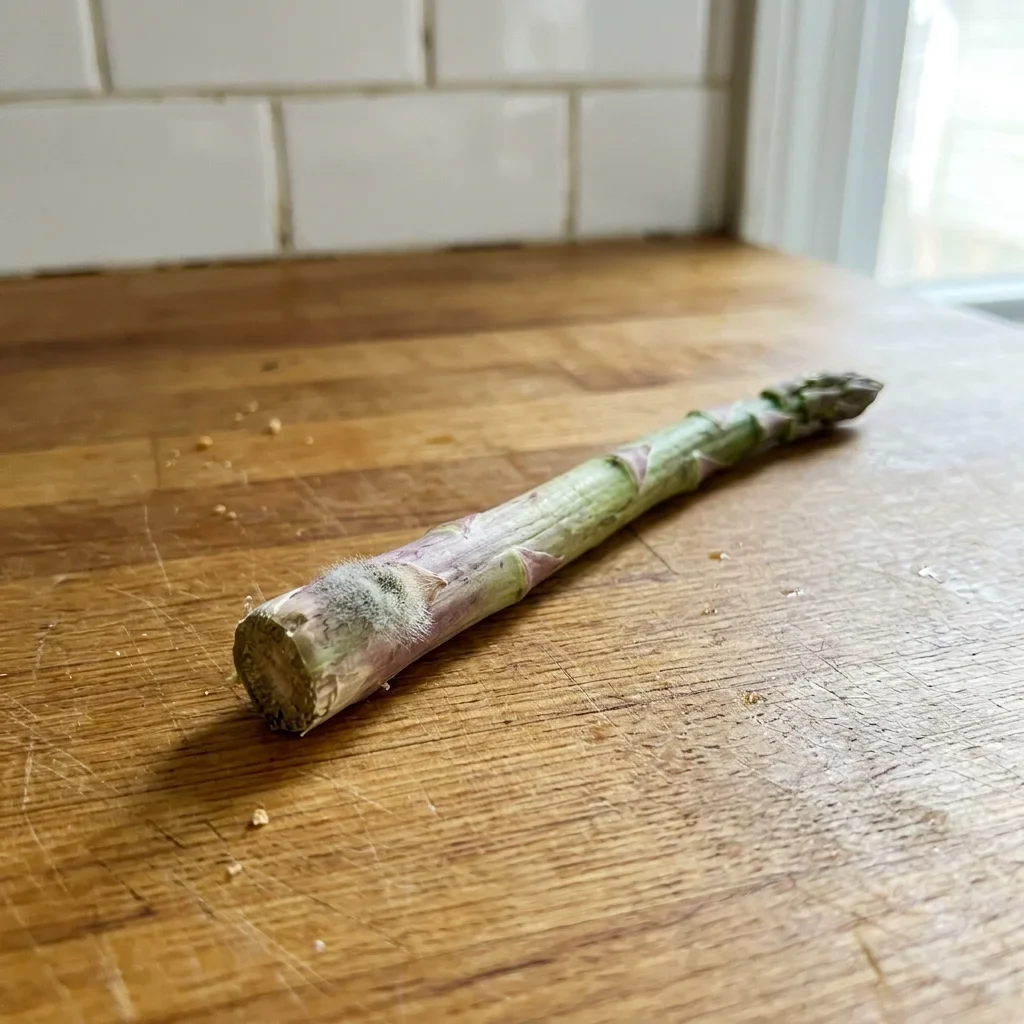
Moldy or sour-smelling asparagus
Mold or a sour smell means the whole spear goes, not the moldy inch. The USDA FSIS mold factsheet puts soft fruits and vegetables in the discard column. That is because high-moisture foods can be contaminated below the surface. It keeps the trim-an-inch advice for firm produce such as carrots and cabbage. Utah State University Extension is simpler: if the asparagus gives off a smell, it is not fresh. Bag it before it goes in the bin. Do not sniff it closely, and check whatever it was lying next to.
Why does asparagus you store go woody?
Because the spear keeps building fiber after it is cut, and warmth and dryness both speed that up. Oregon Vegetables, quoting work from the University of Illinois, says the toughness comes from thick-walled fiber cells containing lignin. Most post-harvest fiber development occurs within 24 hours, although cooling promptly to 36°F slows it dramatically. It adds two more levers you can pull at home. Water loss after harvest increases fiber development, so humidity matters. Film wraps, or standing the butt ends on water, also help. That is the real argument for the jar of water. It is not about looks, it is about tenderness.
Asparagus substitutes
Out of asparagus, or did the tips turn before you got to it? Then these will stand in.
Substitute
Works best in
What changes
Green beans
Roasting and blanching
Firmer and sweeter, and they keep much longer.
Broccolini
Anything griddled or charred
Closest in shape, with a mustardy edge.
Leeks, split lengthways
Braising and tarts
Sweeter and softer, and they store for weeks.
Frozen asparagus
Soups, risotto and tarts
Softer than fresh, so keep it out of salads.
Mistakes people make when they store asparagus
These are the ways people store asparagus that cost them the most, and each one has an easy fix.
Leaving it on the counter. Oregon Vegetables says asparagus deteriorates rapidly above 40°F, so the fridge is not optional.
Letting the butt ends dry out. High humidity at the butts is what prevents desiccation, so stand them in water or wrap them damp.
Parking it beside the apples. Ethylene makes spears elongate, curve and toughen, so keep the fruit on another shelf.
Sealing it in non-perforated film. Oregon Vegetables warns that ethylene builds up inside and toughens the spears, so cover the tops loosely instead.
Cutting the ends off with a knife. Snapping finds the line between woody and tender for you.
Freezing it raw. Blanch for 2 to 4 minutes by thickness first, because under-blanching leaves the enzymes working.
Judging the bunch by the cut ends. The tips go first, so look there before you decide.
Sources
Preparing and Preserving Asparagus, Stacy Reed, Penn State Extension, updated January 2024, on clean, cold and covered, 2 inches of water, 2 to 3 days of peak freshness and blanching times.
Asparagus, Oregon Vegetables, Oregon State University, published July 2010, on 32°F and 95% humidity, deterioration above 40°F, chilling injury, ethylene toughening, bacterial soft rot and post-harvest fiber development.
FoodLink: Asparagus, Purdue Extension, on selecting spears that snap, storing upright in water or with a damp towel for up to 5 days, slimy or yellow tips and 3 to 4 months in the freezer.
Freezing Asparagus, National Center for Home Food Preservation, University of Georgia, on sorting by size, removing scales and blanching small, medium and large spears for 2, 3 and 4 minutes.
How to Nourish With Asparagus, Viva Vegetables, Utah State University Extension, on the damp paper towel, 2 to 3 days, dry cut ends as an age test, smell, and snapping off the woody ends.
Preserving Fresh Asparagus, C. Koehler, Washington State University Extension, on choosing deep green firm stalks with closed tips and using or preserving them soon after purchase.
Molds on Food: Are They Dangerous?, USDA Food Safety and Inspection Service, revised September 2005, hosted by UC Davis Food Safety, on discarding soft produce, trimming firm produce, leftovers within 3 to 4 days and the 2-hour rule.
7 Tips for Cleaning Fruits, Vegetables, U.S. Food and Drug Administration, on rubbing produce under plain running water without soap or produce wash.
Storage times and safety advice on this page come from the sources above. Food safety depends on conditions I cannot see, so read the Disclaimer, and if in doubt, throw it out.
Other ingredient guides
Browse all guides

Share this guide
Never miss a guide
New ingredient guides when they go up, plus one storage tip worth knowing. Anything sponsored is labelled.

Emilly White