
Not an option
The pods wilt fast, so they go straight into the fridge
3 to 5 days
Unwashed, in a bag in the crisper, at 40°F or lower
8 months
Blanched 3 minutes first, then cooled in ice water
The short version: when you store green beans, keep them dry and unwashed in a bag in the crisper. Use them within about 5 days, since the cold works against them. Then blanch the rest for 3 minutes and freeze them.
Storage guidance from Purdue Extension FoodLink, Washington State University Extension and Oregon State University's Oregon Vegetables, plus the cold-chain figures from the WFLO Commodity Storage Manual.
On this page
How to choose green beans that will store well
The snap is the whole test, and it takes a second. A bean that bends instead of breaking has already lost water. So it will not improve in your fridge. Cooking for a Halloween party? How to store Halloween leftovers covers the rest of the table.
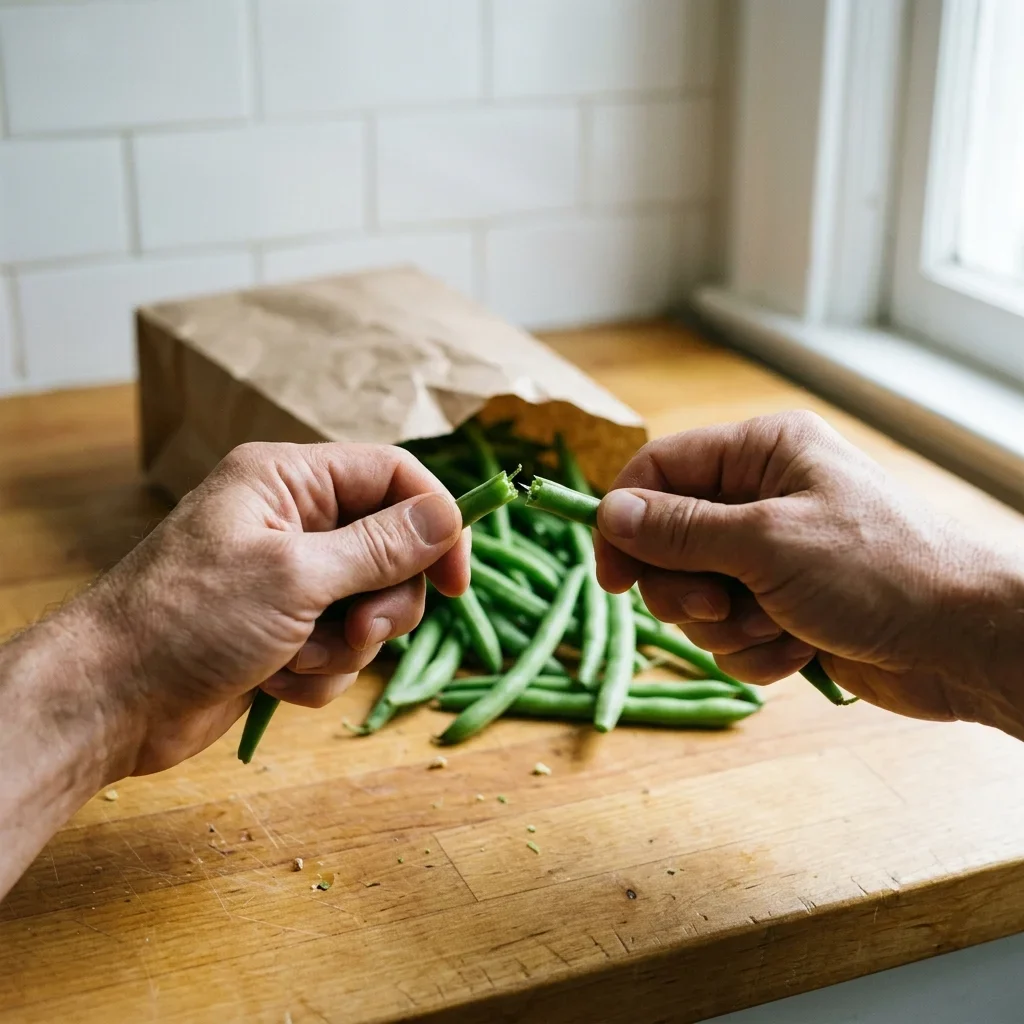
A fresh pod breaks clean. One that bends has already lost water.
A clean snap. Purdue Extension FoodLink looks for evenly colored, fresh, blemish-free beans that snap easily when bent. University of Wisconsin-Madison Division of Extension wants a clean break without strings, too.
A velvety surface. Wisconsin Extension asks for beans with a fresh, bright skin and velvety touch. It also tells you to avoid a dull appearance.
No seeds showing through the pod. Wisconsin Extension says beans with seeds visible through the skin are tough and old. So leave those for the dried-bean jar.
No holes, spots or brown skin. Those are on Wisconsin Extension's do-not-choose list, along with woody or stringy pods. None of it gets better in storage, though.
How to store green beans so they last
To store green beans so they last, keep them cold, humid and dry on the outside. That sounds contradictory, but it is the whole problem with beans. They wilt without humidity, whereas free water on the pods invites decay.
How to store green beans in the fridge
Unwashed, in a bag, in the crisper. Purdue Extension FoodLink keeps snap beans refrigerated in a plastic bag in the crisper. Washington State University Extension adds the reason for leaving them dry. Avoid washing until ready to use to ensure better storage, it says. Humidity still matters, though. The WFLO Commodity Storage Manual puts snap beans at 95 to 100 percent relative humidity, since they are susceptible to wilting. A bag gives you that without wetting the pods. So keep the fridge at 40°F or lower, which is the limit Clemson Cooperative Extension sets.
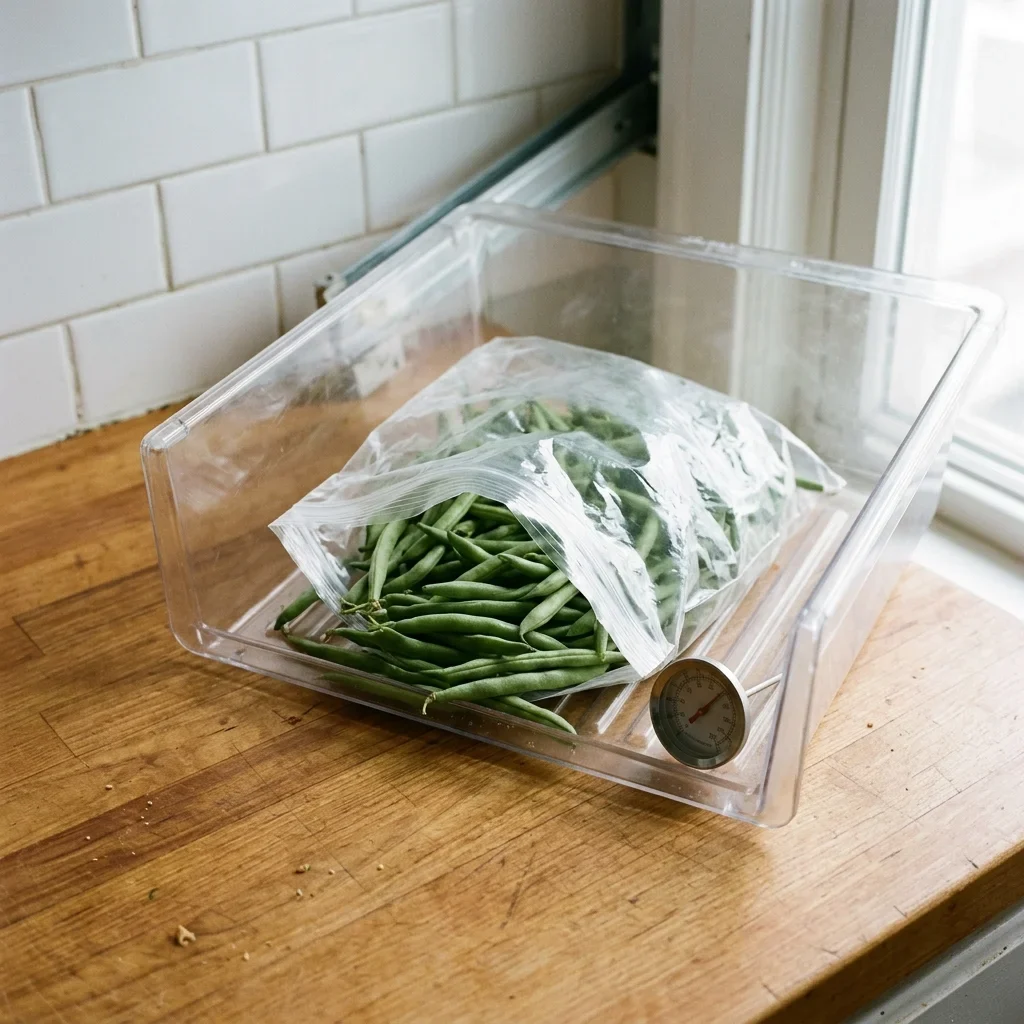
Unwashed, in a bag, in the warmest drawer you have.
How long can you store green beans?
Days rather than weeks, and the sources spread out a long way. Purdue Extension FoodLink says to use them within 5 days. NDSU Extension gives green or wax beans 3 to 5 days at 32 to 40°F. Washington State University Extension says unwashed beans can store for up to a week. Wisconsin Extension goes furthest, with up to two weeks. The cold-chain figures are different again. The WFLO Commodity Storage Manual gives 8 to 12 days at 40 to 45°F.
So take the 3 to 5 days, because that is the figure measured at fridge temperature. The longer numbers come from a warmer store at 40 to 45°F, which no home fridge gives you. In other words, the two-week figure is real, but not in your kitchen.
Is the fridge too cold to store green beans?
Slightly, yes, and that is the one thing the top results never mention. Oregon State University's Oregon Vegetables says snap beans are cold sensitive. They may be severely chill-injured in a few days at 38 F and below, it warns. The WFLO Commodity Storage Manual puts the line below 37°F. It adds that even the recommended 40 to 45°F may cause chilling injury on some varieties after 7 to 10 days. A home fridge runs at 32 to 40°F, so your beans are in the injury range already. That is not a safety problem, though. It is a quality clock, and it is why the short figures are the honest ones. Cucumbers and zucchini have the same complaint about a home fridge.
How to store green beans you have already cut
In a sealed container, and sooner rather than later. None of the extension sources we opened gives a separate figure for cut beans. So we will not invent one. What they do give is a direction. Purdue Extension FoodLink snips the stem end and then leaves the beans whole, or cuts them into halves or thirds for a recipe. That puts the cutting at the cooking end rather than the storing end. So cut them when you are ready to cook, and keep whole pods in the bag until then.
How to store green beans you have cooked
Cool them, cover them, then give them a few days. The USDA Food Safety and Inspection Service tells you to use leftovers within 3 to 4 days. That way mold does not get a chance to grow, it explains. It also says not to leave perishables out of the refrigerator more than 2 hours. When a dish has sat past that, food left out overnight covers it. Cooked beans will not get their snap back, though. So plan them into a salad, a soup or a stir-fry.
Can you store green beans in the freezer?
Yes, and this is where beans do well. Washington State University Extension blanches them first, to destroy enzymes and help maintain color, texture and flavor. NDSU Extension then gives green or wax beans 8 months at 0°F. That is a different world from 5 days.
How to store green beans in the freezer
Blanch, chill, pack and press the air out. Washington State University Extension washes the beans in cold water, then cuts them into 2 to 4 inch lengths. Then it blanches them in boiling water for 3 minutes. Allow 1 gallon of water for each pound of vegetables. Dip blanched beans immediately into ice water for an equivalent length of time, it says. After that, drain them and pack them in moisture-vapor proof containers or freezer-weight bags. Remove all the air you can, leaving half an inch of headspace. Then seal, label and freeze. The FDA adds that freezing at 0°F keeps food safe indefinitely. So the 8 months is about quality.
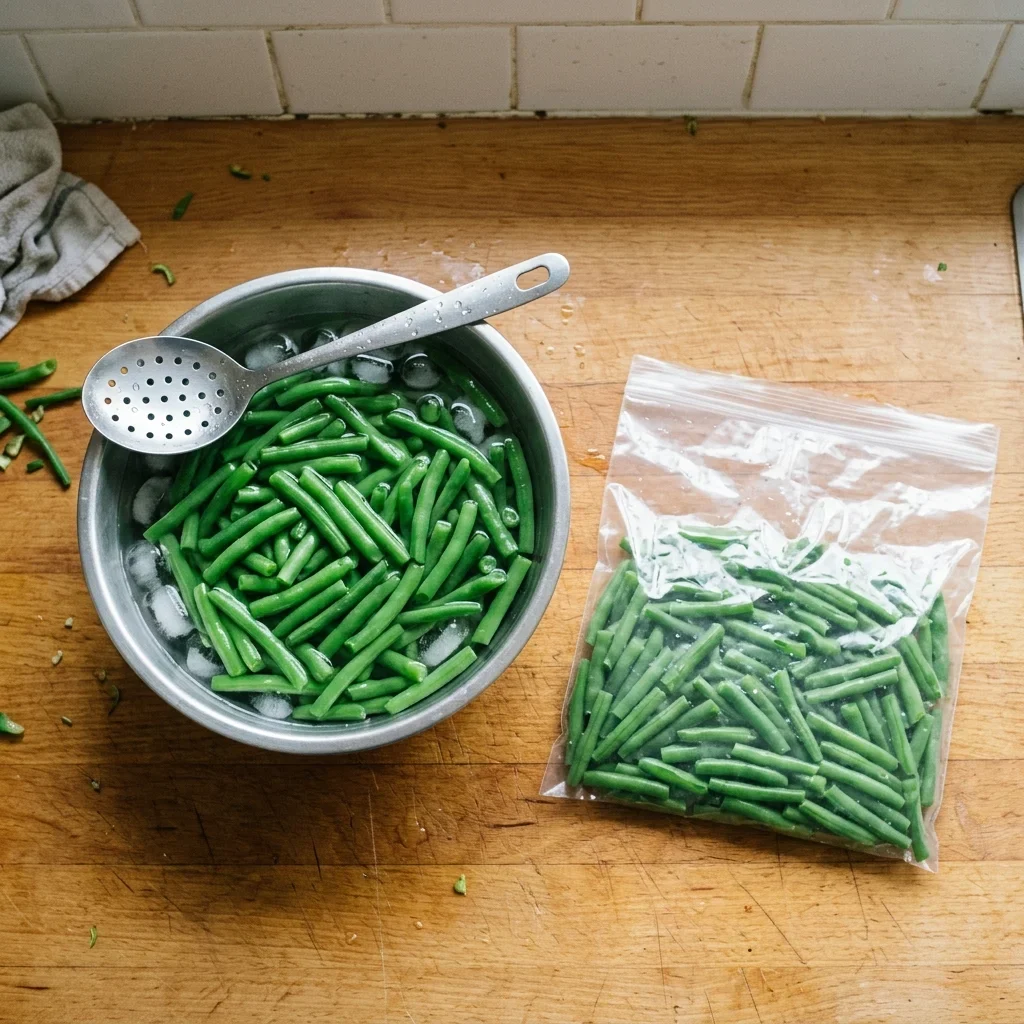
Three minutes in boiling water, then three in ice, then pack them flat.
How long to blanch green beans before you store them
Three minutes in boiling water, then three minutes in ice. Washington State University Extension gives 3 minutes for freezing. It also tells you to dip the beans into ice water for an equivalent length of time. Purdue Extension FoodLink gives 2 minutes, although that is for a different job. Those are beans you eat cold with a dip, or chopped into a salad. So use the 3 minutes when they are going in the freezer.
What happens to green beans you store in the freezer
They come out softer, and that is what the blanching is for. Washington State University Extension blanches to help maintain color, texture, flavor and nutrients. Those are the things at risk, in other words. The pods will never be as crisp as a fresh snap again. So frozen beans belong in cooked dishes. Blanched and frozen broccoli goes the same way, which is why that guide also sends it to the pan.
How to tell if green beans have gone bad
Beans fail in a clear order, although only the last two steps are about safety. First they go limp, then they spot, then they go slimy. In fact the cold-storage literature describes exactly that sequence. Here is what each stage means.
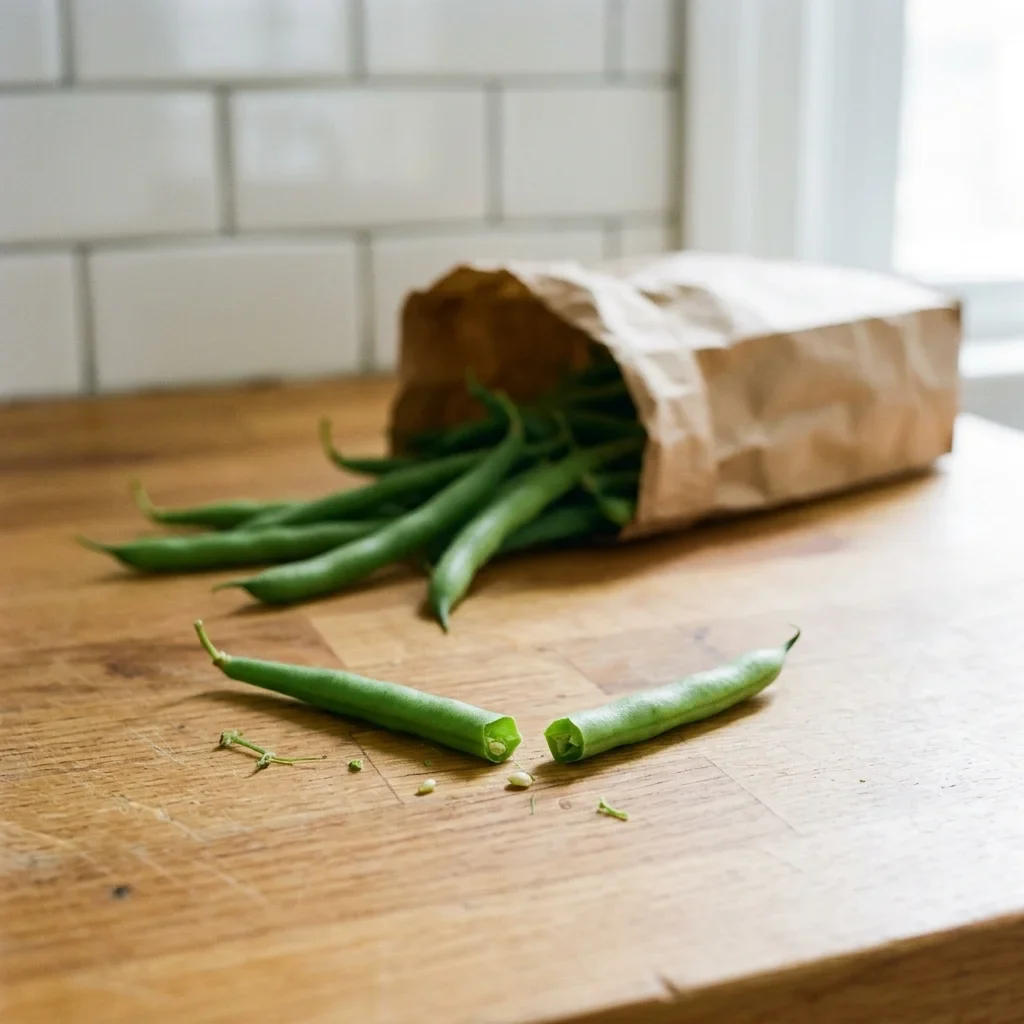
Verdict: use them
Green beans that snap cleanly
Bright, firm, and they break with a clean snap. That is the test both Purdue Extension FoodLink and Wisconsin Extension use, since a fresh pod is full of water. Wisconsin adds a velvety touch to the list, too.

Verdict: cook them
Limp, bendy green beans
A pod that bends has lost water, so the snap is gone for good. Wisconsin Extension puts wilted or tough skins on its do-not-buy list. The WFLO Commodity Storage Manual explains the cause, since snap beans are susceptible to wilting. They are still perfectly good food, though. So cook them in something wet, such as a soup, a stew or a braise.

Verdict: trim them and use them
Green beans with rusty brown spots
This is the one almost nobody explains, and it is the fridge's fault. The WFLO Commodity Storage Manual says chilling injury causes surface pitting and russet discoloration. It happens when snap beans are stored below 37°F for 3 days or longer. The timing is the giveaway, because it shows up especially in 1 to 2 days after removal to room temperature. Russeting usually is not apparent while beans are in cold storage, the manual adds. Oregon State University's Oregon Vegetables describes the same thing, and says free moisture makes it worse. So the spots are cold damage rather than rot. Trim the worst of them, then cook the rest.
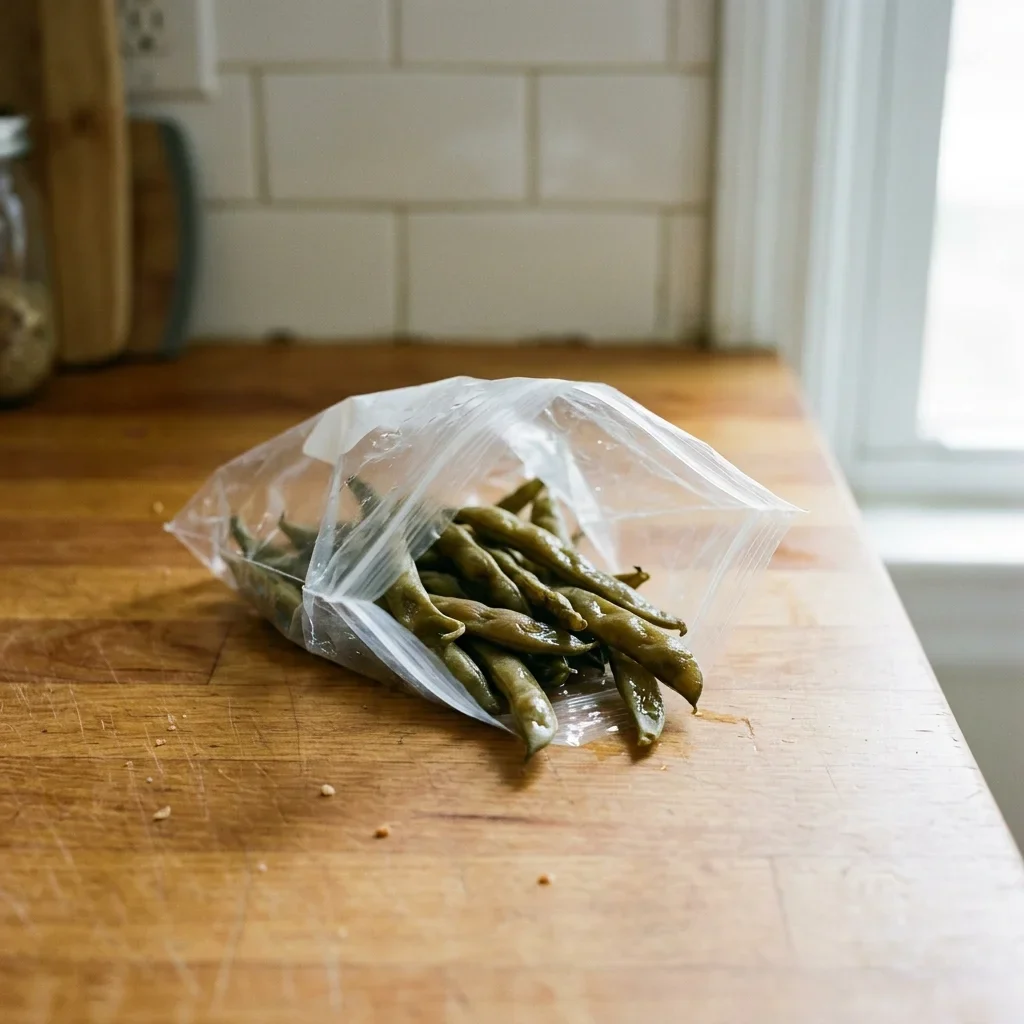
Verdict: throw them out
Slimy green beans
Slime is the end of the line. The WFLO Commodity Storage Manual puts it plainly. If beans are held in storage too long, or if they overheat, they may become slimy and moldy. Heat is part of it, too. The manual says beans are likely to heat in a sack unless the container provides good aeration. Heating then brings a loss of green color and more decay. So bin a slimy bag, and do not try to rinse it back.

Verdict: throw the bag out
Green beans with white fuzz
Fuzz is not the velvet. Wisconsin Extension's velvety touch is the fine down on a fresh pod. White fuzzy growth is mold instead, which the WFLO manual pairs with slime as the end state of overlong storage. The USDA Food Safety and Inspection Service does not list green beans in its mold chart, so this is a reading. It discards soft fruits and vegetables with high moisture content, since they can be contaminated below the surface. Firm, low-moisture produce can be trimmed instead. The WFLO manual puts snap beans at 90.27 percent moisture, though, which lands them on the soft side. So the bag goes. Then clean the drawer where it sat and check what it touched, as the factsheet asks.
Why do green beans you store get brown spots?
Because the fridge is colder than beans tolerate. The WFLO Commodity Storage Manual gives the mechanism. Below 37°F for 3 days or longer, chilling injury causes surface pitting and russet discoloration. Oregon State University's Oregon Vegetables says chilled beans develop pitting and russeting a day or two after removal to warm temperatures. So the spots you see on the counter were made days earlier in the drawer. Free moisture makes it worse, especially in the centers of containers where condensed moisture remains. That is one more reason to keep the pods dry. There is not much you can do at home, though, since a fridge cannot run at 42°F. So buying smaller amounts more often is the real fix.
Green bean substitutes
Out of green beans, or did the bag turn slimy? Then these will stand in.
Substitute
Works best in
What changes
Frozen green beans
Soups, casseroles and stir-fries
Already blanched, and NDSU gives them 8 months.
Sugar snap peas
Stir-fries and salads
Sweeter, and they snap in the same way.
Broccoli
Side dishes and casseroles
Holds its shape, and it keeps a little longer.
Green cabbage, shredded
Braises and stir-fries
Softer, although it keeps for weeks rather than days.
Mistakes people make when they store green beans
These are the ways people store green beans that cost them the most, and each one has a quick fix.
Washing them when you get home. Washington State University Extension says to avoid washing until ready to use, so rinse them at the pan.
Putting them on the coldest shelf. Below 37°F they chill-injure, so use the warmest drawer instead.
Leaving them loose in the drawer. They wilt without humidity, so a bag in the crisper is what Purdue Extension asks for.
Buying a big bag for the week. Since the fridge is already too cold for them, 3 to 5 days is the honest window.
Freezing them raw. Washington State University Extension blanches for 3 minutes first, because that is what protects the color and texture.
Binning them because they bend. A limp bean is still good in soup, so cook it rather than throw it out.
Trimming round white fuzz. Beans are over 90 percent water, so mold in them is not a surface problem.
Sources
FoodLink: Snap Bean, Purdue Extension, on choosing evenly colored, blemish-free beans that snap easily when bent, keeping them in a plastic bag in the crisper for 5 days, and blanching whole beans for 2 minutes to eat cold.
Green Beans, Sherry Tanumihardjo and Jennifer Keeley, University of Wisconsin-Madison Division of Extension publication B4166-17, 2019, on a fresh bright skin and velvety touch, a clean break without strings, visible seeds meaning tough and old beans, and unwashed beans keeping up to two weeks in a bag.
Green Beans, Preserve Skagit crop sheet, Washington State University Extension Skagit County, on a crisp snap when broken, avoiding washing until ready to use, unwashed beans keeping up to a week, blanching 3 minutes in boiling water with an equal time in ice water, and half an inch of headspace.
Beans, Snap: Green, Romano, Yellow Wax, Oregon Vegetables, Oregon State University, last revised January 2010, on storage at 40 to 45 F and 95% humidity for 7 to 10 days, severe chilling injury at 38 F and below, and pitting and russeting appearing a day or two after removal to warm temperatures.
Beans, Snap, WFLO Commodity Storage Manual, World Food Logistics Organization, revised 2008, on 40 to 45°F for 8 to 12 days at 95 to 100% humidity, chilling injury below 37°F for 3 days or longer, russeting aggravated by free moisture, heating in containers, beans becoming slimy and moldy after overlong storage, and a moisture content of 90.27%.
Food Storage Guide, Julie Garden-Robinson, NDSU Extension publication FN579, reviewed January 2023, on green or wax beans at 3 to 5 days in a 32 to 40°F refrigerator and 8 months at 0°F.
Molds on Food: Are They Dangerous?, USDA Food Safety and Inspection Service, slightly revised September 2005, hosted by UC Davis Food Safety, on discarding soft high-moisture produce, trimming firm low-moisture produce, using leftovers within 3 to 4 days, the 2-hour rule, cleaning the storage spot and checking nearby items.
Safety of Stored Foods, Pamela Schmutz and E.H. Hoyle, Clemson Cooperative Extension factsheet HGIC 3520, revised April 2020, on keeping refrigerated food at 40°F or lower.
Refrigerator and Freezer Storage Chart, U.S. Food and Drug Administration, March 2018, on freezing at 0°F keeping food safe indefinitely so freezer times are for quality only.
Storage times and safety advice on this page come from the sources above. Food safety depends on conditions I cannot see, so read the Disclaimer, and if in doubt, throw it out.
Other ingredient guides
Browse all guides

Share this guide
Never miss a guide
New ingredient guides when they go up, plus one storage tip worth knowing. Anything sponsored is labelled.

Emilly White