
1 to 2 years
Dry, airtight, cool; an opened box about 1 year (NDSU, Clemson)
3 to 4 days
Cooked, chilled within 2 hours, reheated to 165°F (Illinois Extension)
1 to 4 months
Cooked; Illinois says 3 to 4 months, NDSU 1 month for a casserole
The short version: to store pasta well, keep the dry boxes airtight and cool, where they last 1 to 2 years. Then get cooked pasta cold within two hours, and eat it within three or four days. Reheat it to 165°F rather than warming it through. Also check the box for fine webbing before you tip it into the pot. That is the other way pasta goes.
Dry figures here come from NDSU Extension and Clemson Cooperative Extension. The cooked rules, meanwhile, come from Illinois Extension and UF/IFAS Extension. Then the pest figures come from Texas A&M AgriLife and University of Maryland Extension.
On this page
What to check before you store pasta
Three questions settle it, and the cupboard is not one of them. Is the pasta dry, fresh or cooked? Is the packet still properly sealed? And how long ago did it come out of the pot? So answer those three first, because each one runs on a different clock.
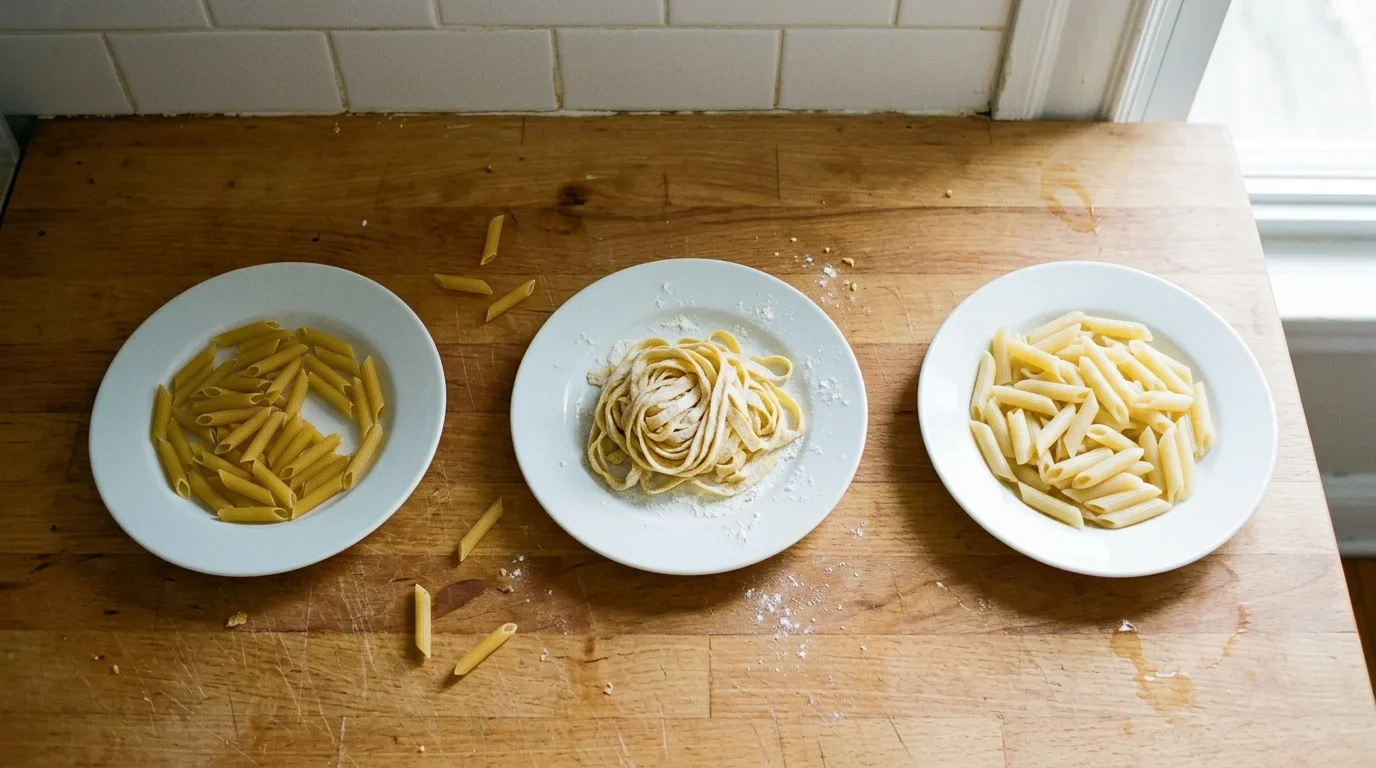
Three forms, three clocks. The dry box is the easy one.
Dry or fresh changes everything. NDSU Extension gives unopened dry spaghetti and macaroni 2 years, and an opened box 1 year. Egg noodles are the exception, however, since it cuts an opened bag to 1 to 2 months. Fresh pasta from the chilled cabinet is a different food again. No source we opened publishes a figure for it, however.
The packet is a pest barrier, and a poor one. Texas A&M AgriLife is blunt about that, because it says even unopened containers may be infested. Waxed paper, plastic and cardboard containers can be penetrated easily by some pests, it adds. So check in the shop that bags or containers are well sealed, which is the same page's advice.
Cooked pasta is on a clock from the moment it leaves the pot. Illinois Extension sets the limit, since it says leftover food should be refrigerated or frozen within two hours of serving. Two hours is not a freshness rule. It is the one line on this page where getting it wrong sends people to hospital.
Where the box sits matters as well. Clemson Cooperative Extension puts pasta in a cool, dry pantry at 65 to 70°F, in tightly sealed or airtight containers. Humidity is the other half of it, though. University of Maryland Extension notes that pantry pests multiply faster in higher humidity. So a dry shelf does two jobs at once, which is what the flour guide asks for too.
How to store pasta so it lasts
To store pasta so it lasts, treat the three forms as three different foods. Dry pasta needs air and damp kept out. Cooked pasta needs cold, and it needs it quickly. Fresh pasta needs the date on the packet, since nobody official has published anything better.
How do you store dry pasta?
Dry pasta keeps best in an airtight container in a cool, dry pantry at 65 to 70°F, according to Clemson Cooperative Extension. Its chart also assumes tightly sealed or airtight containers throughout. The container is a pest measure as much as a freshness one. That is because the same page says one thing plainly. Storing food in tightly sealed glass, metal, or rigid plastic containers may help reduce the chances of insect infestation. NDSU Extension agrees on the method, since it tells you to store opened pasta in an airtight container. So decant the box, or clip it shut and keep it dry. Skip the bag it came in, though. University of Maryland Extension warns that insects can chew through plastic bags and cardboard boxes. It also rates glass jars that pressure seal with rubber gaskets as the best.
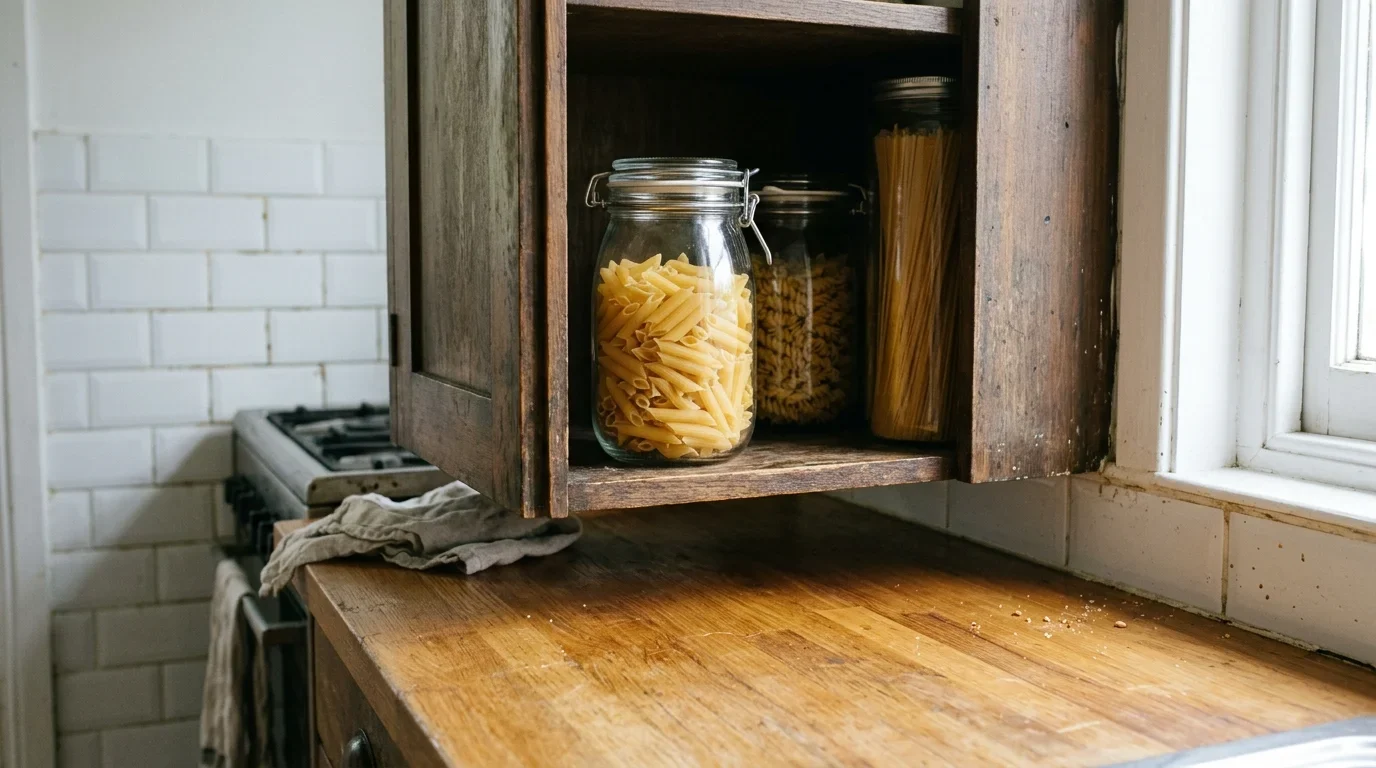
Airtight glass, cool and dry, and away from the stove.
How long does pasta last?
Dry pasta lasts 1 to 2 years in the pantry, while cooked pasta lasts 3 to 4 days in the fridge, according to Clemson Cooperative Extension and Illinois Extension. Clemson Cooperative Extension, for example, gives pasta 1 to 2 years in its pantry chart. Its own food selection factsheet simply says 2 years instead. NDSU Extension then splits the difference by the lid. It gives an unopened box 2 years and an opened one 1 year. Cooked pasta is shorter by a wide margin. Illinois Extension generally gives leftovers 3 to 4 days in the fridge. NDSU also gives a shop-bought macaroni salad the same 3 to 4 days.
There is a much shorter figure out there, though, and it is about pests rather than quality. Texas A&M AgriLife says most pantry pest problems can be prevented one way. Using all dried food within 2 to 4 months of purchase does it. That is a quarter of NDSU's figure for an opened box. So a year-old box is usually fine to eat. A box you turn over every few months, however, is the one that never surprises you.
Does cooked pasta need to be refrigerated?
Cooked pasta does need the fridge, within two hours of serving, according to Illinois Extension. A dry box, however, does not. NDSU Extension, for instance, runs its refrigerator chart at 32 to 40°F. UF/IFAS Extension then puts the line at 41°F or below for cold food. Anything between 41°F and 135°F is what it calls the danger zone for food storage. A dry box has no business in there, however. A fridge is a damp place, and damp is the one thing dry pasta cannot take. So the fridge is for the pot, not the packet.
How long does fresh pasta last?
Fresh pasta has no published shelf life in any university or agency source we opened, so go by the packet date and keep it at 41°F or below. We would rather give you a number here. NDSU Extension, for example, lists only dry pasta and egg noodles. Clemson Cooperative Extension similarly lists pasta in the pantry chart alone. So treat an opened packet as a cooked leftover. That is the nearest published rule: cold, and eaten within a few days. The pages ranking for this question give everything from 24 hours to 7 days. Not one of them names a source.
How do you store cooked pasta?
Cooked pasta has to be in the fridge within two hours, divided into smaller containers, according to Illinois Extension. It also says to cool large quantities faster. Divide them into smaller containers, stir, and add an ice bath. UF/IFAS Extension is stricter again. It asks for 135°F down to 70°F within 2 hours, then 70°F down to 41°F within 4 hours. The whole cooling process should take no more than 6 hours, it adds. A full pot of spaghetti will not manage that in one lump. So split it up, and do not leave the colander on the counter while you eat.
Can you freeze cooked pasta?
Cooked pasta freezes for 3 to 4 months, according to Illinois Extension, while a dry box gains little from the freezer. NDSU Extension gives a casserole only 1 month, however, and a soup or stew 2 to 3 months. That is a three-fold spread for the same tray of baked pasta. So take the shorter figure when there is sauce and cheese in it. The freezer has a second use here as well, because it kills pantry pests.
How do you freeze cooked pasta?
Cooked pasta should be cooled and frozen in portions within the same two-hour window as the fridge, according to Illinois Extension. Its dividing-and-stirring step matters more here, since a deep tub freezes from the outside in. NDSU Extension runs its freezer chart at 0°F. Then reheat it to 165°F. That is the minimum Illinois Extension gives for leftovers. UF/IFAS Extension states it as 165°F for 15 seconds. The rice guide takes the same two steps, for the same reason.
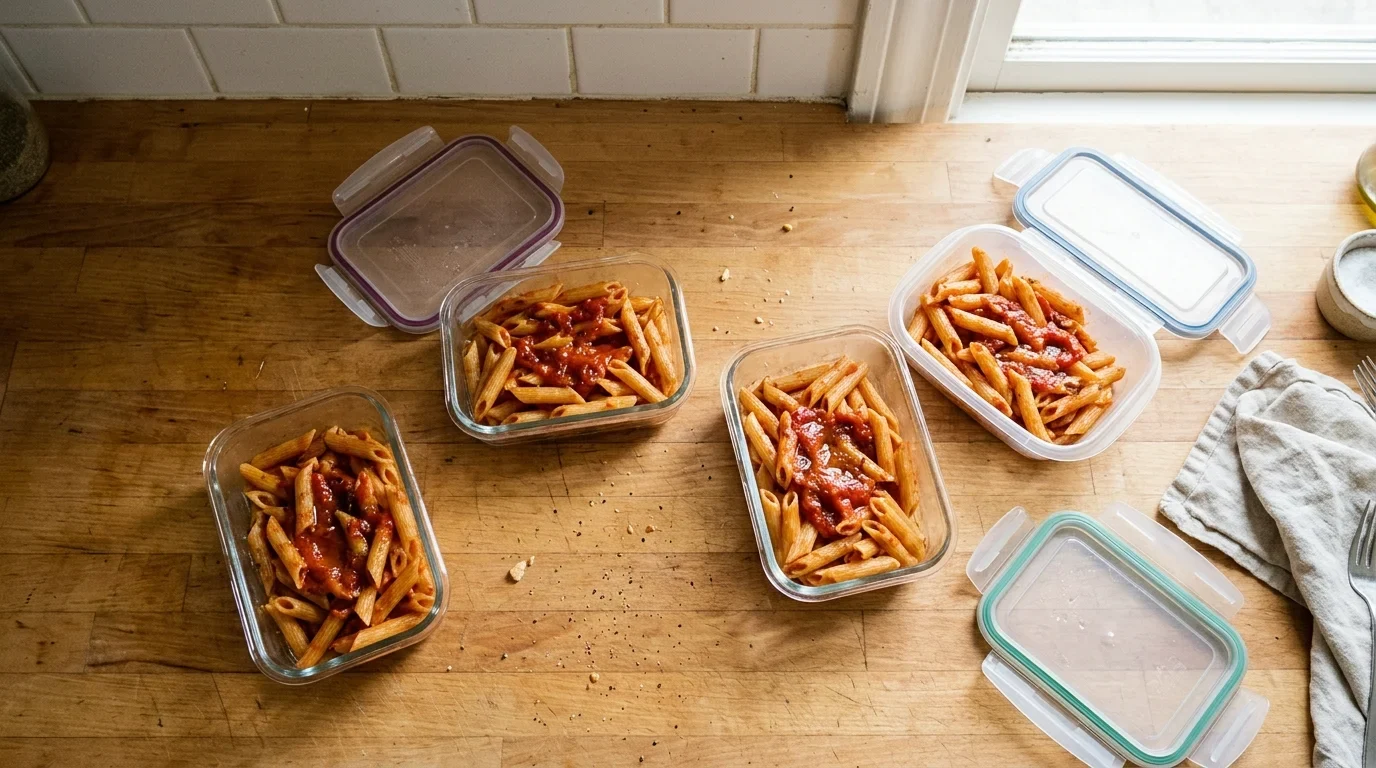
Shallow and portioned, so it cools fast and reheats once.
Does freezing kill bugs in pasta?
Freezing does kill pantry pests in pasta, although the published times run from two to three days to 7 to 14 days. UW-Madison Division of Extension gives the shortest treatment, in fact. Unopened infested packaging can go in a freezer for two to three days. That kills any larvae or eggs. Texas A&M AgriLife asks for 7 to 14 days instead, or an hour in the oven at 130°F. University of Maryland Extension, meanwhile, uses the freezer the other way round. It says many products can be kept in the freezer to prevent infestation. So take the longer figure when you are treating a box you mean to keep. Even so, all three would rather you binned it. Texas A&M says plainly to discard old packages of grain and pasta.
Does frozen pasta get mushy?
Frozen cooked pasta comes out softer, and a sauce hides it, but none of the sources we opened measures how much. So we are not going to put a number on it. The reason is the ordinary one for frozen food, because ice breaks the structure as the water inside freezes. That is why a baked tray freezes better than plain noodles. A thin soup with pasta in it, meanwhile, comes out worst. Dry pasta gains nothing in there apart from pest control. There is almost no water in it to begin with.
How to tell if pasta has gone bad
Pasta splits into two very different questions here. A dry box is nearly always a quality call. Cooked pasta is a safety one, however, and the dangerous version neither smells nor looks wrong. UF/IFAS Extension explains why. The toxin behind the vomiting form of Bacillus cereus is already in the food before you reheat it. Here is what each stage means, then.
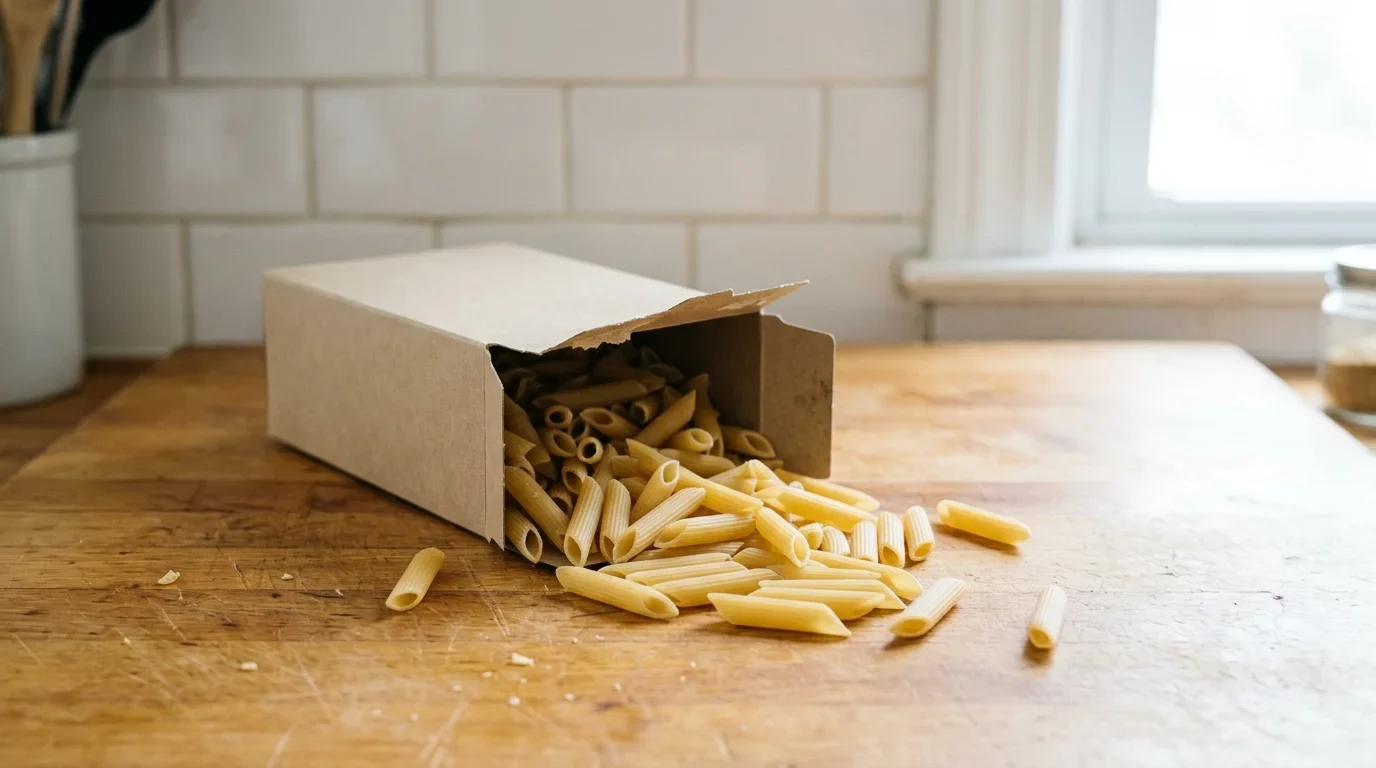
Verdict: use it
Fresh dry pasta
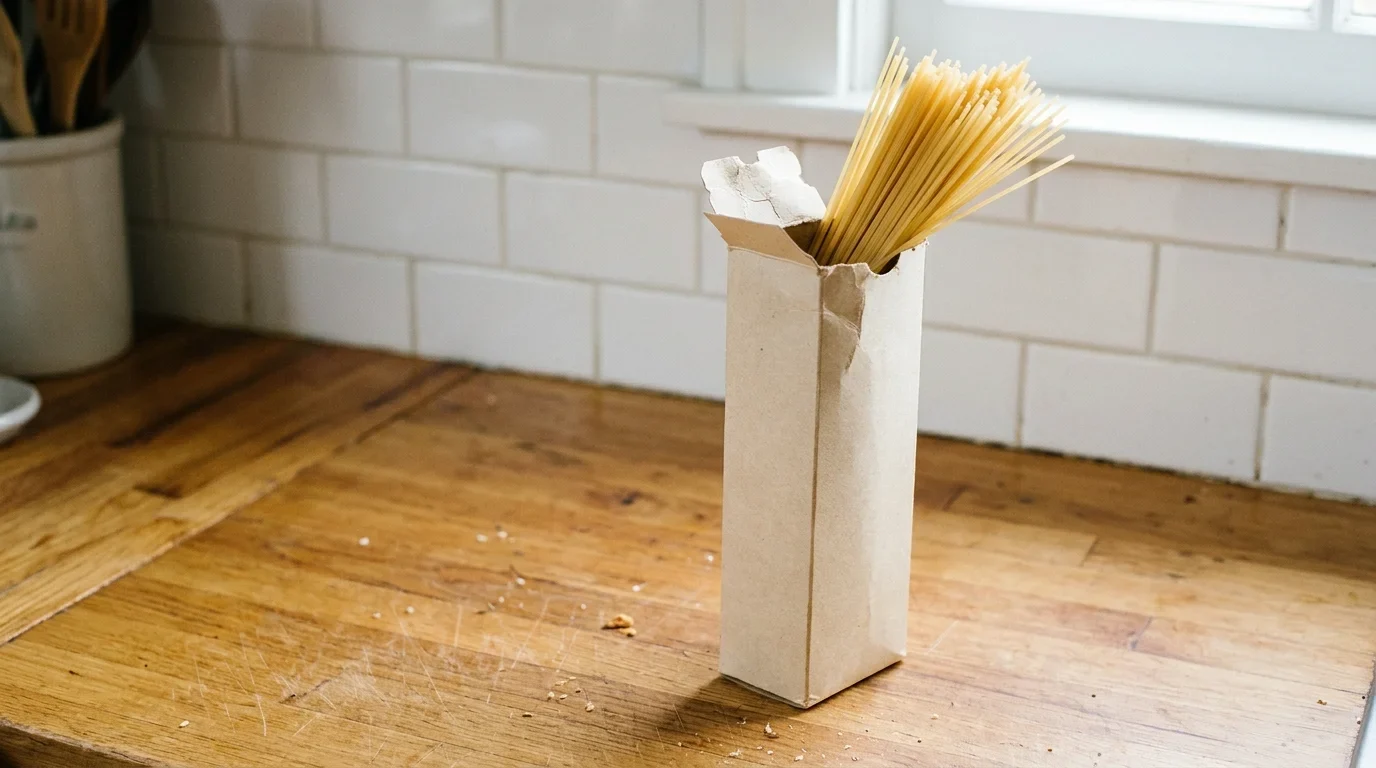
Hard, clean-smelling and loose in the box. This is the straightforward case, because NDSU Extension gives an unopened box 2 years and an opened one 1 year. So cook it as written, and tip whatever is left into something airtight.
Verdict: still fine
Dry pasta past the date on the box
A date has gone by and nothing else has changed. The charts disagree about dry pasta anyway. Clemson Cooperative Extension gives 1 to 2 years, while its own food selection factsheet gives 2 years. Neither one calls a late box unsafe, however. So smell it, look for webbing, and then cook it. NDSU Extension keeps the last word regardless. Its rule is: when in doubt, throw it out.
Verdict: reheat it properly
Cooked pasta kept cold
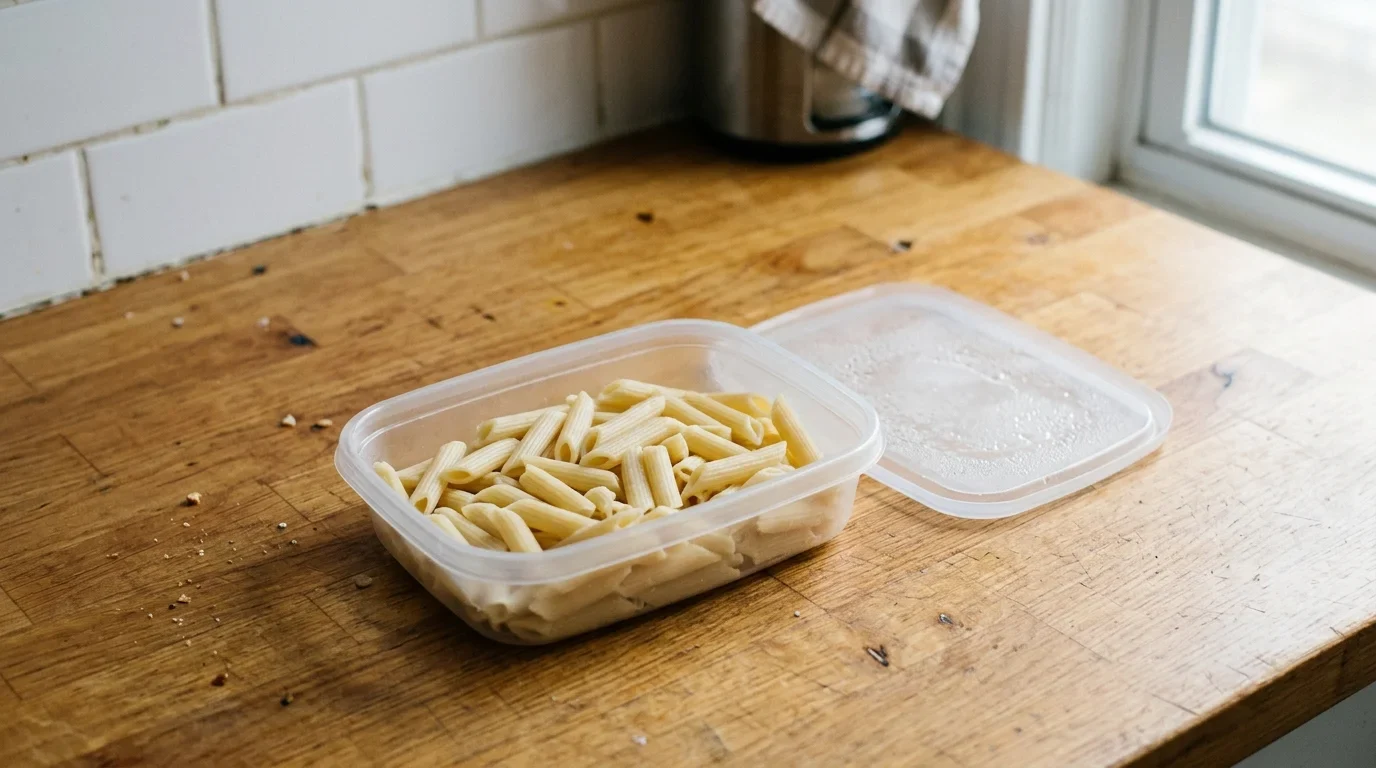
Three or four days old, held at 40°F or below, and smelling of very little. Illinois Extension gives leftovers 3 to 4 days. It also asks for a minimum of 165°F on the way back out. UF/IFAS Extension matches that at 165°F for 15 seconds. So heat it right through rather than warming it. A lukewarm bowl otherwise sits inside the 41°F to 135°F danger zone that the same page names.
Verdict: throw it out
Slimy or sour cooked pasta
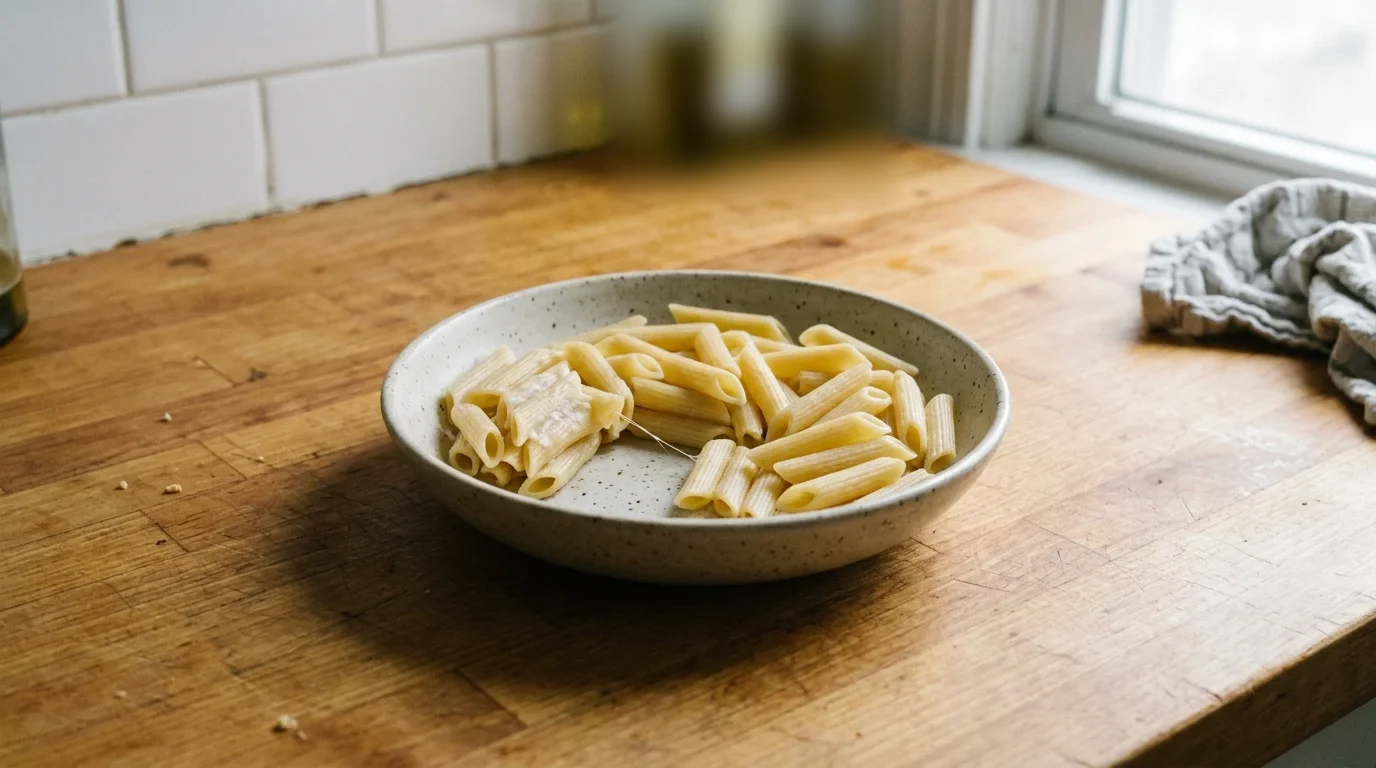
A slick film, a sour smell, or a bowl that sat out all night. The smell is the easy case, and the bowl with no smell at all is the dangerous one. UF/IFAS Extension reports a 2003 Belgian outbreak traced to a pasta salad held at 57°F. A seven-year-old child died about 13 hours later. Its instruction leaves no room. Contaminated food should never be knowingly served, even if properly reheated, it says. So bin it. The vomiting toxin survives heating to around 250°F, and reheating will not rescue the bowl.
Verdict: throw the box out
Pasta with webbing, holes or beetles
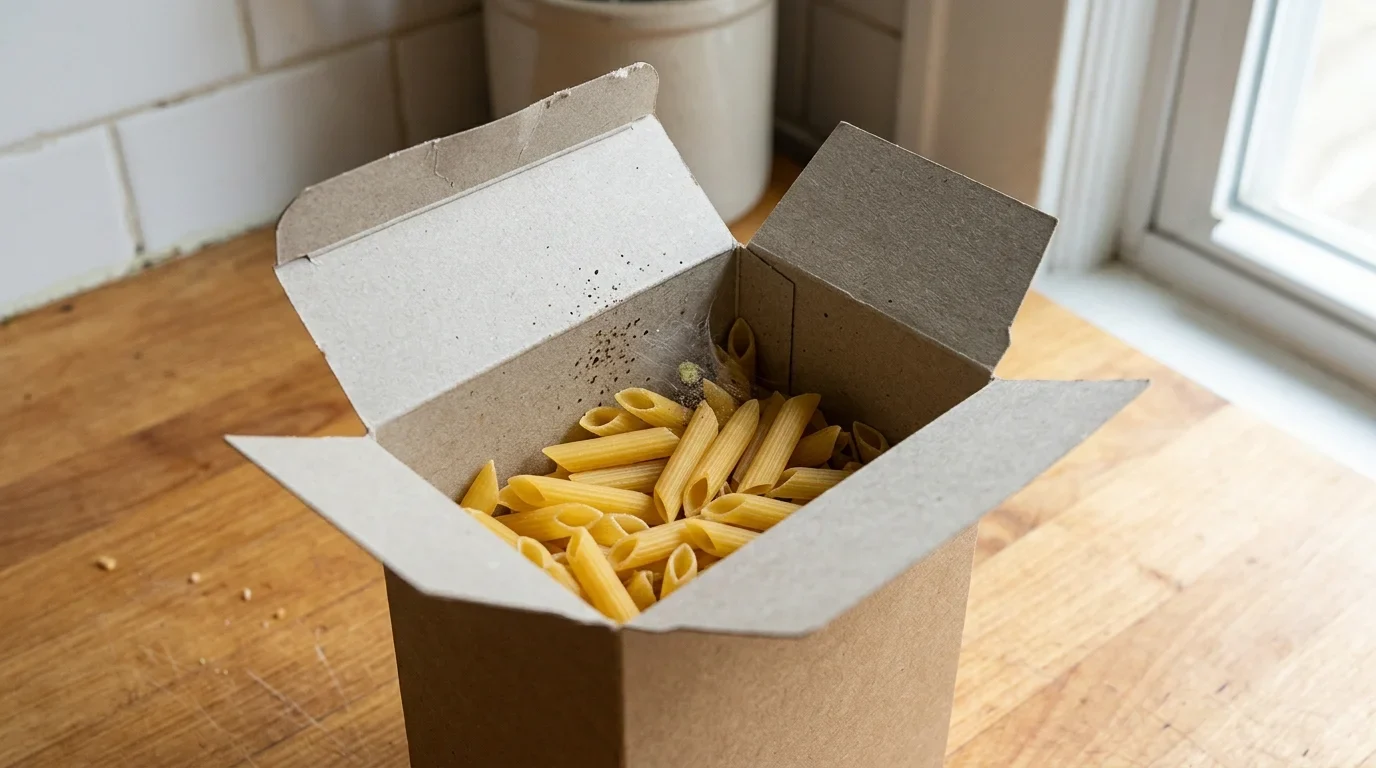
Fine threads across the pasta, small holes in the packet, or something moving. University of Maryland Extension names the signs. They are webbing, a large number of caterpillars or worm-like larva, plus sawdust-like droppings called frass. UW-Madison Division of Extension adds that extensive webbing can spoil more food than the larvae can consume. Texas A&M AgriLife names a beetle too. Rice weevils and granary weevils are pests of processed grain foods such as macaroni, it says. Maryland says infested foods should be thrown away and the shelves cleaned thoroughly. So check the neighbours as well, since flour and rice draw the same insects.
Is pasta left out overnight safe to eat?
Cooked pasta left out overnight is not safe to eat, because Illinois Extension allows only two hours from serving. A night on the counter is many hours past that. UF/IFAS Extension explains what happens in between. Bacillus cereus spores survive boiling, and then they grow as the pasta cools. Its figures are specific. The bacteria grow between 39°F and 118°F, and especially fast between 82°F and 95°F. The vomiting toxin forms at around 77°F to 86°F. A kitchen overnight still sits squarely inside that range. So throw it out, then read the food left out overnight hub for the rest of the fridge.
Pasta substitutes
Out of pasta, or did the box turn out to have company in it? Then one of these covers dinner.
Substitute
Works best in
What changes
Rice
Anything with a sauce
NDSU gives it 1 to 2 years, and cooked it runs the same clock.
Egg noodles
Soups and bakes
Quicker to cook, although NDSU gives an opened bag only 1 to 2 months.
Couscous
Salads and stews
Ready in minutes, so it suits a weeknight.
Gnocchi
Butter and sage, or a bake
Sold chilled or shelf-stable, so check which one you bought.
Mistakes people make when they store pasta
These are the ways people store pasta that cost them the most. Every one of them has a quick fix, though.
Leaving the pot on the stove to cool. Illinois Extension gives you two hours from serving, so get it into the fridge inside that window.
Cooling a big batch in one deep tub. The same page says to divide it into smaller containers and stir. A deep tub otherwise cools from the outside in.
Trusting your nose on cooked pasta. UF/IFAS says the vomiting toxin survives heating to around 250°F. So a bowl that smells fine can still be a bad idea.
Keeping the opened box in its own plastic bag. University of Maryland Extension says insects chew through plastic bags and cardboard, so decant it into glass or rigid plastic.
Putting dry pasta in the fridge. Clemson asks for a cool, dry pantry instead, and damp is what a dry box cannot survive.
Treating chilled fresh pasta like a dry box. Nobody publishes a shelf life for it, so follow the packet date and keep it at 41°F or below.
Putting an infested box back on the shelf. Texas A&M says to discard old packages of grain and pasta, then clean the shelf it sat on.
Sources
Food Storage Guide, Julie Garden-Robinson, NDSU Extension publication FN579, on unopened dry pasta at 2 years and opened at 1 year, egg noodles at 1 to 2 months once opened, airtight containers after opening, soups and stews at 3 to 4 days, casseroles at 3 to 4 days and 1 month frozen, macaroni salads at 3 to 4 days, a refrigerator at 32 to 40°F and a freezer at 0°F, corn syrup up to 3 years, and the rule that when in doubt you throw it out.
Food Storage: Pantry, Clemson Cooperative Extension Home and Garden Information Center, on pasta at 1 to 2 years, a cool dry pantry at 65 to 70°F, tightly sealed or airtight containers, and tightly sealed glass, metal or rigid plastic reducing the chances of insect infestation.
Leftovers, Illinois Extension, University of Illinois, on refrigerating or freezing leftovers within two hours of serving, 3 to 4 days in the refrigerator, 3 to 4 months in the freezer, reheating to a minimum of 165°F, and cooling large quantities by dividing them into smaller containers, stirring and using an ice bath.
Food Selection and Storage, Clemson Cooperative Extension Home and Garden Information Center, on pasta at 2 years in a cool dry pantry at 65 to 70°F, which is the longer of Clemson's two published figures.
Preventing Foodborne Illness: Bacillus cereus, Karuna Kharel, Kaitlyn Koviack, Rachael Silverberg, Bruna Bertoldi and Keith R. Schneider, UF/IFAS Extension publication FSHN15-06/FS269, on heat-resistant endospores surviving cooking, the emetic toxin forming at 77 to 86°F and surviving heating to about 250°F, growth from 39 to 118°F and fastest at 82 to 95°F, the 41 to 135°F danger zone, cooling from 135°F to 70°F within 2 hours and then to 41°F within 4 hours, reheating to 165°F for 15 seconds, the 2003 Belgian pasta salad outbreak in which a seven-year-old died, and never knowingly serving contaminated food even after reheating.
Indian Meal Moth, University of Maryland Extension, on pasta among the dry packaged foods to check, webbing and larvae and frass as the signs, throwing infested foods away and cleaning the shelves, insects chewing through plastic bags and cardboard, pressure-sealing glass jars being best, pests multiplying faster in higher humidity, and the freezer preventing infestation.
Indian Meal Moth, Phil Pellitteri, UW Insect Diagnostic Lab, University of Wisconsin-Madison Division of Extension, item XHT1047, revised April 2004, on the moths arriving from the shop in dried plant products such as rice, flour and noodles, holes and webbing in packaging, extensive webbing spoiling more food than the larvae eat, and freezing unopened infested packaging for two to three days.
Pantry and Fabric Pests in the Home, Michael Merchant and Grady J. Glenn, Texas A&M AgriLife Extension publication L-2046, on rice and granary weevils attacking processed grain foods such as macaroni, unopened containers being infested through waxed paper, plastic and cardboard, checking that packages are well sealed in the shop, discarding old packages of grain and pasta, using all dried food within 2 to 4 months of purchase, and treating food at 130°F for an hour or in the freezer for 7 to 14 days.
Storage times and safety advice on this page come from the sources above. Food safety depends on conditions I cannot see, so read the Disclaimer, and if in doubt, throw it out.
Other ingredient guides
Browse all guides


Share this guide
Never miss a guide
New ingredient guides when they go up, plus one storage tip worth knowing. Anything sponsored is labelled.

Emilly White