

2 hours at most
Cooked, at room temperature; 1 hour above 90°F (USDA FSIS)
3 to 4 days
Covered, at 40°F or below (USDA FSIS)
2 to 4 months
Plain pieces at 0°F, for quality; safe indefinitely (USDA FSIS, NDSU)
The short version: get cooked chicken into the fridge within 2 hours, in shallow covered containers. Then eat it within 3 to 4 days, the time the USDA gives leftover cooked chicken. For longer, freeze it and aim to use it within a few months. Finally, reheat it to 165°F.
Storage times here come from the USDA Food Safety and Inspection Service pages Chicken from Farm to Table and Leftovers and Food Safety. The freezer figures are also checked against the NDSU Extension food storage guide.
On this page
How do you cool cooked chicken quickly?
Cut cooked chicken into smaller pieces and spread it in shallow containers, as the USDA advises. The FSIS leftovers page says cooling fast is what stops bacteria growing. So take the meat off the bone, slice the breast, and leave the legs and wings whole. Hot food can also go straight into the fridge, since FSIS says it can be placed there directly.

Shallow, sliced and into the fridge within 2 hours.
Shallow, sliced and into the fridge within 2 hours.
Shallow containers rather than one deep tub. USDA FSIS divides large amounts into shallow containers so they reach 40°F faster.
Smaller pieces rather than a whole bird. FSIS cuts large items into smaller portions to cool, and it slices breast meat while leaving legs and wings whole.
Meat and broth cooled apart. The NDSU Extension food storage guide cools meat and broth separately for quicker cooling.
An ice bath when there is a lot of it. FSIS says hot food can be rapidly chilled in an ice or cold water bath before it goes into the fridge.
How to store cooked chicken so it lasts
To store cooked chicken so it lasts, cool it fast, cover it well and keep it at 40°F or below. Speed matters most at the start, because bacteria grow rapidly between 40 and 140°F.
How do you store cooked chicken in the fridge?
Cooked chicken goes in the fridge in airtight packaging or sealed containers, at 40°F or below, according to USDA FSIS. Covering it keeps bacteria out, and it also holds in moisture. In addition, it stops the chicken picking up odors from other food. FSIS then refrigerates or freezes the wrapped leftovers straight away for rapid cooling. So check that the fridge itself is at 40°F, since FSIS says a refrigerator should be set to hold that or below.
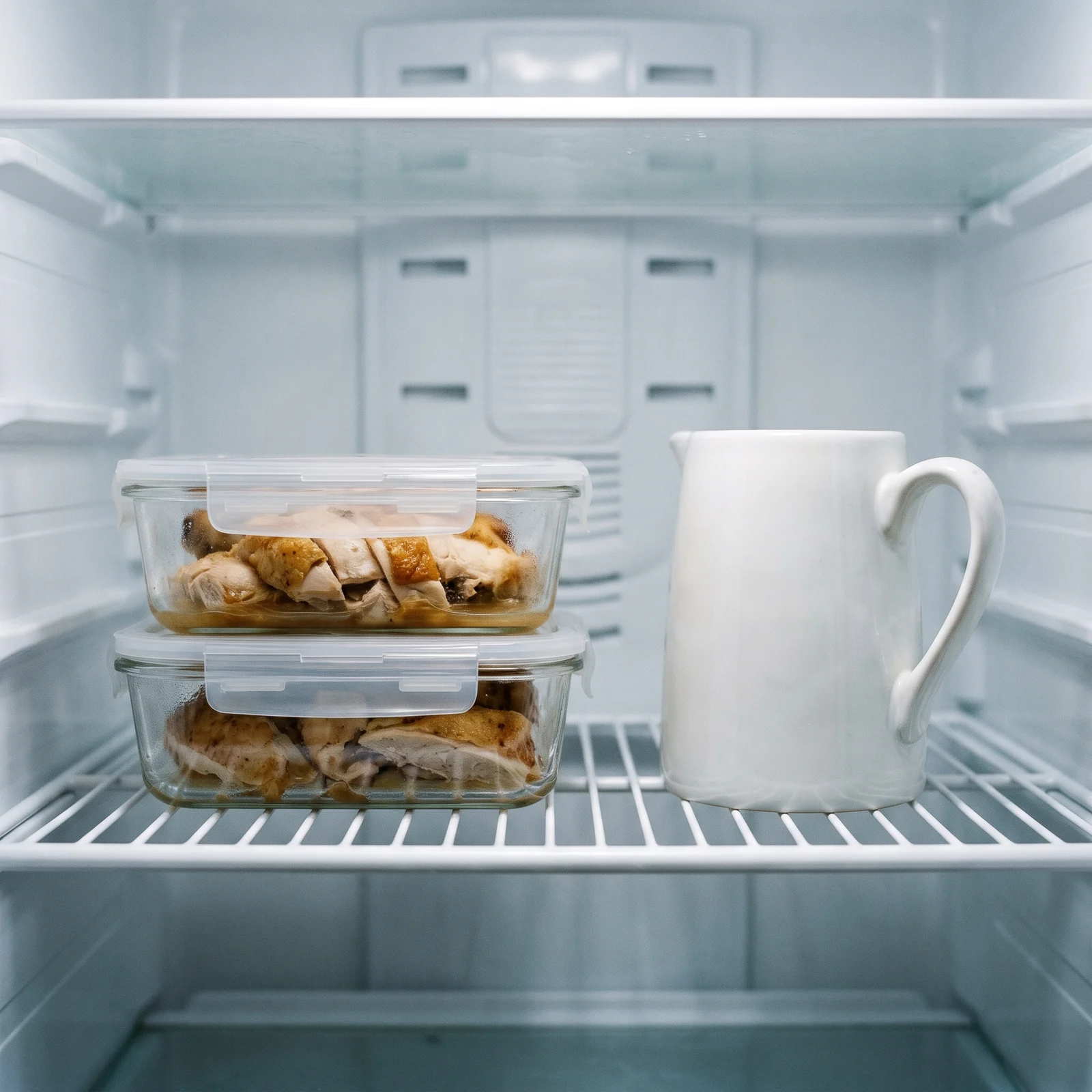
Sliced, shallow and sealed, at 40°F or below.
Sliced, shallow and sealed, at 40°F or below.
How long does cooked chicken last in the fridge?
Cooked chicken lasts 3 to 4 days in the fridge, according to USDA FSIS. Its chicken storage chart gives the same 3 to 4 days to leftovers, fried chicken, casseroles and rotisserie chicken from the shop. The NDSU Extension food storage guide also gives every kind of cooked poultry 3 to 4 days. Chicken salad is the exception, since FSIS gives it 3 to 5 days. So count from the day it was cooked, rather than the day you put it away.
So day four is the last day. The same window applies to leftover turkey and to almost every cooked meat.
How long can cooked chicken sit out?
Cooked chicken can sit out for 2 hours at most, or 1 hour above 90°F, according to USDA FSIS. Its leftovers page throws away perishable food left at room temperature longer than that. The reason is that bacteria grow rapidly between 40 and 140°F. Hot chicken, however, can be held safely at 140°F or warmer, for example in a slow cooker. The guide to food left out overnight covers what to do when the evening got away from you.
How do you reheat cooked chicken?
Reheat cooked chicken to 165°F, checked with a food thermometer, according to USDA FSIS. Cover it while it heats, because that holds in moisture and helps it heat right through. In a microwave, FSIS also covers and rotates the food, then checks the temperature in several places. Microwaves leave cold spots, so let it rest before you take that reading.
Can you eat cooked chicken cold?
Yes, as long as it has stayed in the fridge and is within its 3 to 4 days. The 165°F rule in the FSIS leftovers page is for reheating, not a requirement to heat chicken at all. What matters is the time it spent out of the fridge and the days since it was cooked. Cold chicken past day four is no safer than hot chicken past day four, however.
Can you freeze cooked chicken?
Yes, cooked chicken freezes well, and USDA FSIS says frozen food stays safe indefinitely. The freezer times are for quality only, so they tell you when it starts to dry out rather than when it turns unsafe. USDA FSIS gives plain leftover cooked chicken 4 months. However, the NDSU Extension food storage guide gives plain pieces only 2 to 3 months. So aim for the shorter figure.
How do you freeze cooked chicken?
Cool the chicken first, then wrap it airtight in portions you will use in one go. FSIS says freezer burn comes from air touching the surface, so press out as much air as you can. Store packaging also lets air through, which is why FSIS overwraps any package meant for long storage. Then label each bag with the date, so the oldest gets used first. FSIS also says a pack that tears in the freezer is still safe, as long as you rewrap it.

Airtight, portioned and dated.
Airtight, portioned and dated.
Can you freeze cooked chicken in broth or gravy?
Yes, but the two sources give very different times. USDA FSIS gives cooked chicken pieces covered with broth or gravy 6 months. On the other hand, the NDSU Extension guide gives the same thing only 1 to 2 months. So use it within 2 months to be safe on quality. The gravy guide covers freezing the sauce on its own.
How do you thaw frozen cooked chicken?
Thaw cooked chicken in the fridge, in cold water or in the microwave, according to USDA FSIS. The fridge takes longest but keeps the chicken safe the whole time. Afterwards, FSIS gives thawed leftovers another 3 to 4 days. Microwave-thawed chicken, however, should go straight on to 165°F. FSIS also says frozen leftovers can be reheated without thawing at all, which simply takes longer.
How to tell if cooked chicken has gone bad
Knowing how to store cooked chicken matters more than any sniff test. USDA FSIS says the bacteria that cause food poisoning do not generally change the taste, smell or appearance of food. The bacteria that do change it are mostly spoilage bacteria. So a smell or slime means throw it out, but a clean look never proves it is safe. Here is what each stage means.

Verdict: eat it
Moist, fresh cooked chicken
Cooked within the last 3 to 4 days, refrigerated within 2 hours, and kept covered at 40°F or below. That is the window USDA FSIS gives leftover cooked chicken, so this chicken is fine cold or reheated to 165°F.

Verdict: trim it and eat it
Freezer-burned cooked chicken
Dry, grayish-brown leathery patches on chicken from the freezer. USDA FSIS says freezer burn does not make food unsafe, merely dry in spots. So cut those patches away before or after cooking. FSIS adds that heavily burned food may have to go, for quality rather than safety.

Verdict: throw it out
Cooked chicken left out over 2 hours
It looks and smells perfectly normal, but it sat on the counter past the limit. USDA FSIS throws out perishable food left at room temperature for more than 2 hours, or 1 hour above 90°F. It also says food left out too long may be dangerous but could look fine. So this chicken goes, however good it looks.

Verdict: throw it out
Sour-smelling cooked chicken
A sour or off smell, or a sticky, tacky surface. USDA FSIS says spoilage bacteria cause unpleasant odors, tastes and textures, and they grow even in the fridge. So once cooked chicken smells off, it has been kept too long, and it goes in the bin.

Verdict: throw it out
Moldy cooked chicken
A fuzzy spot of any color, however small. USDA FSIS says to discard cooked leftover meat and poultry with mold. Moist food can be contaminated below the surface, and bacteria may grow along with the mold. So do not cut the spot away, and throw out the whole container.
Is cooked chicken safe after 5 days?
No, USDA FSIS gives leftover cooked chicken 3 to 4 days in the fridge, not 5. It may look and smell fine on day five, since FSIS says the bacteria that cause illness do not change food that way. Listeria is the particular worry, because FSIS says it can multiply in the fridge over time. So throw it out after day four, or freeze it before then. The food after a power outage guide covers chicken that warmed up in a dead fridge.
Cooked chicken substitutes
Out of cooked chicken, or did yours pass its four days? Then one of these will fill the same spot.
Substitute
Works best in
What changes
Canned chicken
Chicken salad and casseroles
Ready cooked, so check the date on the can.
Mistakes people make when they store cooked chicken
These are the ways people store cooked chicken that put them at most risk, so each one has an easy fix.
Letting it cool on the counter first. USDA FSIS says hot food can go straight into the fridge, within 2 hours of cooking.
Storing a whole bird in one deep container. FSIS cuts large items into smaller portions and uses shallow containers so they cool fast.
Trusting the sniff test. FSIS says the bacteria that cause illness do not generally change how food smells.
Counting from the day you put it away. Count the 3 to 4 days from the day the chicken was cooked.
Freezing it in the shop's packaging. FSIS says that wrap lets air through, so overwrap it for long storage.
Cutting the mold off. FSIS says to discard cooked leftover meat and poultry with mold, since it can reach below the surface.
Reheating it only until warm. FSIS reheats leftovers to 165°F, checked with a food thermometer in several places.
Sources
Chicken from Farm to Table, USDA Food Safety and Inspection Service, last updated September 30, 2024, on cooked chicken keeping 3 to 4 days in the fridge, 4 months frozen, 6 months in broth or gravy, and freezer times being for quality only.
Leftovers and Food Safety, USDA Food Safety and Inspection Service, last updated July 31, 2020, on the 2-hour rule, shallow containers, airtight wrapping, 3 to 4 days in the fridge, thawing, and reheating to 165°F.
Refrigeration and Food Safety, USDA Food Safety and Inspection Service, last updated March 23, 2015, on pathogens not changing the taste, smell or look of food, spoilage bacteria causing off odors, and Listeria growing in the cold.
Freezing and Food Safety, USDA Food Safety and Inspection Service, last updated August 9, 2024, on freezer burn being safe but dry, and overwrapping store packaging for long storage.
Molds on Food: Are They Dangerous?, USDA Food Safety and Inspection Service, last updated August 22, 2013, on discarding cooked leftover meat and poultry with mold.
Food Storage Guide FN579, Julie Garden-Robinson, NDSU Extension, reviewed January 2023, on cooked poultry keeping 3 to 4 days, plain pieces 2 to 3 months frozen, pieces in broth 1 to 2 months, and cooling meat and broth separately.
Storage times and safety advice on this page come from the sources above. Food safety depends on conditions I cannot see, so read the Disclaimer, and if in doubt, throw it out.
Other ingredient guides
Browse all guides





Share this guide
Never miss a guide
New ingredient guides when they go up, plus one storage tip worth knowing. Anything sponsored is labelled.

Emilly White