
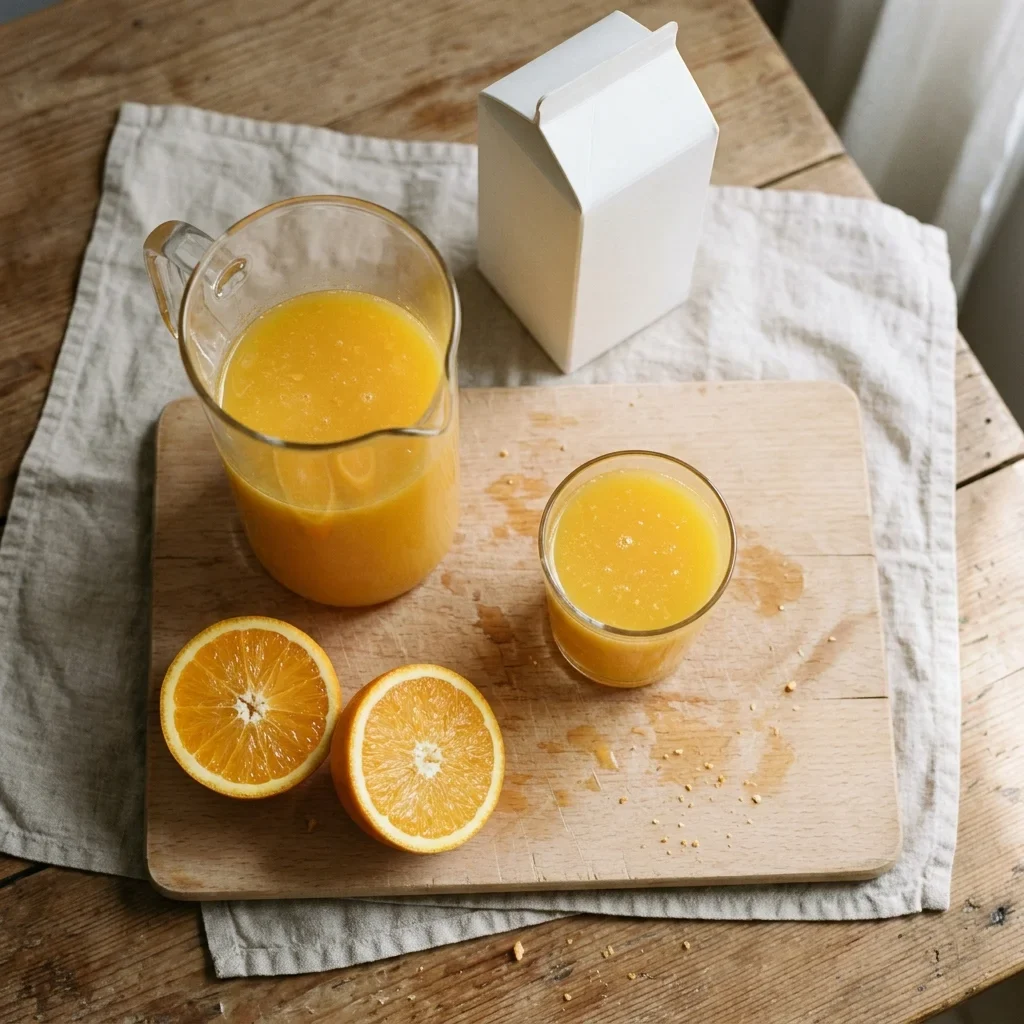
6 to 12 months
Unopened shelf-stable carton or can, 50 to 70°F (GCCF, Clemson)
Up to 5 days
Fresh-squeezed or opened, 40°F or below (Washington State, Clemson)
About 1 year
Concentrate or home-frozen juice at 0°F, quality only (GCCF, Colorado State)
The short version: to store orange juice well, keep unopened shelf-stable cartons in a cool cupboard, refrigerate everything else at 40°F or below, drink fresh-squeezed juice within about five days, and freeze the rest at 0°F.
Storage times here come from the GCCF Commodity Storage and Handling Manual, Clemson Cooperative Extension and Washington State University Extension, while the safety rules come from the FDA, UC Agriculture and Natural Resources and the University of Hawaii.
On this page
Which orange juice are you storing?
Orange juice sells in four forms, and the GCCF Commodity Storage and Handling Manual gives each one a different shelf life. So the label matters more than the jug does. Check these four things before you put it away.

Four cartons, four clocks, because processing decides the shelf life.
Fresh-squeezed and unpasteurized juice is perishable. The FDA requires untreated juice to carry a warning that it has not been pasteurized, and it says those untreated products should be kept under refrigeration. Untreated juice usually sits in the refrigerated case, so that is where it goes at home too.
Chilled cartons are pasteurized, whether or not they say so. NDSU Extension notes that sometimes pasteurized juices are sold at refrigerator temperature, while the University of Hawaii puts the pasteurized share of juice sold in the United States at about 98 percent.
Shelf-stable cartons and cans are a pantry item until you open them. The GCCF Commodity Storage and Handling Manual gives aseptically packaged juice a shelf life of 6 to 12 months, although it adds that flavor and vitamin C fade faster the warmer the storage is.
Frozen concentrate is pasteurized as well. NDSU Extension counts frozen concentrates among pasteurized juice, so the freezer aisle is not the risky one. Even so, the GCCF manual wants concentrate held at 0°F, since quality slides at 5°F.
How to store orange juice so it lasts
To store orange juice so it lasts, keep it cold and keep it closed. Cold slows the bacteria that acidity does not stop, while a sealed container slows the flavor loss that comes next.
How long does orange juice last in the fridge?
Fresh-squeezed orange juice keeps up to five days in the fridge, Washington State University Extension's figure for home-pressed juice. Treat five days as the outer edge, though. UC Agriculture and Natural Resources gives cut oranges and the products made from them about 1 to 2 days refrigerated. Commercial numbers run longer, but they are not yours. The GCCF Commodity Storage and Handling Manual allows fresh-squeezed juice 2 to 3 weeks at 34 to 40°F. Even so, that figure assumes strict sanitary conditions and rapid distribution. An opened carton is perishable as well, since Clemson Cooperative Extension says so and asks for 40°F or below. So keep the jug on a cold shelf, never in the door.
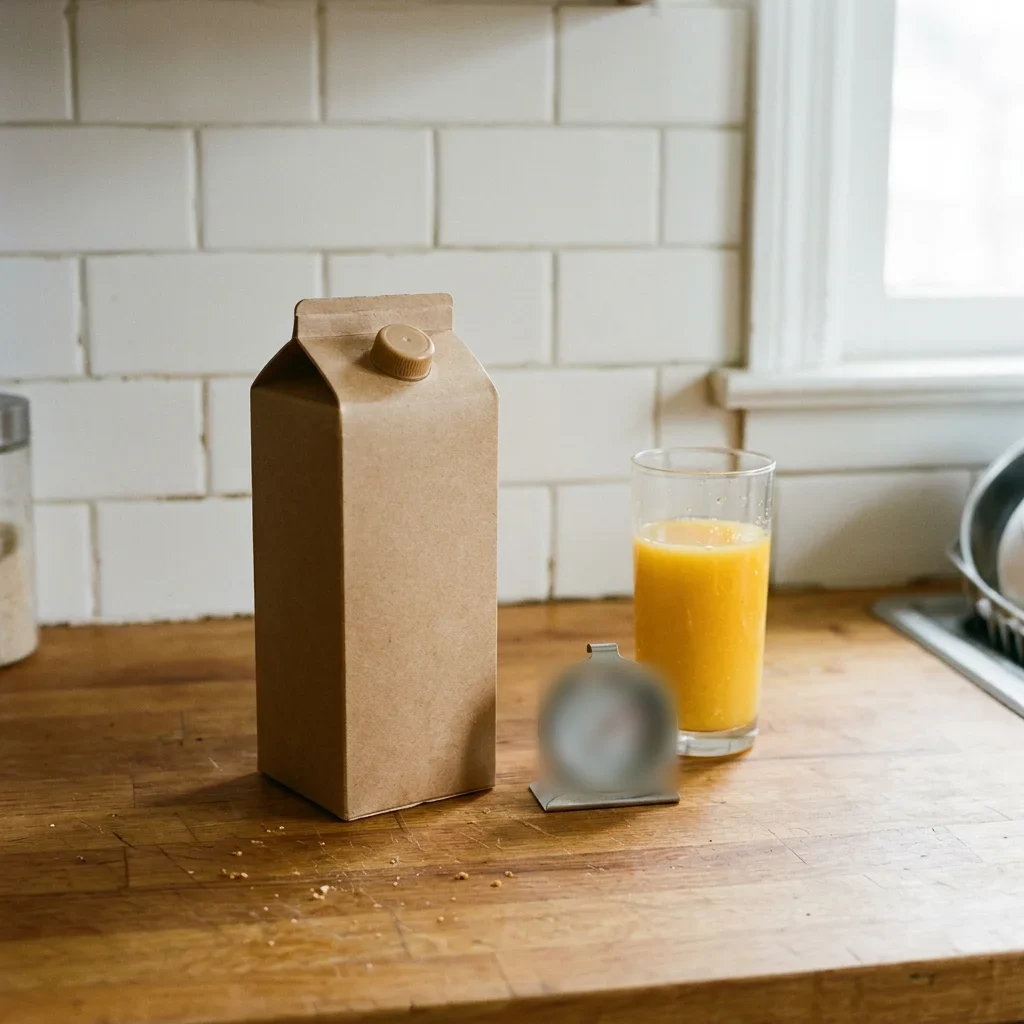
On a cold shelf at 40°F or below, because the door is the warmest spot.
How long does an unopened carton of orange juice last?
An unopened shelf-stable carton of orange juice keeps 6 to 12 months, says the GCCF Commodity Storage and Handling Manual. Clemson Cooperative Extension is close behind, because it gives commercially canned high-acid foods, juices among them, 12 to 18 months. Both figures assume a cool cupboard, since Clemson wants 50 to 70°F. The same factsheet warns that storage time decreases significantly above 75°F. A chilled carton from the refrigerated case is a different thing. In fact the GCCF manual gives chilled single-strength juice about 2 months at 40°F, unopened.
So the date on a carton is a quality marker rather than a safety deadline. Clemson names what actually disqualifies a container: a bulging lid, a leaking can, spurting liquid, an off odor or mold. Check those first, then the date.
Does orange juice have to be refrigerated after opening?
Yes, refrigerate orange juice once the seal is broken, because Clemson Cooperative Extension treats opened commercial product as perishable. Acidity does not stand in for cold, although plenty of people assume it does. In fact, UC Agriculture and Natural Resources says that bacteria can survive for long periods of time in orange juice and other fruit juices. The University of Hawaii goes further, since it reports laboratory studies showing salmonella surviving in orange juice for more than three weeks. So the cold shelf is doing real work.
How long can orange juice sit out?
Orange juice should not sit out longer than two hours, according to UF/IFAS Extension. Above 90°F, however, the limit drops to one hour. UC Agriculture and Natural Resources applies those same two limits to cut oranges and the products made from them. So a jug on the breakfast table is covered by the rule. Bacteria grow fastest between 40°F and 140°F, which is why the clock is so short. If a carton stood out all night, then the food left out overnight guide covers that case.
Is it safe to drink unpasteurized orange juice?
Unpasteurized orange juice is safe for most healthy adults, although the FDA warns four groups off it. Those are children, older adults, pregnant people and anyone with a weakened immune system. In fact, the risk is not theoretical. For example, the University of Hawaii records a 1999 and 2000 outbreak that sickened hundreds and killed one person. Colorado State University counts three unpasteurized orange juice outbreaks and 251 illnesses between 2000 and 2020. So if someone in the house is at high risk, skip it or boil it for three minutes. That is the University of Hawaii's advice. The apple cider guide covers the same question for cider.
Can you freeze orange juice?
Yes, but choose the oranges first. UC Agriculture and Natural Resources warns that a bitter compound called limonin develops in oranges when they are frozen. Levels are highest in Navel oranges, so the publication calls them a poor choice for freezing whole or as juice. Other varieties carry less of it, so they freeze better. Freezing does not make juice safe, either. The University of Hawaii is explicit, since it says freezing untreated juice will not destroy all harmful bacteria.
How do you freeze orange juice?
Freeze orange juice in clean glass jars with a 1 1/2-inch headspace, as UC Agriculture and Natural Resources directs. Squeeze it first with a juicer that does not press oil from the rind, because the National Center for Home Food Preservation asks for that. Then pour the juice straight into the containers and seal them. Headspace matters, since liquid expands as it freezes. Sweetening is optional: the Center offers 2 tablespoons of sugar per quart of juice, or none at all. Glass matters more, because the Center packs juice in glass jars to avoid development of off-flavors. Colorado State University Extension also adds 3/4 teaspoon of ascorbic acid per gallon to prevent darkening. Then freeze to 0°F or below. The lemon juice guide covers the same job in ice cube trays.
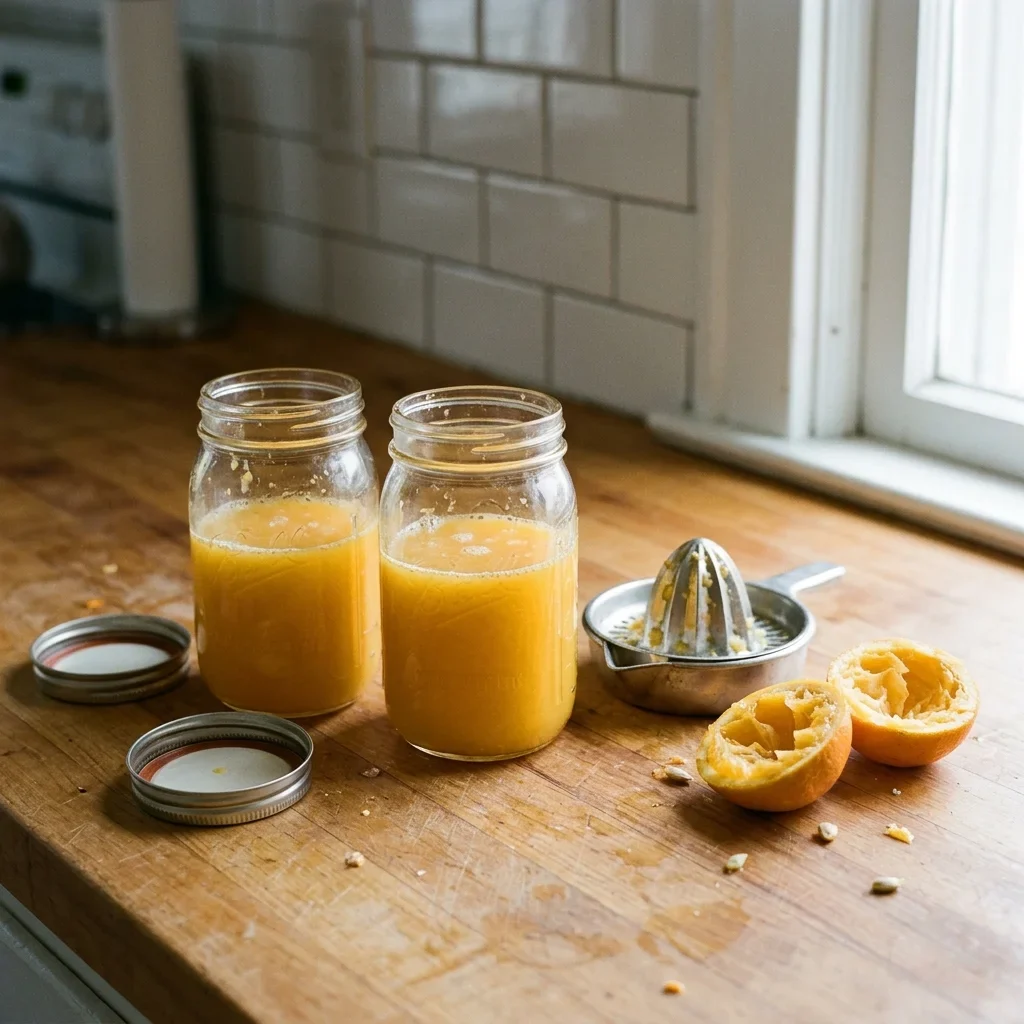
Glass jars and 1 1/2 inches of headspace, because juice expands as it freezes.
How long does frozen orange juice keep?
Frozen orange juice concentrate keeps about a year at 0°F, according to the GCCF Commodity Storage and Handling Manual. It says quality and nutritive loss is negligible as long as the juice stays that cold. Warmer is worse, though. At 5°F the cloud becomes unstable in about 6 months, while 15°F ruins quality in 20 to 30 days. Home-frozen juice sits in the same range, since Colorado State University Extension gives most fruit 8 to 12 months at 0°F. Either way, a freezer figure is a quality clock rather than a safety one.
Does freezing change orange juice?
Freezing changes orange juice less than it changes most foods, because the GCCF Commodity Storage and Handling Manual calls the quality and nutritive loss negligible at 0°F or below. The Navel problem is the exception, since limonin turns that variety bitter. Color, however, does drift. That is why Colorado State University Extension suggests ascorbic acid. Texture is not an issue, because juice has none to lose. Then treat thawed juice as chilled juice, as the GCCF manual puts it, and drink it within days.
How to tell if orange juice has gone bad
Orange juice warns you in stages, and only the last two mean throw it out. Separation and settled pulp are ordinary, whereas fizz, a sour smell and mold end the carton. One rule covers all five, because UC Agriculture and Natural Resources says bacteria can survive for long periods in orange juice. So do not taste a carton to settle the question.

Verdict: use it
Bright orange juice
Opaque orange, sharp-smelling, with pulp that stirs back in. This is juice well inside its window, so pour it without a second thought.

Verdict: use it
Separated orange juice
A paler layer on top and a denser one below, once the carton has stood still. That is settling rather than spoilage, since the GCCF manual files cloud instability under quality. So shake it, then smell it.
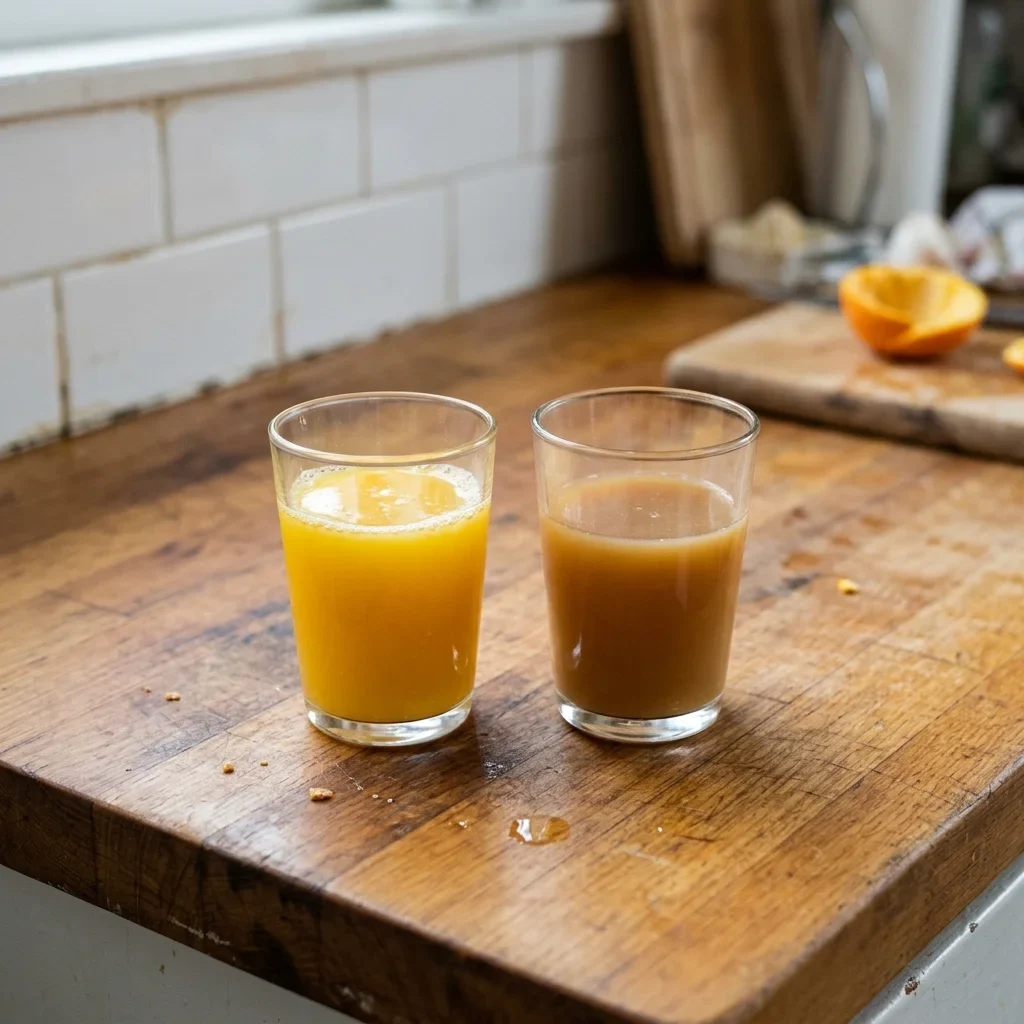
Verdict: cook with it
Dull orange juice
A color closer to brown than orange, and a taste that has lost its edge. In fact, the GCCF manual says flavor and vitamin C fade faster the warmer and longer the juice is stored. Colorado State University Extension offers ascorbic acid against the darkening. Nothing here is unsafe, so cook with it or pour it into a marinade.

Verdict: throw it out
Fizzing orange juice
Bubbles, a hiss on opening, or a carton that has swollen. Something is fermenting the sugars, since Oregon State University Extension says fermented juice becomes an alcoholic beverage. Clemson Cooperative Extension is firmer, because it calls a bulging lid or a leaking can a sign of spoilage. So pour it away rather than tasting it.

Verdict: throw it out
Sour-smelling or moldy orange juice
A sour, yeasty or alcoholic smell, or fuzz on the surface, around the cap or inside the spout. The smell usually comes first, because fermenting juice turns alcoholic, as Oregon State University Extension describes. Mold is the rarer sign, and N.C. Cooperative Extension puts juice with mold on the pitch list, because the mycotoxin can spread in liquids. So empty the carton rather than tasting it, then wash the shelf it stood on.
Can you drink orange juice after the date on the carton?
The date on an orange juice carton marks quality rather than safety. Clemson Cooperative Extension gives commercially canned high-acid foods 12 to 18 months for best quality. It also names what disqualifies a container: a bulging lid, a leak, spurting liquid, an off odor or mold. So check the seal and the smell before you check the date. Even so, nobody we opened publishes a day count for an opened carton in the fridge. That is why this guide does not give one either.
Orange juice substitutes
Out of orange juice, or did the last carton have to go? Then one of these will stand in.
Substitute
Works best in
What changes
Frozen concentrate
Everyday drinking
Pasteurized, and it holds its quality for about a year at 0°F.
Shelf-stable carton
The emergency cupboard
Six to twelve months unopened, so it waits for you.
Lemon juice
Dressings and marinades
Sharper and far less sweet, and the lemon juice guide covers it.
Apple cider
Breakfast and braises
Softer and sweeter, with the same pasteurization question behind it.
Mistakes people make when they store orange juice
These are the ways people store orange juice that cost them the most, and each one has a quick fix.
Freezing Navel oranges for juice. Limonin turns them bitter, so save Navels for eating and freeze another variety.
Leaving the jug on the table through breakfast. UF/IFAS Extension gives perishable food 2 hours at room temperature, so put it back.
Trusting acidity to keep juice safe. Bacteria survive for long periods in orange juice, as UC Agriculture and Natural Resources says, so refrigerate it.
Keeping the carton in the fridge door. The door is the warmest part, while Clemson wants 40°F or below.
Freezing unpasteurized juice to make it safe. The University of Hawaii says freezing will not destroy all harmful bacteria.
Filling a jar to the brim before freezing. Juice expands, so UC Agriculture and Natural Resources leaves 1 1/2 inches of headspace.
Pouring out separated juice. Pulp settles and the cloud drifts, so shake it and smell it before you decide.
Sources
Oranges: Safe Methods to Store, Preserve, and Enjoy, Jennifer E. Snart, Mary Lu Arpaia and Linda J. Harris, UC Agriculture and Natural Resources publication 8199, January 2006, on Salmonella surviving in orange juice, bacteria moving from the rind into the juice during juicing, cut oranges and the products made from them keeping 1 to 2 days refrigerated, the 2-hour and 1-hour limits, limonin making Navel oranges a poor choice for freezing, and a 1 1/2-inch headspace for freezing juice.
What You Should Know About Untreated Juice, Aurora Saulo Hodgson, Food Safety and Technology FST-4, University of Hawaii CTAHR Cooperative Extension Service, November 2001, on freezing untreated juice not destroying all harmful bacteria, salmonella surviving in orange juice for more than three weeks, the 1999 to 2000 unpasteurized orange juice outbreak, about 98 percent of juice sold in the United States being pasteurized, and boiling juice for about three minutes when someone is in a high-risk group.
What You Need to Know About Juice Safety, U.S. Food and Drug Administration, content current as of March 2024, on the required warning statement for untreated juice, keeping untreated products under refrigeration, the groups most at risk, and untreated juice being sold in the refrigerated section.
Oranges - Food Source Information, Food Source Information, College of Health and Human Sciences, Colorado State University, on pasteurization of juice and pulp, unpasteurized juice needing continual refrigeration, and three unpasteurized orange juice outbreaks with 251 illnesses in national data from 2000 to 2020.
Safety of Stored Foods, Pamela Schmutz and E. H. Hoyle, Clemson Cooperative Extension factsheet HGIC 3520, revised April 2020, on a refrigerator at 40°F or below, commercially canned high-acid foods keeping 12 to 18 months, a pantry at 50 to 70°F, storage time dropping above 75°F, opened commercial product being perishable, and discarding containers that bulge, leak, spurt or smell off.
Fruit Juice, Citrus Juices, GCCF Commodity Storage and Handling Manual, Global Cold Chain Alliance, revised 2024, on frozen concentrate keeping 1 year at 0°F, chilled single-strength juice keeping about 2 months at 40°F, fresh-squeezed juice keeping 2 to 3 weeks at 34 to 40°F under strict sanitary conditions, shelf-stable aseptic juice keeping 6 to 12 months, cloud instability at 5°F, and flavor and vitamin C falling with warmth and time.
FSM 356: Making Pasteurized Apple Cider at Home, Susie Craig, Food Safety in a Minute, Washington State University Extension, on Salmonella and E. coli O157:H7 in unpasteurized juice, pasteurizing at 160°F, and refrigerating juice up to five days or freezing it for longer storage.
Fresh-squeezed: A Parent's Guide to Juice Facts, Julie Garden-Robinson, NDSU Extension publication FN1644, reviewed January 2023, on the warning label for unpasteurized juice, frozen concentrates and shelf-stable containers being pasteurized, pasteurized juice sometimes being sold at refrigerator temperature, and heating home-squeezed juice to 160°F.
FOOD SAFETY: The 2-hour rule, Brenda Marty-Jimenez, UF/IFAS Extension Broward County, October 2023, on discarding perishable food left at room temperature longer than 2 hours, 1 hour above 90°F, bacteria growing fastest between 40°F and 140°F, and keeping cold food at 40°F or below.
Freezing Citrus-Juice, Preserve Smart, Colorado State University Extension, on 3/4 teaspoon of ascorbic acid per gallon of juice to prevent darkening, headspace by container type, freezing to 0°F or below, and most fruit keeping 8 to 12 months.
Freezing Citrus Fruits, National Center for Home Food Preservation, University of Georgia, on squeezing with a juicer that does not press oil from the rind, 2 tablespoons of sugar per quart of juice or none at all, and packing juice in glass jars to avoid development of off-flavors.
Preserving foods: Fruit juice and apple cider, Nellie Oehler, Oregon State University Extension Service SP 50-455, revised July 2024, on fresh pressed juice looking cloudy, pasteurizing at 160°F, 2 inches of headspace for freezing, and fermented juice becoming an alcoholic beverage.
Moldy Foods: Use or Pitch, Cheryle Syracuse, N.C. Cooperative Extension, Brunswick County Center, September 2024, on pitching beverages such as open juice, mycotoxins spreading easily in liquids, and mold roots reaching below what you can see.
Storage times and safety advice on this page come from the sources above. Food safety depends on conditions I cannot see, so read the Disclaimer, and if in doubt, throw it out.
Other ingredient guides
Browse all guides



Share this guide
Never miss a guide
New ingredient guides when they go up, plus one storage tip worth knowing. Anything sponsored is labelled.

Emilly White