
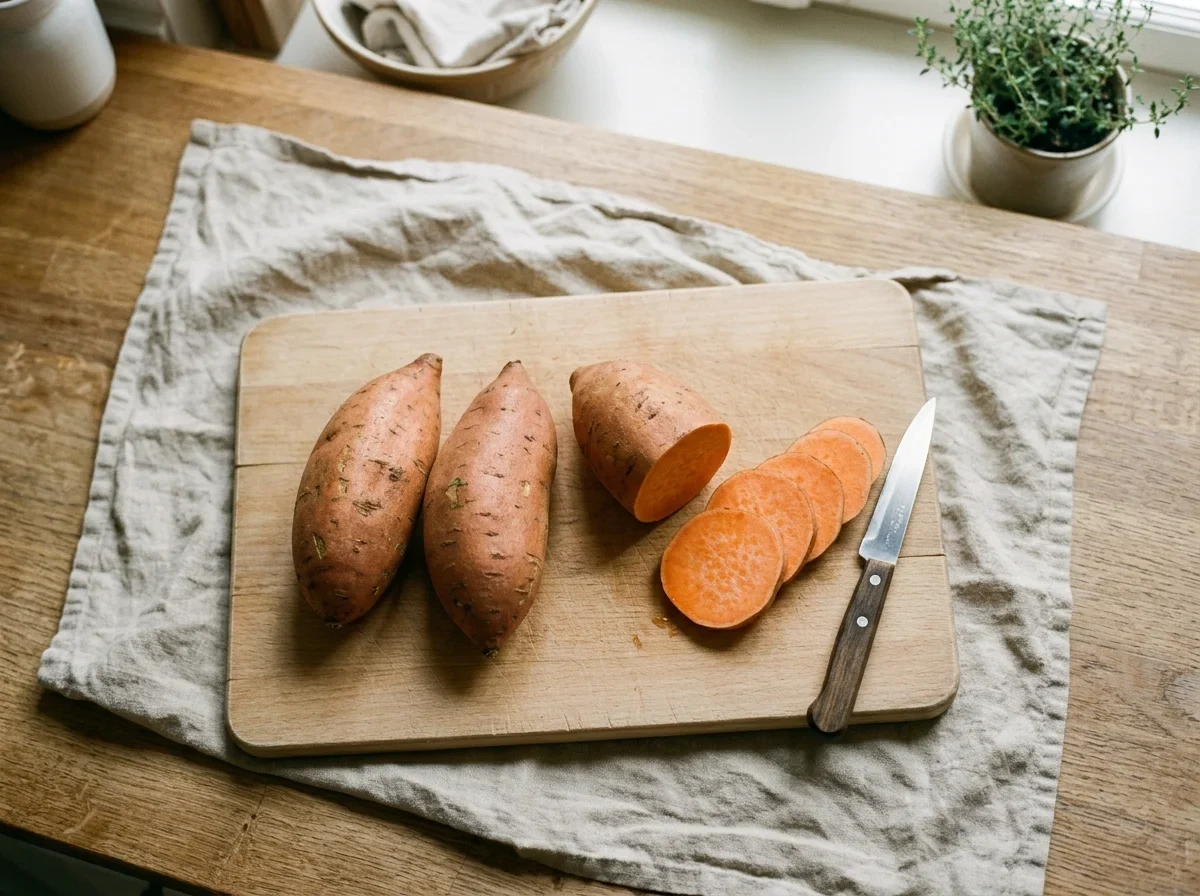
1 to 2 weeks
Cool, dark and dry at 55 to 60°F, loose in paper or a basket
Cooked only
Raw roots are injured below 50°F. Cooked, 3 to 4 days
Cooked only
Bake or boil first, then peel and pack with ½ inch headspace
The short version: store sweet potatoes loose in a cool, dark, dry spot near 55 to 60°F. Because cold below 50°F causes hard cores, keep them out of the fridge, and eat them within a week or two.
Storage guidance from NC State Extension, Penn State Extension and Washington State University.
On this page
How to choose sweet potatoes that store well
Rot needs a wound to get started, so the skin decides how long a root will keep. That is why it pays to look each one over before you buy it, instead of reaching for the biggest. Baking pies for Halloween? How to store Halloween leftovers covers what is left afterwards.
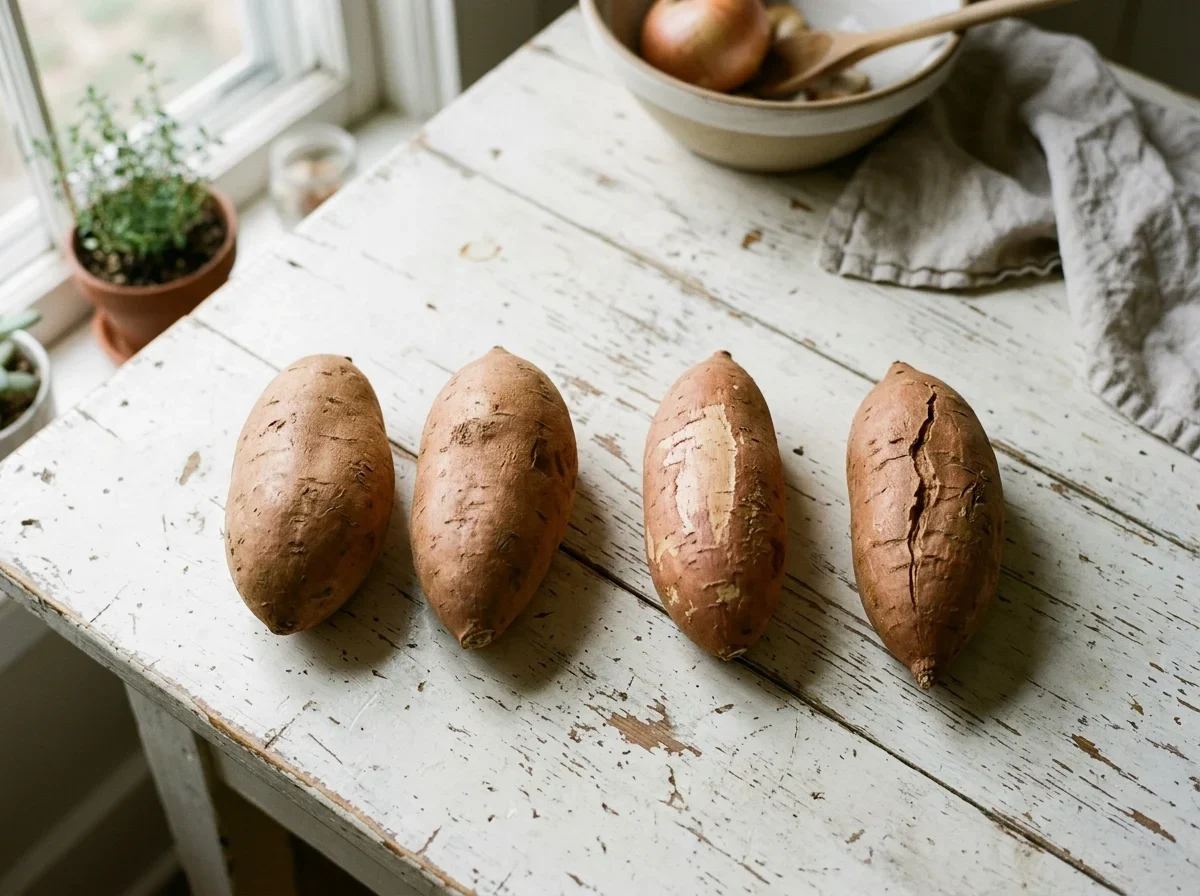
Smooth skin keeps. A graze or a crack is where the rot starts.
Firm, with clean smooth skin. Clemson Cooperative Extension says to look for firm, well-shaped sweetpotatoes with clean, smooth skins. So avoid any with soft spots or bruises.
No cracks. University of Minnesota Extension gives the same short test: firm, and no cracks, bruises or soft spots.
Nothing nicked or grazed. NC State Extension explains that Rhizopus soft rot needs a wound before it can begin at all. Bruising wounds matter in particular.
Dry rather than washed. NC State Extension notes that harvested roots go straight into storage without washing. That is why a good one often still carries soil.
How to store sweet potatoes so they last
To store sweet potatoes so they last, give them warmth, air and darkness. That is the opposite of what salad wants, so the crisper drawer and a sealed bag are both wrong here.
Where to store sweet potatoes in the kitchen
Keep them loose in a paper bag, a basket or an open box, somewhere dark and dry. Washington State University puts the range at 55 to 60°F with 80 to 90% humidity. Penn State Extension gives the same 55 to 60°F, while UMass Extension agrees on that range too. When the shelf goes above 60°F they sprout, according to NC State Extension. Sprouts take a month or more to show at 65°F, but only a few weeks at 75°F. So a cool cupboard beats a shelf near the oven. Give them room as well, because NC State Extension puts postharvest disease at the top of storage losses. One rotting root can shed millions of spores. When that cupboard already holds potatoes or onions, keep each in its own basket. Then one soft one is easy to spot.
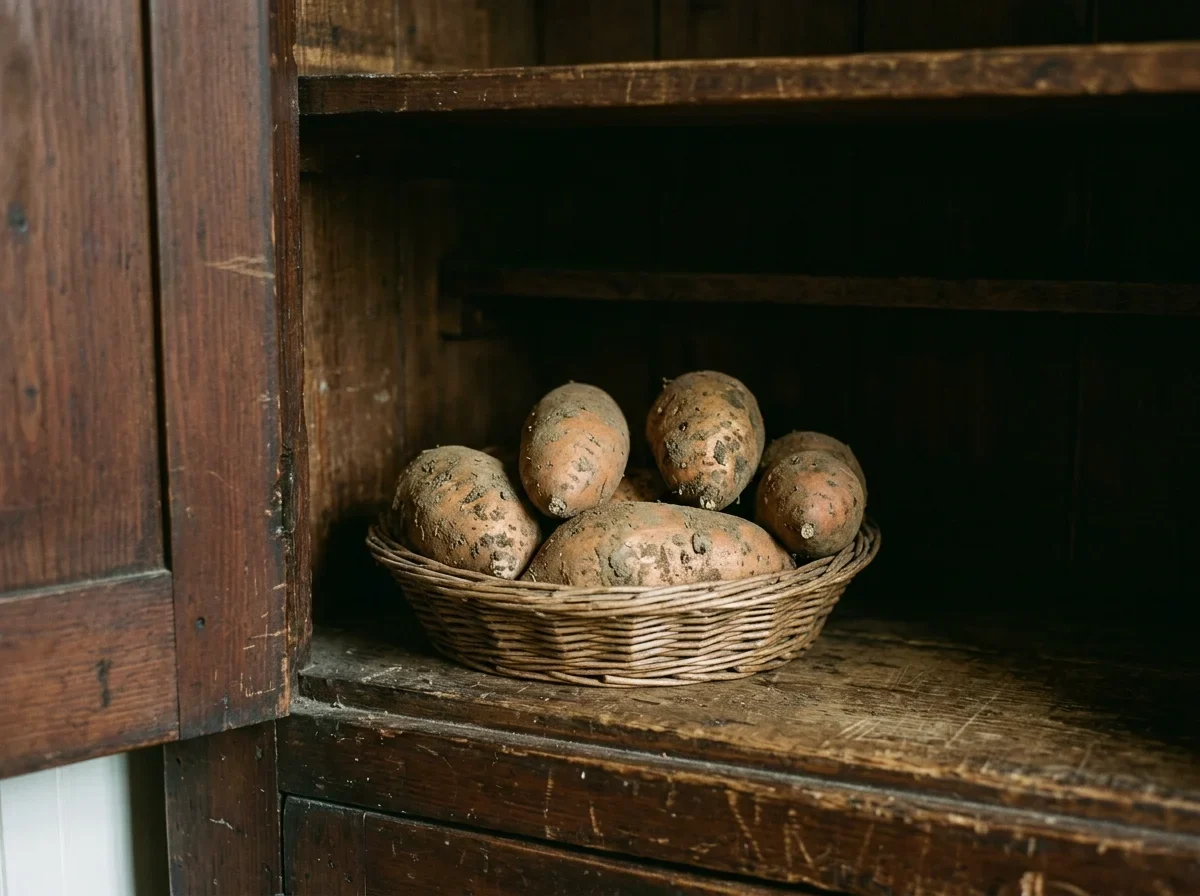
Cool, dark, dry and loose. Not the fridge, and not a sealed bag.
How long can you store sweet potatoes?
In a kitchen, plan on a week or two. Published advice varies more than you would expect. N.C. Cooperative Extension in Orange County says to use them within three to five weeks. The Lee County office says a week or two, while University of Minnesota Extension gives up to 10 days. The long figures belong to proper stores, because NC State Extension's 13-month ceiling assumes 55°F, 85 to 90% humidity and steady ventilation. Since a kitchen is warmer and drier, take the shorter number. Then look at the basket every few days.
In other words, the room sets the clock, not the root. A cellar near 55°F will hold them for months, while a warm kitchen gives you a week or two. A cured pumpkin answers to the same room, since Oregon State Extension puts its range at 50 to 55°F.
Should you store sweet potatoes in the fridge?
Not raw ones, no. NC State Extension says sweetpotatoes are injured below 50°F, while a home fridge runs at 40°F or colder. The damage shows up as surface pitting, internal breakdown, hardcore and discolored flesh. It is cumulative too, so one cold night may pass unnoticed while a dozen add up. In fact, the Lee County office of N.C. Cooperative Extension puts it in kitchen terms: cold turns them bitter and gives them a hard center core. Clemson Cooperative Extension also adds dark spots and off-flavors to that list. Sources do differ on where the line sits, because UMass Extension puts chilling injury below 55°F rather than 50°F. So the safer rule is to keep raw roots above 55°F, and out of the fridge altogether. Basil draws a line of its own at about 50F, and it is one of the few herbs with published numbers behind it.
How to store sweet potatoes you have cut
Cut pieces do belong in the fridge, whatever the rule for whole roots. The FDA says to refrigerate produce that has been cut, and to keep perishable fresh produce at 40°F or below. So use a covered container, then cook the pieces within a day or two. Scrub the skin before you cut, since the FDA also asks for firm produce to be cleaned with a produce brush under running water.
How to store sweet potatoes once they are cooked
Once they are cooked they are leftovers, so they follow the leftovers clock. N.C. Cooperative Extension passes on the USDA rule of no longer than three to four days in the fridge. It also asks you to get the food cold within two hours. Then it makes a point worth keeping: freezing does not reset that clock, so days already spent in the fridge still count after thawing. If a tray of roasted sweet potatoes sat out all evening instead, the food left out overnight guide covers what to do.
Can you freeze sweet potatoes?
Yes, once they are cooked. The National Center for Home Food Preservation starts its method with roots that have been cured for at least a week. Then every step that follows comes on the far side of cooking. So the freezer is the honest answer to a basket you cannot finish.
How to store sweet potatoes in the freezer
Sort the cured roots by size and wash them first. Then cook them until almost tender in water, in steam, in a pressure cooker or in the oven, as the National Center for Home Food Preservation describes. Let them stand at room temperature until cool. Peel them next, then cut them in halves, slice them or mash them. To keep the color, dip whole roots or slices for 5 seconds in a solution of half a cup of lemon juice to a quart of water. For mash, stir in 2 tablespoons of orange or lemon juice for each quart instead. Then pack everything with half an inch of headspace, seal and freeze.

Cook them first, add citrus juice, then leave half an inch of headspace.
Can you store sweet potatoes raw in the freezer?
No published method does it that way. The National Center for Home Food Preservation gives no directions for freezing them raw, because cooking comes first in every version of its method. NC State Extension also describes what real cold does to a raw root. Sweetpotatoes freeze at about 30°F, and they are immediately ruined at that point. So bake or boil them first, even if you only have time to part-cook them.
What happens when you store sweet potatoes in the freezer
Cooked flesh thaws soft, which suits mash, pie filling, soup and anything you roast afterwards. The citrus juice matters more than it sounds. In fact, the Center adds it specifically to stop mashed sweet potatoes from darkening. Thawed pieces are leftovers again, however, and N.C. Cooperative Extension warns that freezing does not reset the clock. So the fridge days you already used still count.
How to tell if sweet potatoes have gone bad
Most of the sweet potatoes people throw out are still dinner. Sprouts are not spoilage, and nor is a wrinkled skin, whereas one soft wet patch really is the end. Here is what each stage means.
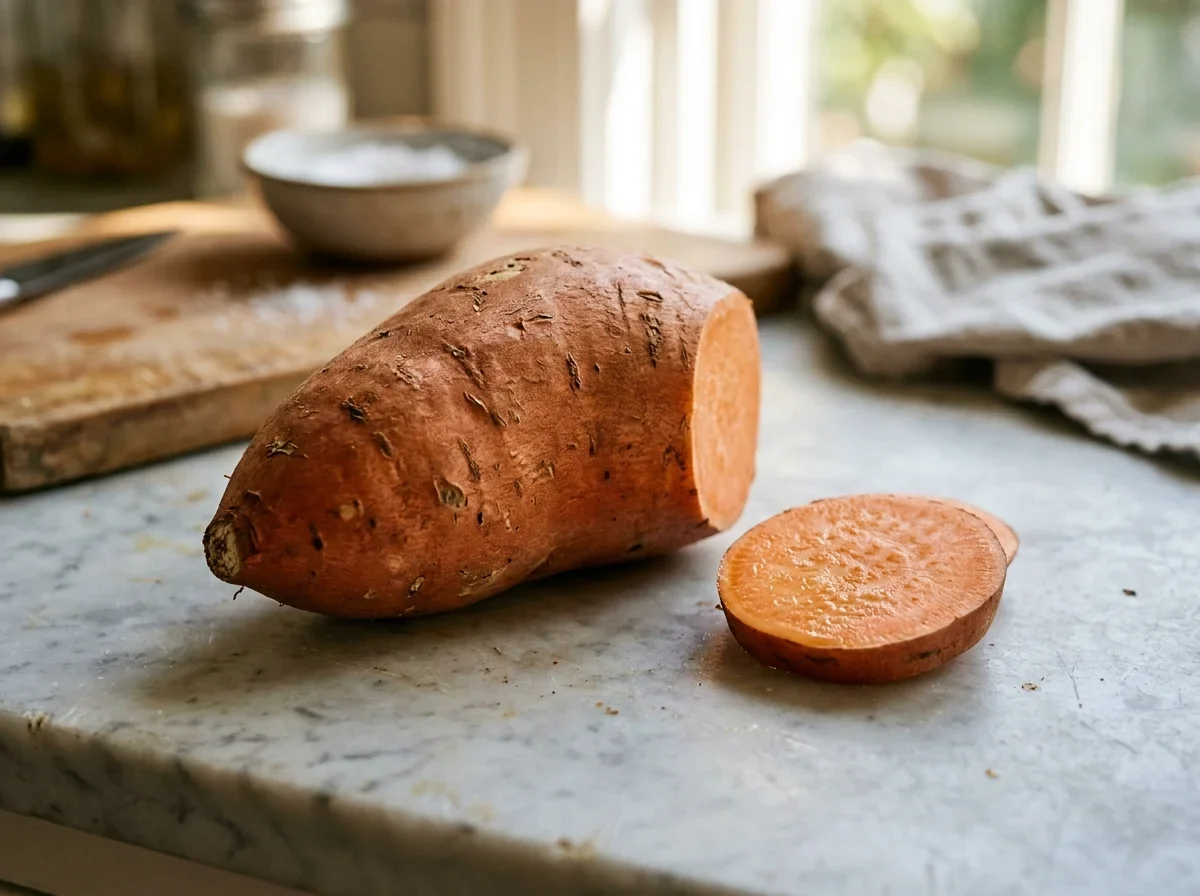
Verdict: use it
Firm sweet potatoes
Even skin, no give under your thumb, and nothing much to smell. Clemson Cooperative Extension also describes the ones worth buying in the same words: firm and well shaped, with clean, smooth skin. So a root that still looks like that has not started to turn.
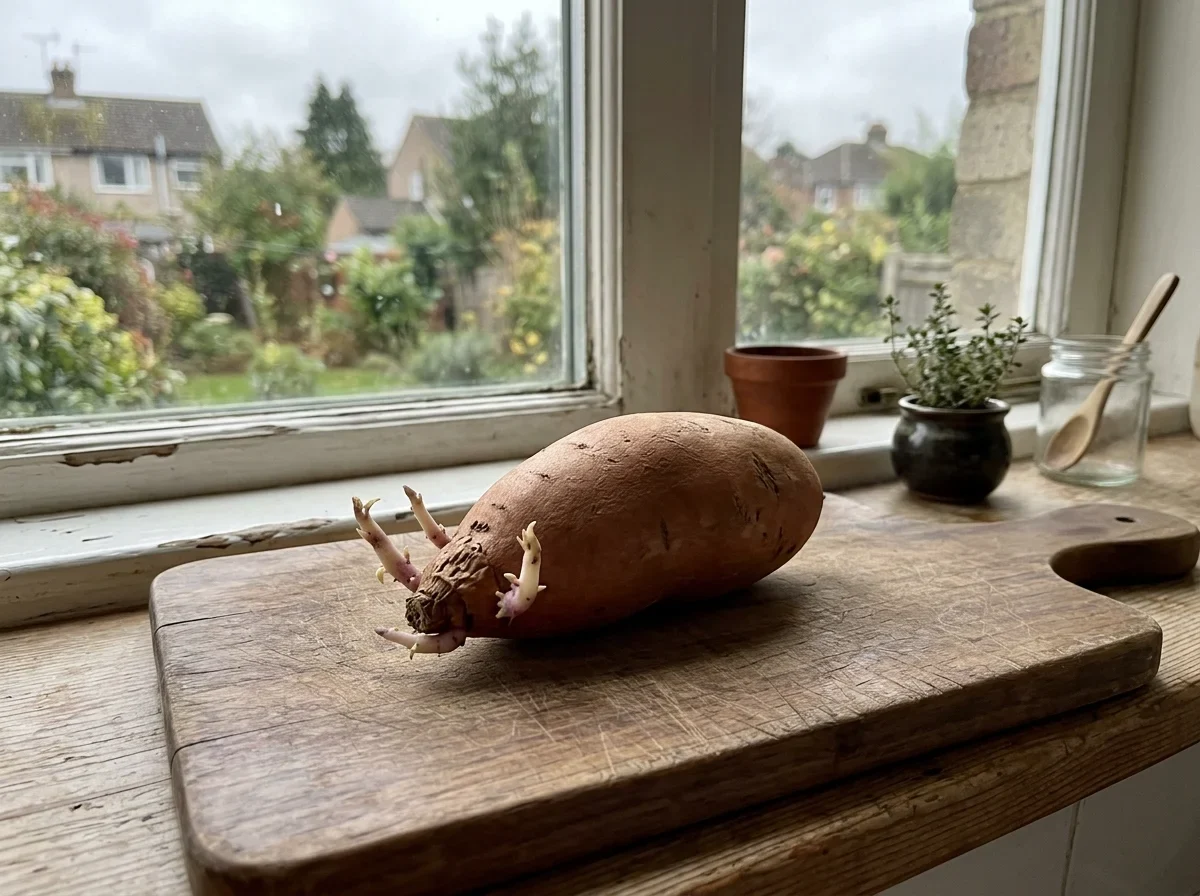
Verdict: snap the sprouts off, then use it
Sprouted sweet potatoes
Sprouts mean warmth, not danger. NC State Extension says sweetpotatoes sprout above 60°F, and that USDA grade standards only count sprouts over three-quarters of an inch as a defect. The worry people carry over from white potatoes does not apply here either. That is because the University of Maryland Extension points out that sweet potato is a cousin of morning glory rather than a nightshade. So the chemicals a greened potato skin makes are not the same ones. Break the sprouts off, then move the basket somewhere cooler.
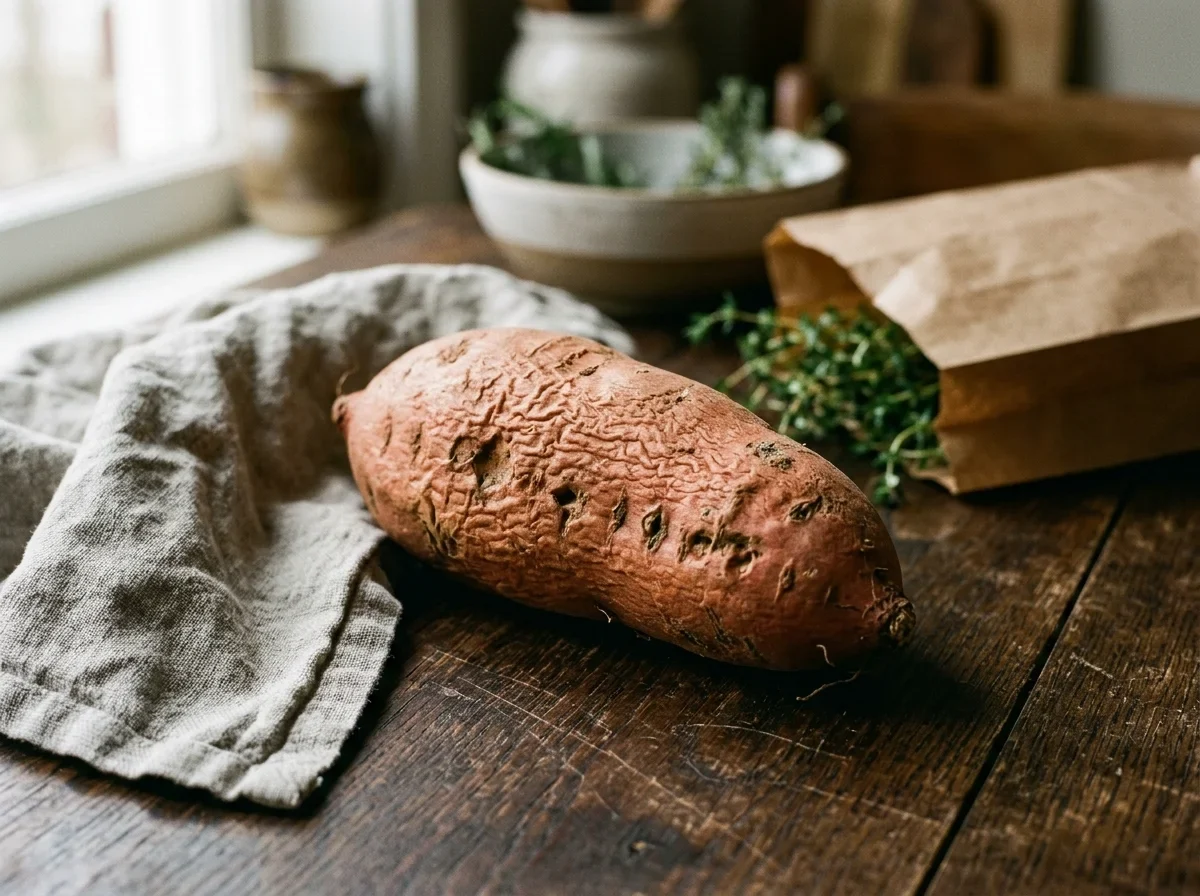
Verdict: cook it this week
Shriveled or pitted sweet potatoes
Loose, wrinkled skin means water has left the root, while surface pitting usually means it spent time somewhere too cold. NC State Extension lists pitting and dry matter loss among the first signs of chilling injury. UMass Extension also describes shriveled, sunken, dark areas on the surface. Neither one is mold, so cook it soon rather than binning it. Even so, expect less sweetness than you hoped for.
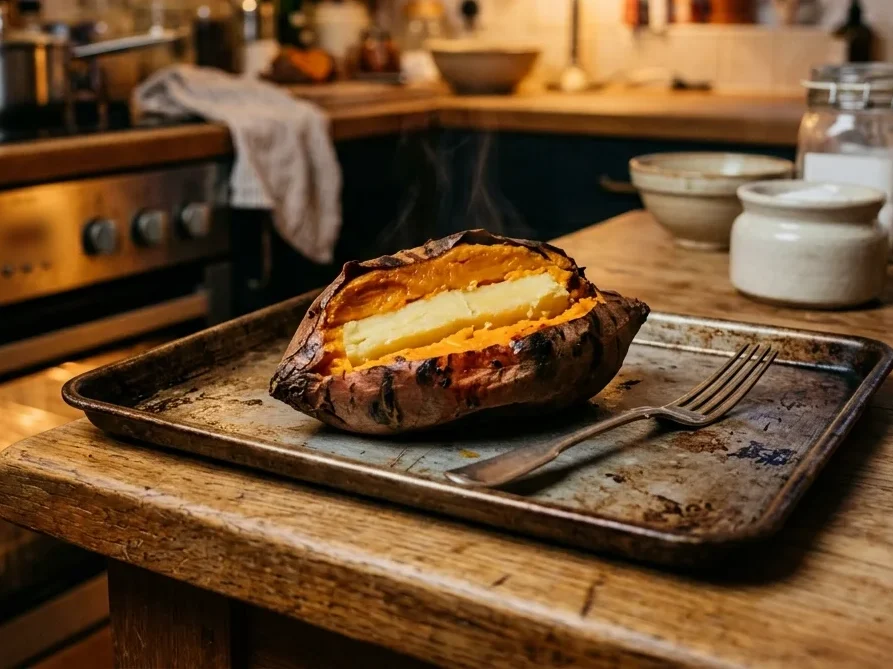
Verdict: eat around it
Sweet potatoes that stay hard when you cook them
A root that is still firm in the middle after a long bake was almost certainly chilled. NC State Extension lists hardcore among the symptoms of chilling injury. It also notes that nothing shows on the outside or inside until the roots are cooked. Penn State Extension names hard cores and off-flavor as what cold storage leaves behind. This is a quality problem rather than a safety one, so eat around the hard part. Then move the basket out of the cold.
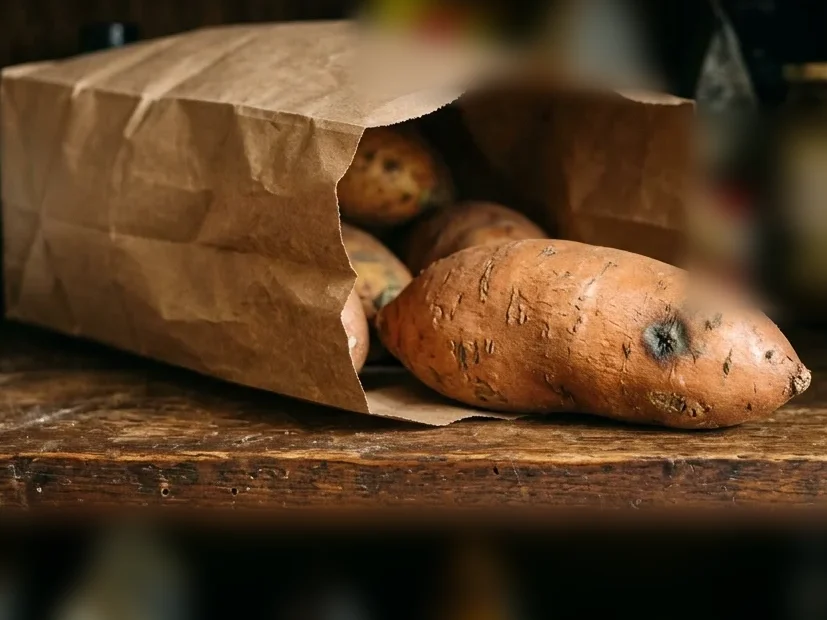
Verdict: throw it out
Soft, wet or moldy sweet potatoes
A soft, watery patch is soft rot, and it moves fast. NC State Extension describes Rhizopus soft rot as a soft, watery rot that starts at a wound. Then it can take a whole root down in as little as three days. In fact, it often sits under white to grey fungal growth with black spore heads, which NC State likens to a grey man's beard. Mold is its own reason to stop. UConn Extension allows cutting an inch around and below a moldy spot on firm vegetables such as cabbage, peppers or carrots. However, it does not name sweet potatoes, and a wet root is no longer firm. So throw that one out, then check the ones it was touching.
Do sweet potatoes get sweeter the longer you store them?
They do, and that is the whole point of curing. The Lee County office of N.C. Cooperative Extension explains that curing tightens the skin, converts starches to sugars and heals surface damage. That is why cured roots taste sweeter and bruise less than freshly dug ones. UMass Extension goes further and recommends waiting at least three weeks after harvest before eating them. In other words, a sweet potato that has sat in your cupboard for two weeks is not past its best. In fact, it may taste better than it would have on the day you bought it.
Sweet potato substitutes
Out of sweet potatoes, or had to throw a soft one away? Then these will cover most of what you wanted from it.
Substitute
Works best in
What changes
Butternut squash
Roasting, soup and mash
The closest match for sweetness and color. Softer, so watch the oven.
Carrots
Roasting and stews
Sweet but much firmer. Cut them smaller.
Potatoes
Roasting, fries and mash
Starchier and not sweet. Season more boldly.
Pumpkin
Pie, soup and mash
Wetter, so cook it down first.
Mistakes people make when they store sweet potatoes
These are the ways people store sweet potatoes that cost them the most, and each one has an easy fix.
Putting raw ones in the fridge. Below 50°F they pick up hard cores and off-flavors, so use a cool cupboard instead.
Washing them before they go in the basket. NC State Extension stores roots without washing, so brush the soil off dry and wash them when you cook.
Sealing them in a plastic bag. Every extension source on this page asks for ventilation, so choose paper, mesh or an open box.
Leaving them on a warm windowsill. Above 60°F they sprout, and at 75°F sprouts can show within a few weeks.
Heaping them deep in one bowl. One rotting root sheds spores by the million, so spread them out and pull any soft one straight away.
Throwing out a sprouted one. Snap the sprouts off, because the firm root underneath is still good.
Freezing them raw. The published method starts with cooked roots, so bake or boil first.
Sources
Postharvest Handling of Sweetpotatoes, Brooke A. Edmunds, Michael D. Boyette and others, NC State Extension, on curing, 55°F storage, chilling injury below 50°F, hardcore and sprouting above 60°F.
Sweetpotato Curing and Storage, Laura Schulz, Carol Miles and others, Washington State University Northwestern Washington Research and Extension Center, January 2026, on storage at 55 to 60°F with 80 to 90% humidity.
Sweetpotato Curing and Storage, Luis Duque, Penn State Extension, November 2025, on 55 to 60°F storage and on hard cores and off-flavor from chilling.
Sweet Potato Harvest and Storage, UMass Extension Vegetable Program, updated October 2025, on chilling injury below 55°F, shriveled sunken dark areas, and waiting three weeks after harvest.
How to Store In-Season Produce, Jonathon Smith with Ivelisse Colón, N.C. Cooperative Extension Orange County Center, December 2025, on a cool dark place, never the refrigerator, and three to five weeks.
North Carolina Sweet Potatoes, Minda Daughtry, N.C. Cooperative Extension Lee County Center, updated September 2021, on curing, bitterness and a hard center core from cold, and a week or two at home.
Sweetpotato Basics, HGIC 3538, Pamela Schmutz, J.E. Campbell and E.H. Hoyle, Clemson Cooperative Extension, revised September 2022, on choosing firm smooth roots and on dark spots and off-flavors from refrigeration.
Sweet Potatoes, Real Life Good Food, University of Minnesota Extension, on choosing firm roots without cracks and on up to 10 days in a cool dark place.
Freezing Sweet Potatoes, National Center for Home Food Preservation, University of Georgia, on curing, cooking first, the lemon juice dip and half-inch headspace.
Rhizopus Soft Rot of Sweetpotato, Lina Quesada-Ocampo, NC State Extension, April 2018 and reviewed January 2023, on wounds, the three-day collapse and the grey fungal growth with black spore heads.
Keep Those Leftovers Safe, Cheryle Syracuse, N.C. Cooperative Extension Brunswick County Center, updated February 2024, on three to four days for cooked leftovers, the two-hour rule and freezing not resetting the clock.
Selecting and Serving Produce Safely, U.S. Food and Drug Administration, March 2024, on refrigerating cut produce at 40°F or below and scrubbing firm produce.
Handling Food with Mold, Austin Goldberg, Daniela Avelino and Valerie Duffy, UConn Extension, April 2024, on trimming an inch from firm vegetables and discarding the soft ones whole.
Sweet potato danger?, Home and Garden Information Center, University of Maryland Extension, October 2024, on sweet potato not being a nightshade and on greened skin.
Storage times and safety advice on this page come from the sources above. Food safety depends on conditions I cannot see, so read the Disclaimer, and if in doubt, throw it out.
Other ingredient guides
Browse all guides


Share this guide
Never miss a guide
New ingredient guides when they go up, plus one storage tip worth knowing. Anything sponsored is labelled.

Emilly White