
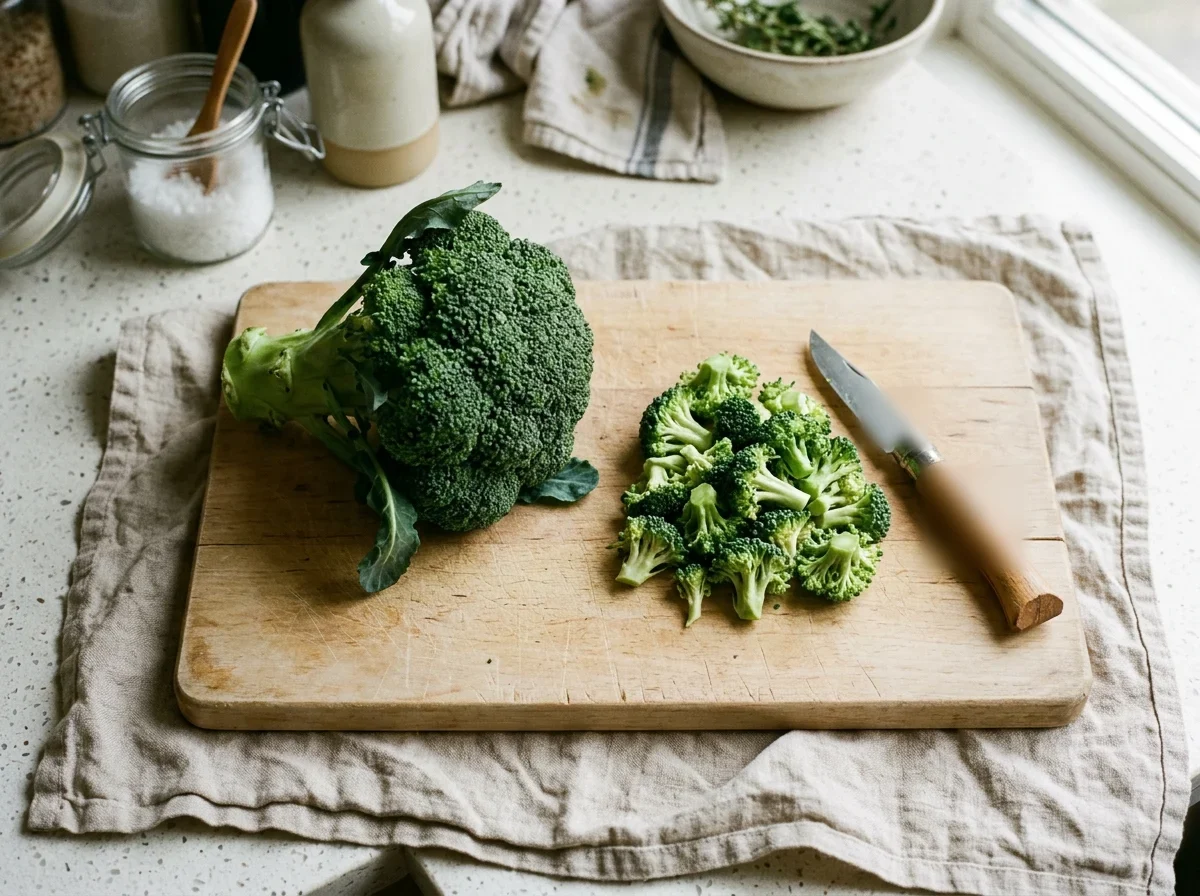
Not a storage spot
Broccoli wants cold and damp, so move it to the fridge
3 to 5 days
Loose perforated bag, coldest shelf, away from the fruit
Yes, blanched
Water blanch 3 minutes, cool it fast, then pack with no headspace
The short version: to store broccoli well, keep it unwashed in a loose perforated bag on the coldest shelf. Also keep it away from apples and bananas. Then plan on 3 to 5 days, because a home fridge cannot hold the conditions that stretch a head to weeks.
Storage guidance from Utah State Extension, SDSU Extension, Colorado State Extension and the NCHFP.
On this page
How to choose broccoli that will store well
A head that is already past its peak will not recover in your fridge. So the choice at the shop decides most of the week. Look at the buds first, since they age before the stem does.
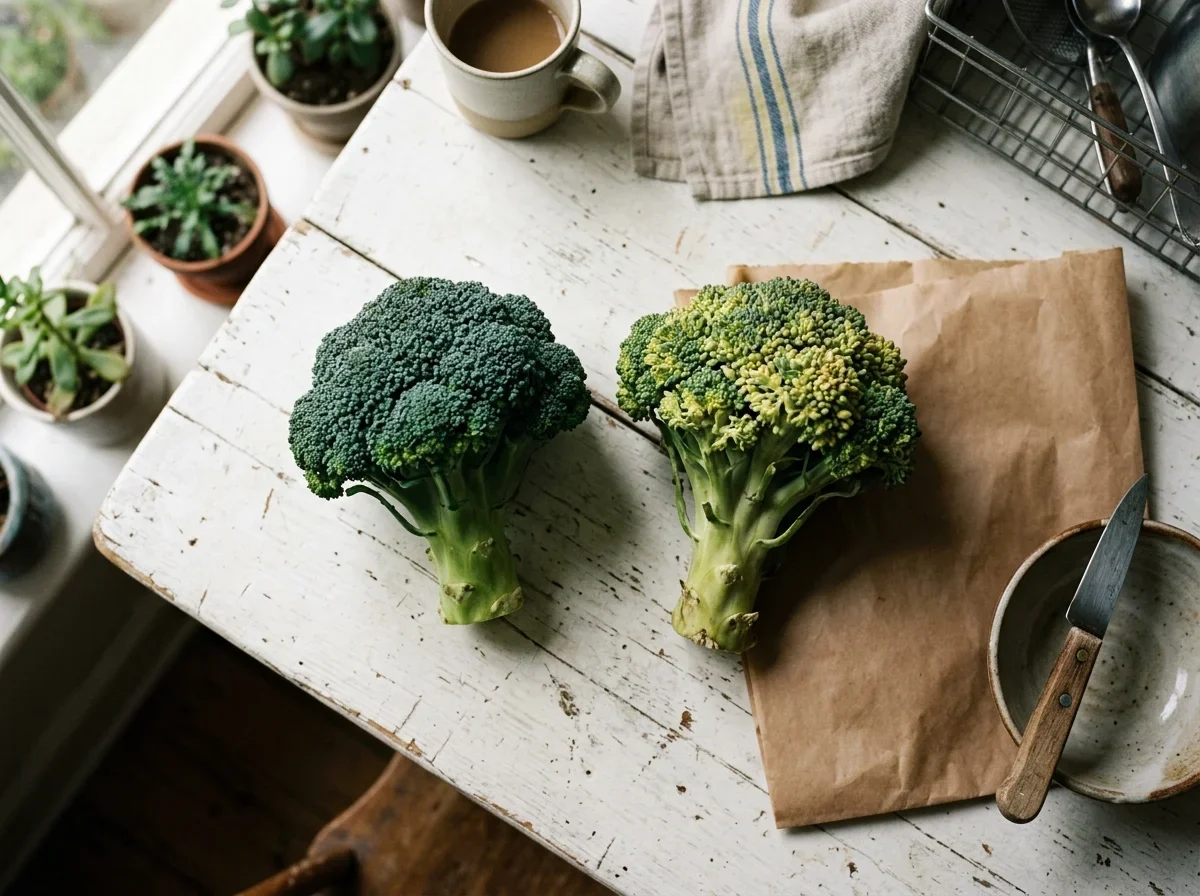
Tight and blue-green on the left. Yellow buds mean the head was already old.
Tight, blue-green buds. UMN Extension says to harvest broccoli while the flower buds are still tight and green. Kentucky's vegetable IPM team agrees, since it asks for florets that are tight and blue-green.
No yellow. Kentucky's team notes that florets begin to yellow in broccoli that stays in the field too long. So yellow buds on a shop head mean it was already old when you bought it.
A firm stem. Utah State Extension says to cut heads while they are still compact, before the flower buds open. So pass over any head whose stem bends in your hand.
No bruised or damaged patches. The FDA tells you to cut away damaged or bruised areas before eating produce. So a clean head gives you more to work with.
How to store broccoli so it lasts
To store broccoli so it lasts, you need cold, moisture and air at the same time. Broccoli is a flower bud, and it is still alive and still breathing. So sealing it up or drying it out will both shorten the week.
How to store broccoli in the fridge
Put the head in a loose, perforated plastic bag and keep it on the coldest shelf, unwashed. Colorado State Extension gives exactly that advice. It also says to clean broccoli right before you use it, then rinse well with cold water. Broccoli belongs in the cold, damp part of the fridge, the same corner the lettuce guide deals with. Also keep it away from fruit. SDSU Extension lists broccoli as ethylene-sensitive, so it says to store it separately from apples, melons and tomatoes. The ethylene side of that is in the bananas guide. Utah State Extension bags the head too, while its figures are 32 to 40°F at 90 to 95% humidity.
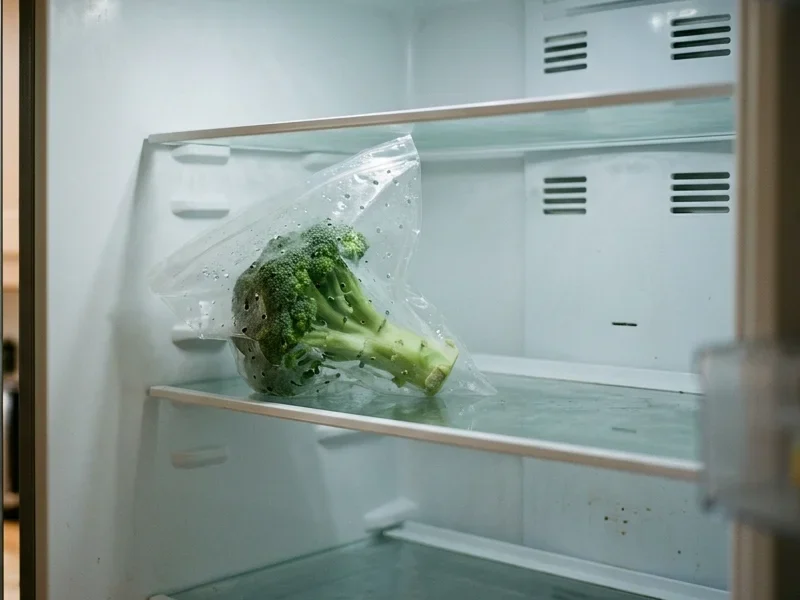
Loose bag, coldest shelf, unwashed, with the fruit bowl somewhere else.
How long can you store broccoli in the fridge?
Count on 3 to 5 days, which is what Colorado State Extension gives for a loose perforated bag. Longer figures do exist, but each one comes with conditions attached. Utah State Extension says 7 to 10 days in a plastic bag, while UMN Extension gives two weeks. Both of those assume 32 to 40°F and 95% humidity. SDSU Extension stretches to 2 to 3 weeks, at 32 to 36°F and 95 to 98% humidity. However, a home fridge rarely holds 32°F or 95% humidity, so plan around the shorter figure.
In other words, the gap between those numbers is not a disagreement about broccoli. It is a disagreement about fridges. The longer figures describe a cold room, while the Colorado figure describes a kitchen.
Do you need to store broccoli in a perforated bag?
A bag of some kind, yes, because a bare head dries out quickly at fridge humidity. Colorado State Extension asks for a loose, perforated plastic bag. Utah State Extension simply says a plastic bag. So the perforations matter less than leaving the bag open. Do not seal it airtight, since broccoli keeps respiring in the fridge. SDSU Extension notes that cold storage works partly by slowing that respiration down.
How to store broccoli florets and cut stems
Cut florets dry out faster than a whole head, because cutting exposes much more surface. So cut only what you will cook within a day or two. Also give cut pieces a covered container rather than an open bowl. The FDA asks for perishable produce in a clean refrigerator at 40°F or below. No source I opened puts a day count on cut raw broccoli. So this guide gives you the condition instead of a number.
How to store broccoli after you cook it
Treat cooked broccoli as a leftover, because once it is cooked the clock is a food-safety clock. Clemson Cooperative Extension says to refrigerate leftovers within 2 hours. Then hold the fridge at 41°F or colder, and use them within 4 days. Also cool it in a shallow container, since Clemson asks for containers no more than 2 inches deep. When a cooked batch has sat out overnight instead, the food left out overnight hub covers the call.
Can you freeze broccoli?
Yes, and the freezer is where a glut of broccoli should go, although it has to be blanched first. The NCHFP gives the full method. Clemson Cooperative Extension explains what skipping the blanch costs you. Without it, enzymes keep working in the freezer, so Clemson says you lose flavor, color and texture.
How to store broccoli in the freezer
Start with firm, young, tender stalks and compact heads, as the NCHFP specifies. Then remove the leaves and woody portions. For garden broccoli, soak the head in brine for 30 minutes to remove insects. That is 4 teaspoons of salt to a gallon of water. Then split the head so the flowerets are no more than 1½ inches across. Water blanch for 3 minutes, or steam blanch for 5. After that, cool promptly, drain, and package leaving no headspace, then seal and freeze. Clemson Cooperative Extension adds the cooling detail that matters. Plunge the florets into a large quantity of cold water at 60°F or below. Keep them there for about as long as you blanched them.
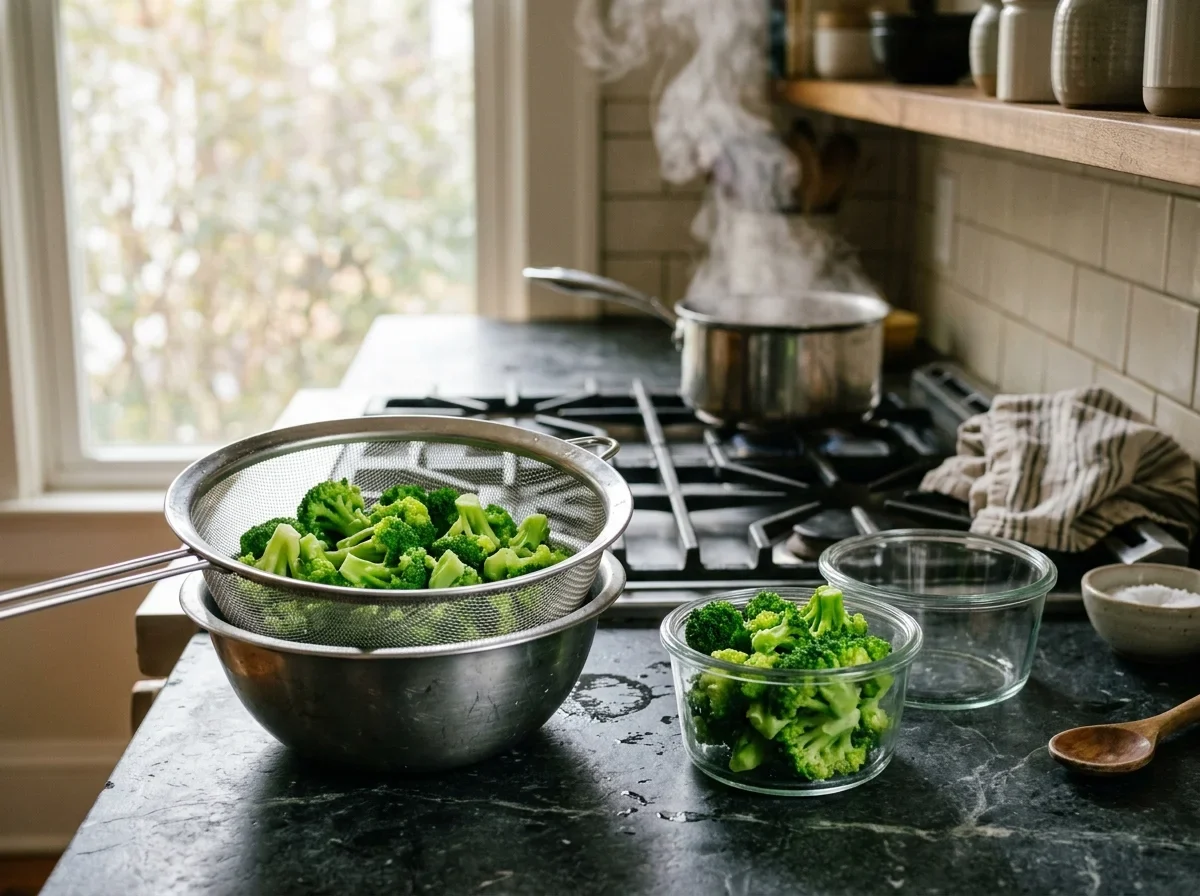
Three minutes in boiling water, then straight into cold water at 60F or below.
Why blanching comes before you store broccoli in the freezer
Because enzymes do not stop at freezer temperatures. Clemson Cooperative Extension says blanching stops the enzyme action that otherwise costs you flavor, color and texture. It also warns that under-blanching is worse than no blanching at all. A short dip stimulates those enzymes instead of killing them. So use a timer rather than a guess.
What happens when you store broccoli in the freezer
The florets soften, because the blanch has already wilted them. Both the NCHFP and Clemson describe blanching as wilting or softening vegetables so they pack more easily. In practice that means frozen broccoli belongs in soups, stir-fries, bakes and curries. A raw platter, however, needs a fresh head. Colorado State Extension gives the same home route in short form. Clean it, trim it into small pieces, blanch, cool in an ice bath, drain and pack. Blanched green beans end up in the same dishes, since three minutes in boiling water costs them their snap as well.
How to tell if broccoli has gone bad
In fact, most broccoli that gets thrown out has not gone bad at all. Yellow florets and a limp stem are age, so they cost you crunch and not safety. Slime and mold, however, are the point where a head stops being food. Here is what each stage means, and what to do with it.
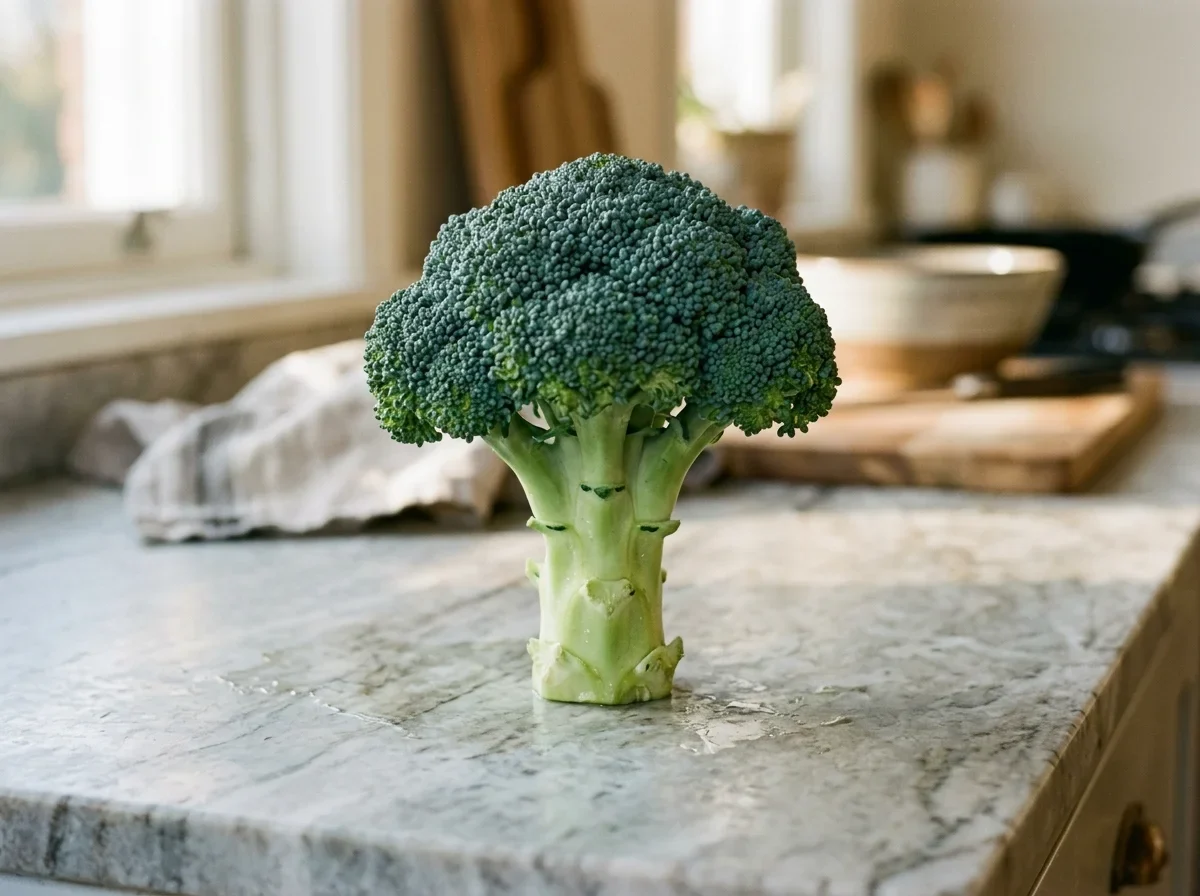
Verdict: use it
Firm, green broccoli
Tight blue-green buds, a stem that does not bend, and almost no smell. That is the head UMN Extension and Kentucky's IPM team both describe as ready. So cook it however you like.
Verdict: cook it
Limp broccoli
A stem you can bend and florets that have gone soft mean the head has lost water. Because cold, damp storage is mainly there to slow that loss, a limp head is telling you about its week. It is not telling you about bacteria. Nothing here is what the FDA calls rotten, so roast it or put it in soup.
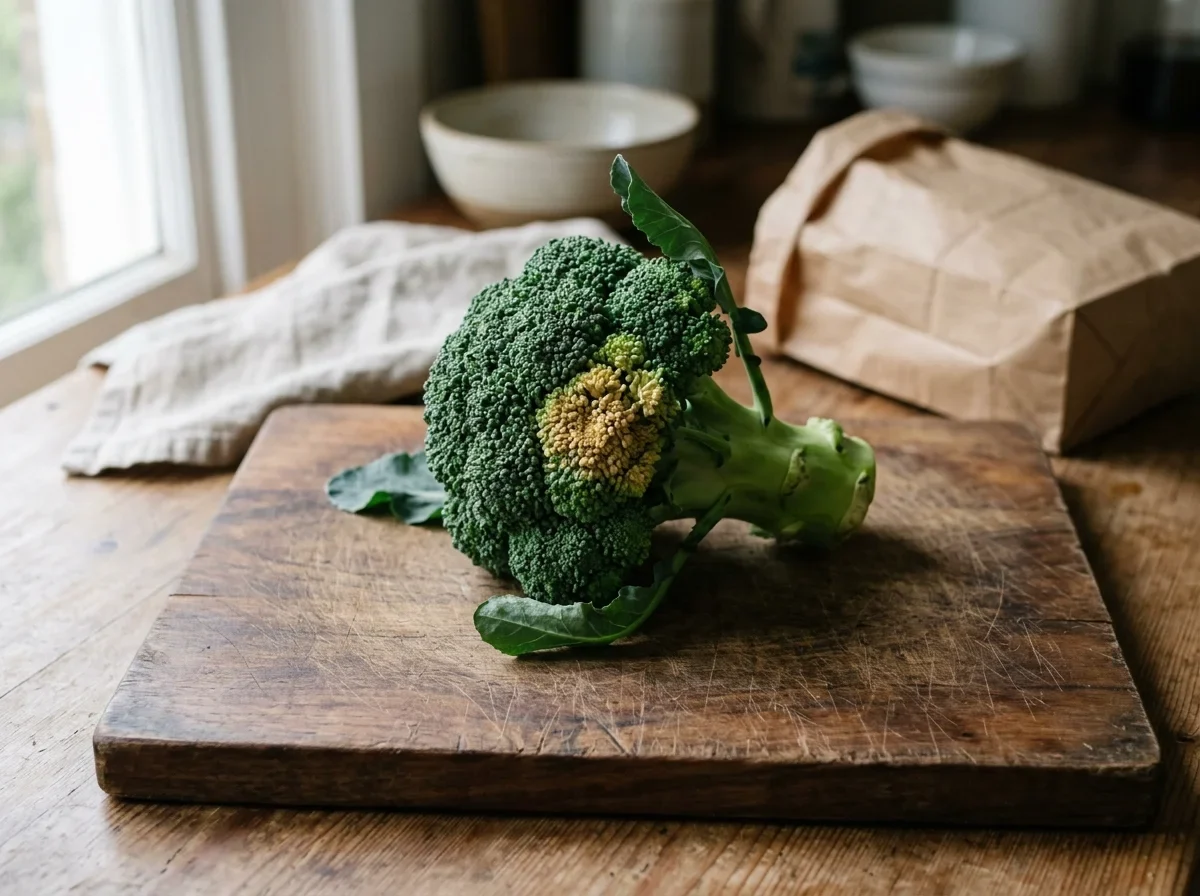
Verdict: cook it soon
Yellowing broccoli
In fact, yellow buds are the head aging rather than spoiling. Kentucky's vegetable IPM team says florets begin to yellow in broccoli that stays in the field too long. SDSU Extension also lists yellowing among the changes that cold storage is meant to slow. So a few yellow buds are fine once cooked. However, a head that has gone yellow all over has little left to give.
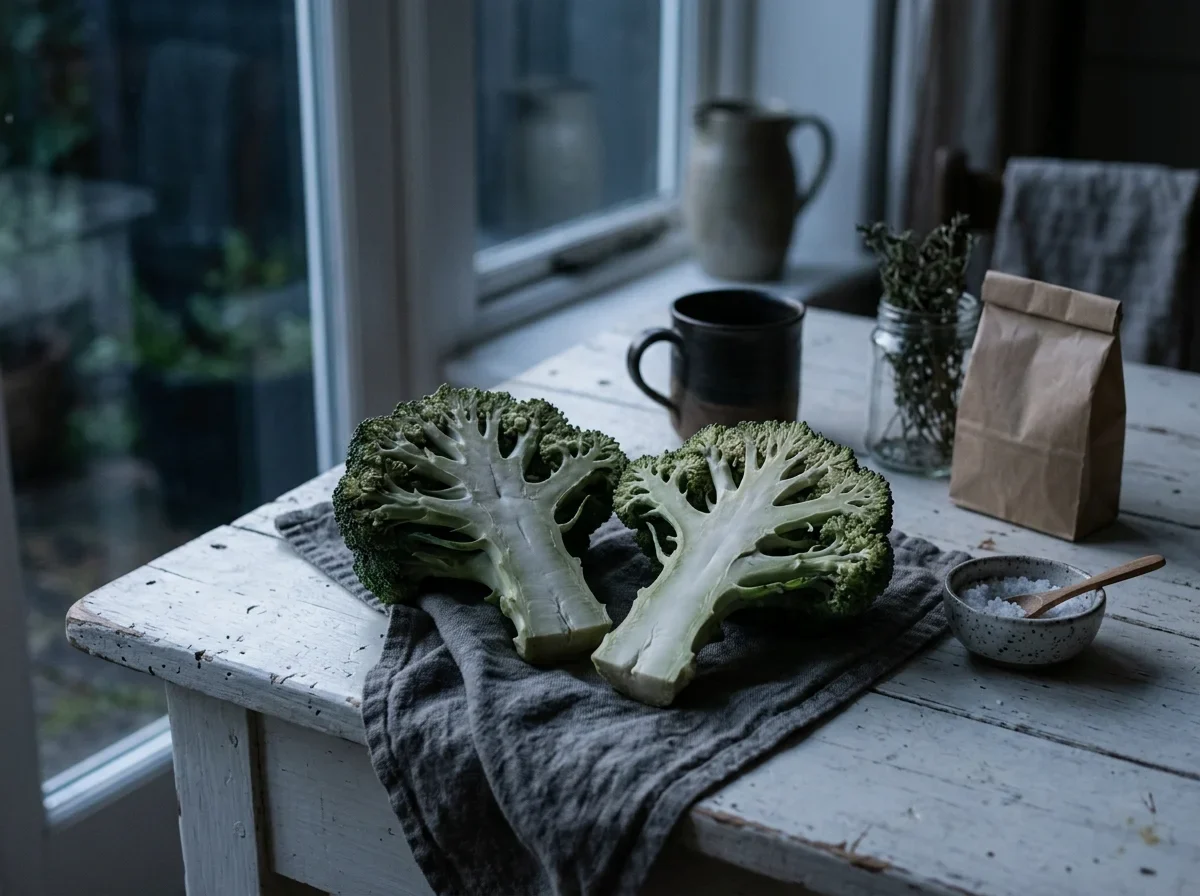
Verdict: cook it if the stem is still firm
Strong-smelling broccoli
Broccoli smells of sulfur for a reason. The Linus Pauling Institute at Oregon State University explains that it is full of sulfur-containing glucosinolates. An enzyme called myrosinase turns those into pungent products when the cells are damaged. So an aging head, whose cells are breaking down anyway, smells stronger than a fresh one. When the stem is still firm and there is no slime, trim it, cook it and move on. However, a sharp smell with a soft, wet head belongs in the next stage.
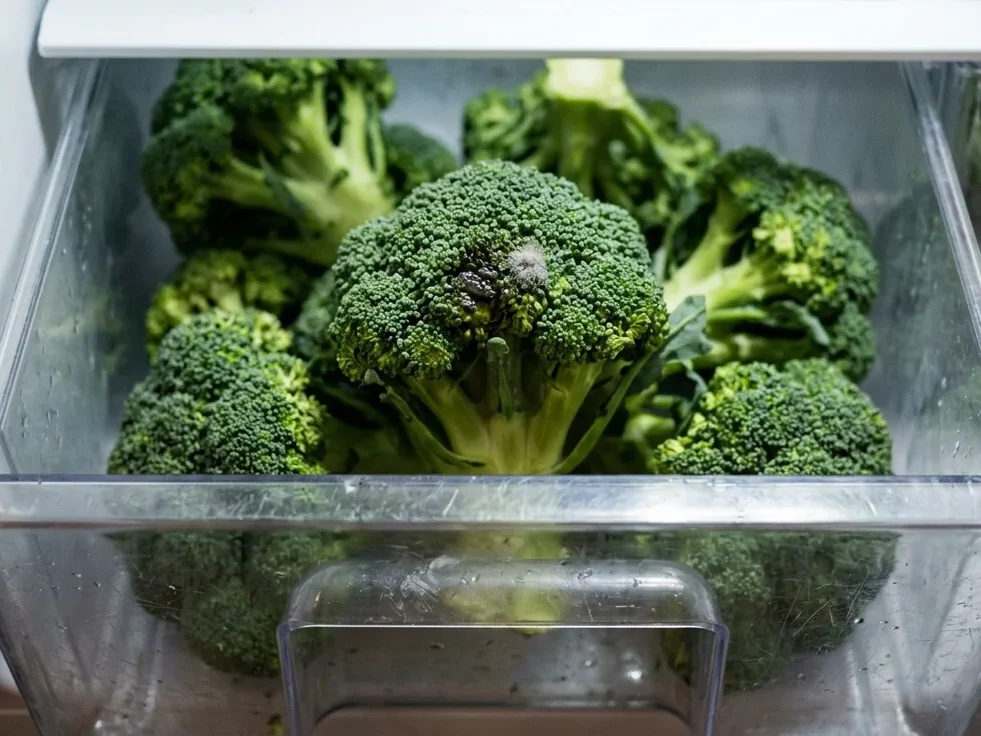
Verdict: throw it out
Slimy or moldy broccoli
Wet, slick patches, or fuzzy spots of white, grey or black on the florets, and the head is done. UConn Extension lets you cut an inch around and below mold on firm vegetables such as cabbage, peppers or carrots. However, it discards soft produce whole, which is the rule the strawberry guide follows. None of the sources I opened names broccoli in either list. So this guide follows the FDA, which says plainly to throw away any produce that looks rotten. Then check whatever was touching it in the bag.
Is it bad to store broccoli in a jar of water?
Two of the pages that rank for this question tell you to stand the cut stem in water. One of them claims weeks of freshness. However, no extension or USDA source I opened this run tests that method. In fact, none of them mentions it at all. What they say points the other way: Colorado State Extension wants broccoli unwashed and dry until you use it. Both it and Utah State Extension put the head in a bag. So treat the jar as untested, and keep the bag.
Broccoli substitutes
Out of broccoli, or had to bin a head? Then these will cover most of what you wanted it for.
Substitute
Works best in
What changes
Cauliflower
Roasting, soups and gratins
Same family, milder, and it browns well.
Broccolini
Sautés and sheet pans
Thinner stems, sweeter, and it cooks faster.
Green beans
Stir-fries and salads
Snappier, with none of the sulfur note.
Frozen broccoli florets
Soups, bakes and stir-fries
Blanched before freezing, so they soften quickly.
Mistakes people make when they store broccoli
These are the ways people store broccoli that cost them the most, and each one has a quick fix.
Washing it before it goes in the fridge. Colorado State Extension says to clean broccoli right before you use it, so keep it dry in the bag.
Sealing it in an airtight bag. Broccoli keeps respiring in the fridge, so use a loose, perforated bag instead.
Parking it next to the fruit bowl. SDSU Extension lists broccoli as ethylene-sensitive, so store it away from apples, melons and tomatoes.
Putting it in the warmest part of the fridge. Broccoli stores best at 32 to 36°F, so give it the coldest shelf you have.
Binning yellow heads. Yellowing is age, so cook those florets instead of throwing them away.
Freezing it raw. Clemson Cooperative Extension says under-blanching is worse than no blanching, so give florets the full 3 minutes.
Leaving cooked broccoli out to cool. Clemson asks for leftovers in the fridge within 2 hours, in shallow containers, so do not wait for the pan.
Sources
Harvest and Storage of Vegetables and Fruits, Shawn Olsen, Dan Drost and Teresa Hunsaker, Utah State University Extension, January 2015, on compact heads, the plastic bag, 7 to 10 days and cold, moist storage at 32 to 40°F.
Postharvest Handling, Utah Vegetable Production Guide, Utah State University Extension, 2016, on broccoli at 32°F and 90 to 95% humidity for 1 to 2 weeks, and on keeping ethylene-sensitive crops away from fruit.
Storage Life of Vegetables, Rhoda Burrows, SDSU Extension, updated October 2021, on 32 to 36°F, 95 to 98% humidity, 2 to 3 weeks and broccoli's ethylene sensitivity.
Harvesting and storing home garden vegetables, Cindy Tong, University of Minnesota Extension, reviewed 2026, on harvesting while the buds are tight and green, and two weeks at 32 to 40°F and 95% humidity.
How to Use Broccoli, Food Smart Colorado, Colorado State University Extension, on loose perforated bags, 3 to 5 days, cleaning right before use and the brine soak.
Freezing Broccoli, National Center for Home Food Preservation, University of Georgia, from So Easy to Preserve, 6th edition, 2014, on selection, the brine soak, 1½-inch flowerets, a 3-minute water blanch and packing with no headspace.
Why Blanch?, Susan Barefoot, Clemson Cooperative Extension Home and Garden Information Center, April 2018, on what blanching stops, why under-blanching is worse than none, and cooling in water at 60°F or below.
Leftovers, Pamela Schmutz and E.H. Hoyle, revised by Angela Fraser, Clemson Cooperative Extension, November 2016, on refrigerating leftovers within 2 hours, holding 41°F or colder, shallow containers and 4 days.
Selecting and Serving Produce Safely, U.S. Food and Drug Administration, March 2024, on refrigerating perishable produce at 40°F or below, washing under running water, cutting away damaged areas and discarding anything that looks rotten.
Handling Food with Mold, Austin Goldberg, Daniela Avelino and Valerie Duffy, UConn Extension, April 2024, on the one-inch trim for firm vegetables and discarding soft produce whole.
Over-mature broccoli head, UK Vegetable IPM Team, University of Kentucky Martin-Gatton College of Agriculture, Food and Environment, on florets yellowing when broccoli stays in the field too long, and harvesting while they are tight and blue-green.
Cruciferous Vegetables, Jane Higdon, updated by Victoria J. Drake and Barbara Delage, Linus Pauling Institute, Oregon State University, December 2016, on sulfur-containing glucosinolates, myrosinase and the pungent aroma they give broccoli.
Storage times and safety advice on this page come from the sources above. Food safety depends on conditions I cannot see, so read the Disclaimer, and if in doubt, throw it out.
Other ingredient guides
Browse all guides

Share this guide
Never miss a guide
New ingredient guides when they go up, plus one storage tip worth knowing. Anything sponsored is labelled.

Emilly White