
Up to 6 months
Cured first, then 50 to 55°F at 50 to 70% humidity
Cut pieces only
A whole pumpkin deteriorates rapidly below 50°F
10 to 12 months
Cooked and pureed, with half an inch of headspace
The short version: when you store pumpkin whole, cure it first and keep it at 50 to 55°F. Leave the stem on, and stand the pumpkins apart in a single layer. Cut pieces, then, go in the fridge and get eaten within a few days. Cooked puree freezes well, so that is where a big pumpkin should end up.
Storage guidance from Oregon State University Extension, Illinois Extension and Iowa State University Extension, plus the chart figures from NDSU Extension too.
On this page
How to choose a pumpkin that will store well
The pumpkin you buy for the doorstep is rarely the one you want in the kitchen. So decide which job it has first, because the rind and the stem then tell you how long it keeps. For jack-o'-lanterns and pumpkin pie, see how to store Halloween leftovers.
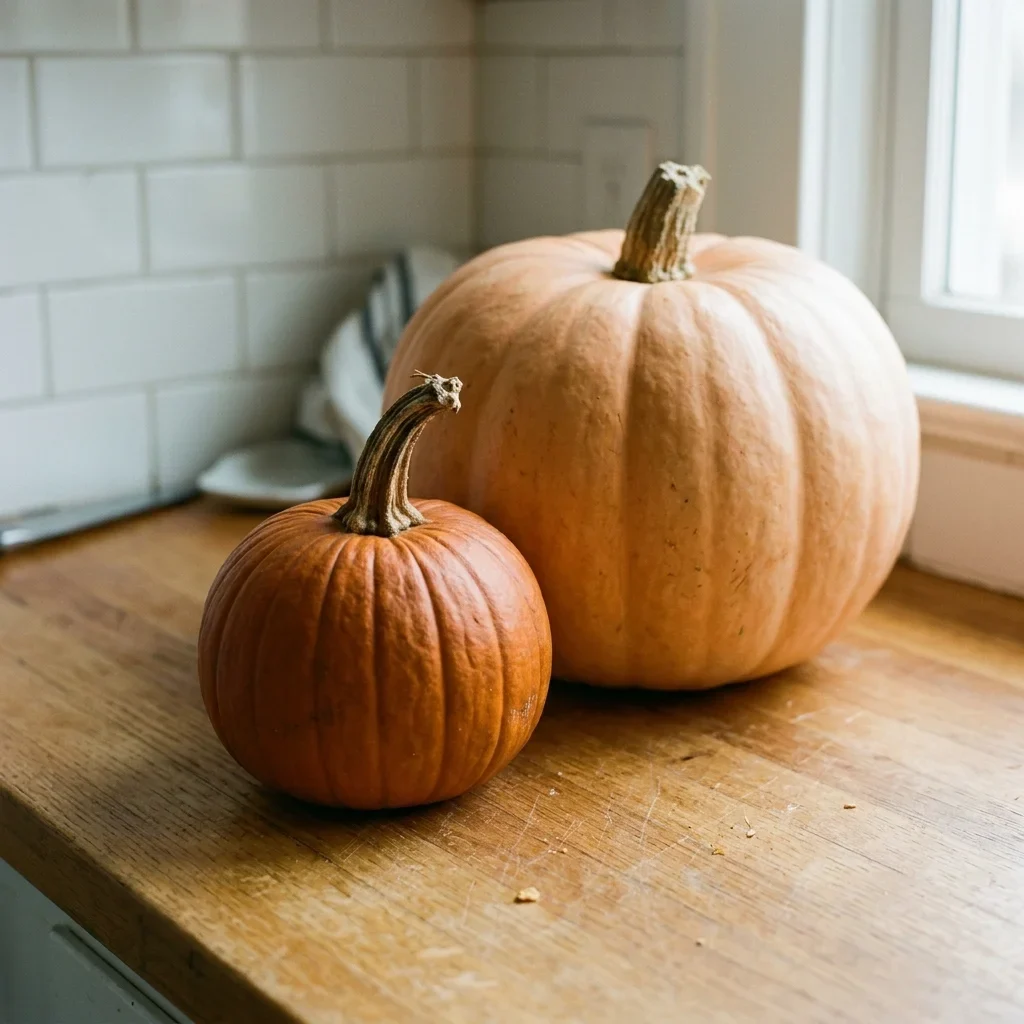
The sugar pumpkin is the one for the kitchen. The big one is for the doorstep.
A sugar or pie variety, rather than one you mean to carve. Washington State University Extension says the pumpkin varieties that are best for preserving are sugar and pie varieties. Oregon State University Extension makes the same point, since the large ones on doorsteps are the decorative kind.
A hard rind, because that is what makes storage possible. Washington State University Extension says winter squash is harvested only after it forms the hard rind that allows cold-weather storage. So a rind your fingernail can scratch is not ready.
The stem still attached. University of Minnesota Extension is blunt about it. If the stem detaches from the fruit, the shelf life will be decreased. Because of that, never carry one by the stem.
No soft spots, cuts or bruises, since the rind is the whole defense. Iowa State University Extension tells growers to promptly remove and discard any pumpkins that show signs of decay. That is because one rotting fruit becomes a problem for the whole pile.
How to store pumpkin so it lasts
To store pumpkin so it lasts, cure it, then keep it cool, dry and off the floor. Because the rind is the only thing protecting the flesh, everything here is really about keeping that rind intact.
How to store pumpkin whole
Cure it first, because that is what hardens the rind. Iowa State University Extension cures pumpkins at 80 to 85°F and 80 percent relative humidity for 10 days. Curing helps to harden their skins and heal any cuts and scratches, it says. Oregon State University Extension asks for less time: 80 to 85°F with good air flow for 5 to 7 days. Then move them somewhere cool. Oregon State gives 50 to 55°F at 50 to 70 percent relative humidity. University of Minnesota Extension gives the same temperature at about 50 percent instead. Stand them in a single layer without touching, since Iowa State says good air circulation retards the growth of decay fungi and bacteria. Piles are worse than they look, too. They generate unwanted heat, which may result in the rotting of some fruit.
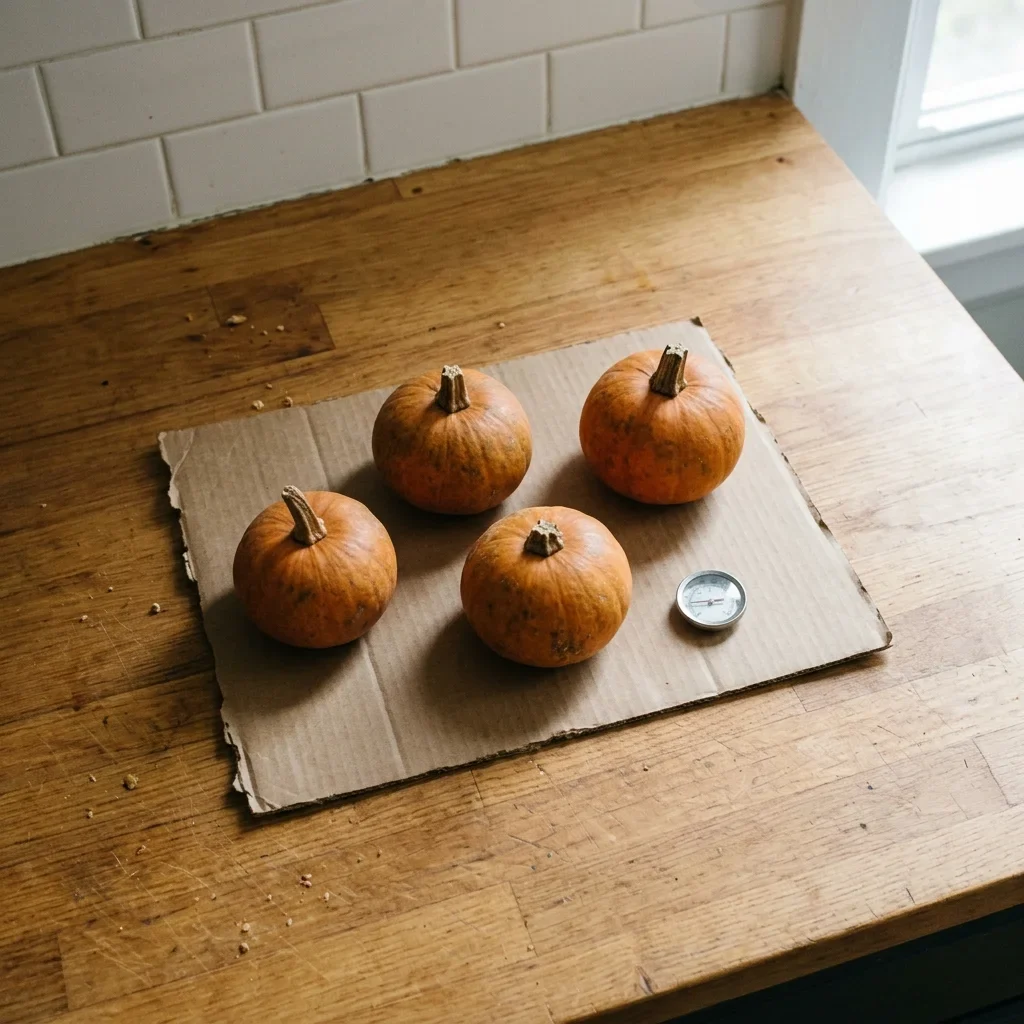
A single layer, none of them touching, at 50 to 55°F once they are cured.
How long can you store pumpkin?
Months, although the sources put the ceiling in different places. Illinois Extension says pumpkin can be stored for up to 6 months at 50 to 55°F in 50 to 70% relative humidity. University of Minnesota Extension gives 1 to 6 months, depending on the variety. Oregon State University Extension only says several months. Then there is the food-storage chart. NDSU Extension gives winter squash 2 to 6 weeks in a pantry. So use that figure when the house has no cool room.
So the honest answer depends on your house more than on your pumpkin. A heated kitchen is nearer the 2 to 6 weeks. An unheated porch or a cellar, on the other hand, is where the 6 months comes from. Variety matters as well, since the extension services agree that some types keep far longer than others.
Should you store pumpkin in the fridge?
Not whole, and here the sources genuinely disagree. Oregon State University Extension is firm that pumpkins and squash deteriorate rapidly if stored below 50°F. Illinois Extension repeats that word for word. A home fridge runs at 32 to 40°F, so that rules it out. However, NDSU Extension gives winter squash 1 to 3 months at 32 to 40°F. That is the opposite advice. The two are answering different questions, though. The horticulture publications are about long storage of a cured whole fruit, while the chart is a general quality table. We follow the 50°F floor for a whole pumpkin, because that is where the specific guidance sits. Cut pieces are a different matter, and those do belong in the fridge.
How to store pumpkin once you cut it
In the fridge, wrapped, and on a short clock. Illinois Extension says to store sliced pumpkin in the refrigerator for food safety. It stops short of a number for raw pieces, though. For fresh puree or pumpkin butter it does give one: eaten within three to four days. So we treat cut raw pumpkin the same way. No extension source we opened publishes a separate figure for it, and we would rather say so than invent one. Keep the fridge at 40°F or lower, which is the limit Clemson Cooperative Extension sets. When cut pumpkin or cooked puree has sat out, food left out overnight covers the two-hour rule.
How to store pumpkin seeds
Dry them, then keep them cold. Illinois Extension washes the seeds to remove the fibrous tissue first. Then it dries them at 115 to 120ºF for 1 to 2 hours, or in an oven on warm for 3 to 4 hours. Roasting comes after that, at 250ºF for 10 to 15 minutes. Oregon State University Extension agrees that drying and roasting are two different processes. Drying first gives more even roasting, it says. Then store the cooled seeds in a bag. Both send them to the refrigerator or the freezer for long-term storage, because the seeds will become rancid at room temperature. The roasted pumpkin seeds guide covers them in full.
Can you store pumpkin in the freezer?
Yes, and cooked is the way to do it. Oregon State University Extension cooks the pumpkin until soft, then mashes it and cools the pan in cold water. After that it goes into freezer bags or containers. Illinois Extension adds half an inch of headspace. The freezer is also the only route for a pumpkin you cannot eat fast. NDSU Extension gives winter squash 10 to 12 months at 0°F.
How to store pumpkin in the freezer
Cook it, then puree it, cool it fast and freeze it flat. For example, Oregon State University Extension cooks the pieces in boiling water, a steamer, a pressure cooker or an oven. Different varieties have widely different cooking times, it warns. Then it removes the soft pulp from the rind and mashes it. Cooling matters next, so set the pan of puree in cold water and stir it occasionally. Pack it in freezer bags, leaving half an inch of headspace as Illinois Extension advises. The FDA also adds the useful part. Frozen food stays safe indefinitely at 0°F, so those month figures are about quality only.
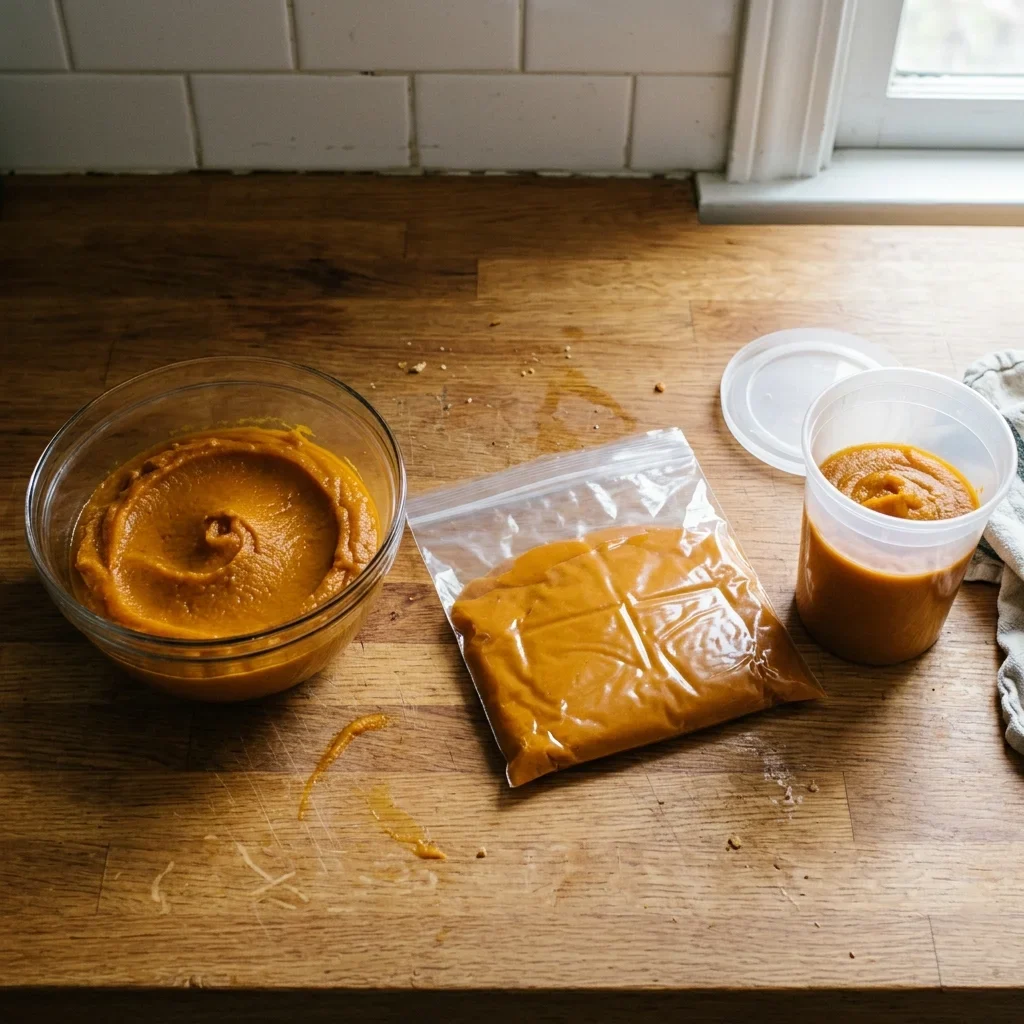
Cooked, pureed, cooled fast, with half an inch of headspace.
How to store pumpkin from an opened can
Out of the can, into a covered container, then into the fridge. Clemson Cooperative Extension says to store leftovers tightly covered in a glass or plastic container in the refrigerator. It gives canned vegetables 3 days. That is shorter than the three to four days Illinois Extension allows for fresh puree. So the opened can is the stricter case. Neither source names pumpkin by itself, though, which is worth knowing before you plan a week around half a tin.
What happens to pumpkin you store in the freezer
It comes out soft, which is why it goes in cooked. Freezing suits a puree, whereas raw cubes thaw into something closer to soup. Canning is where the density really matters. Oregon State University Extension says safe processing times have not been determined for mashed or pureed squash. The high density of the product is the reason. Illinois Extension adds that USDA directions for canning puree were withdrawn in 1989. There was too much variation in the thickness of pumpkin purees, it explains. The freezer has no such limit, so that is where a puree belongs. Sweet potatoes follow the same logic, since that guide also cooks them first.
How to tell if a pumpkin has gone bad
In fact a pumpkin tells you early, if you look at it. The rind is the whole defense. So a scratch is a warning, while a soft spot is a verdict. Mold on a hard rind, meanwhile, is the one case with a published rule. Here is what each stage means.
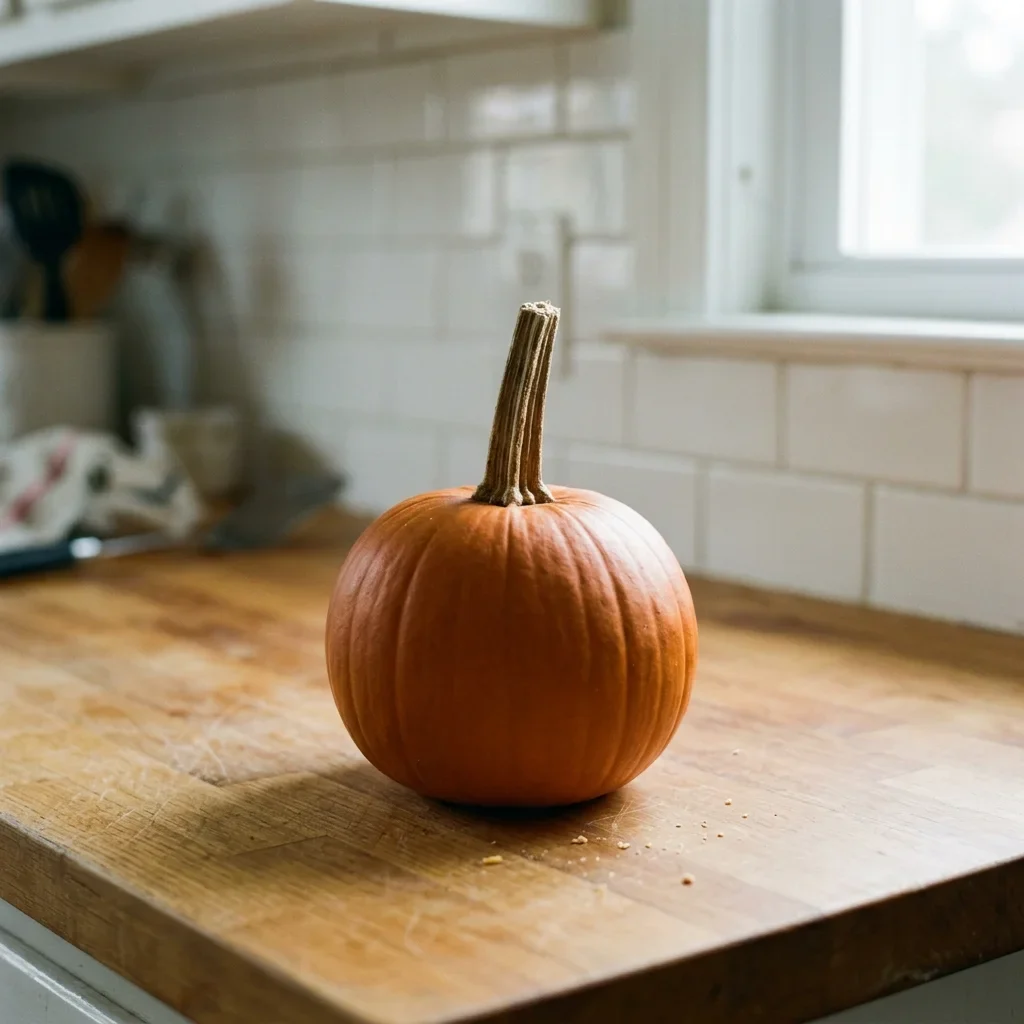
Verdict: store it
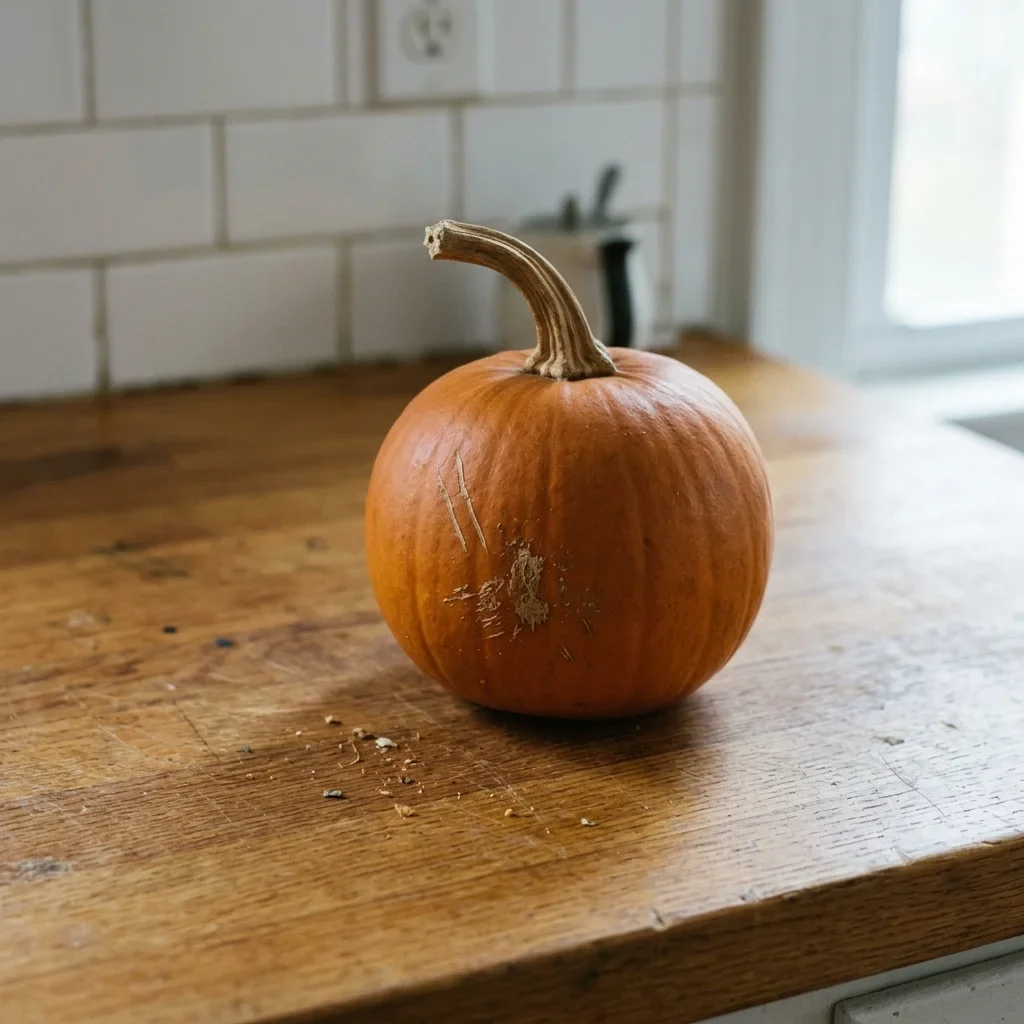
A firm pumpkin with the stem on
Hard all over, bright, with a dry stem still attached. That is the condition Oregon State University Extension calls peak: mature, firm, bright-colored and with a hard rind. Then cure it, and it will keep for months.
Verdict: use it first
A pumpkin with a scratched or scuffed rind
Scrapes are cosmetic until they are not. Curing exists partly to heal them: Iowa State University Extension says it helps harden their skins and heal any cuts and scratches. A fresh scratch on a pumpkin already in storage will not heal, though. So move that one to the front of the queue.
Verdict: cut an inch clear
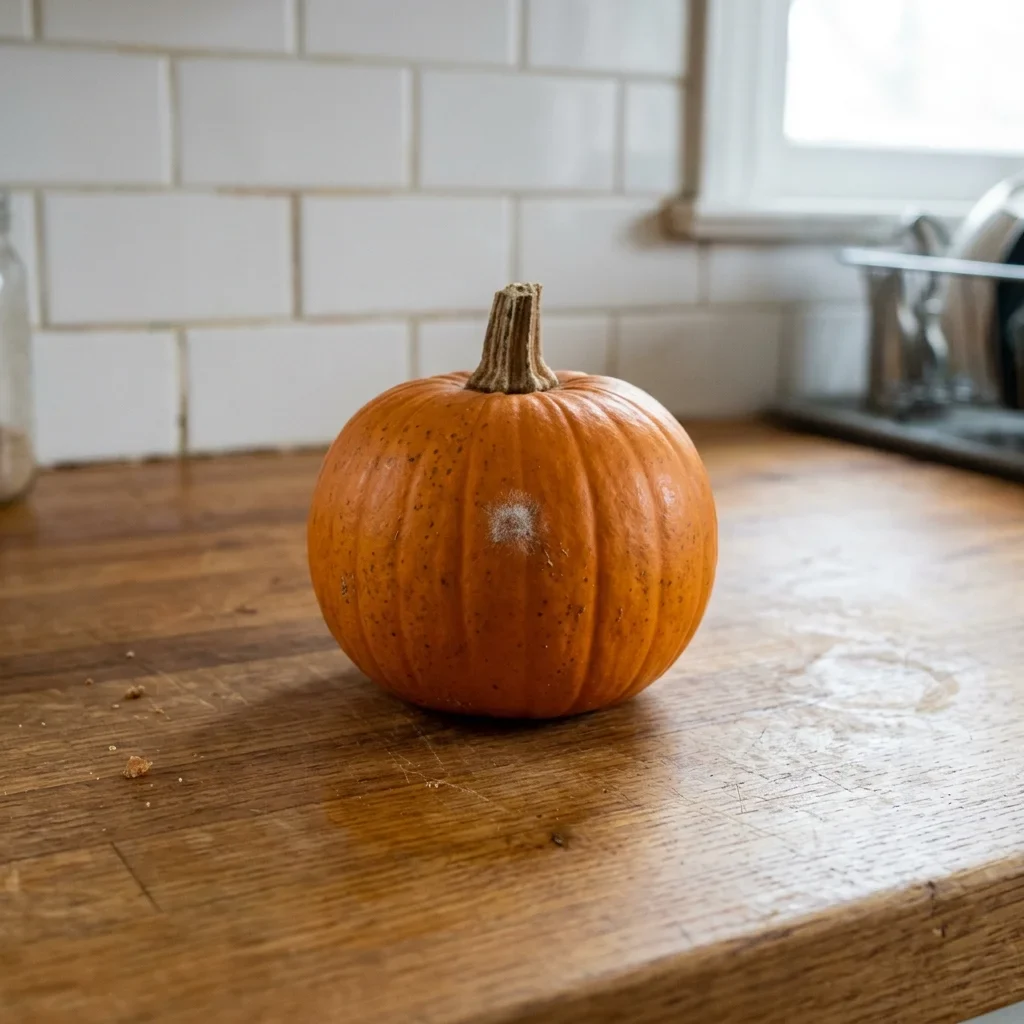
A mold spot on a hard pumpkin rind
Here there is a rule, and it is the firm-produce rule. The USDA Food Safety and Inspection Service says small mold spots can be cut off firm fruits and vegetables with low moisture content. Cut at least 1 inch around and below the spot. It also tells you to keep the knife out of the mold itself, so it will not cross-contaminate other parts of the produce. Pumpkin is not one of the examples it lists, which are cabbage, bell peppers and carrots. So this is a reading rather than a quotation. The cabbage guide uses the same 1-inch rule.
Verdict: throw it out
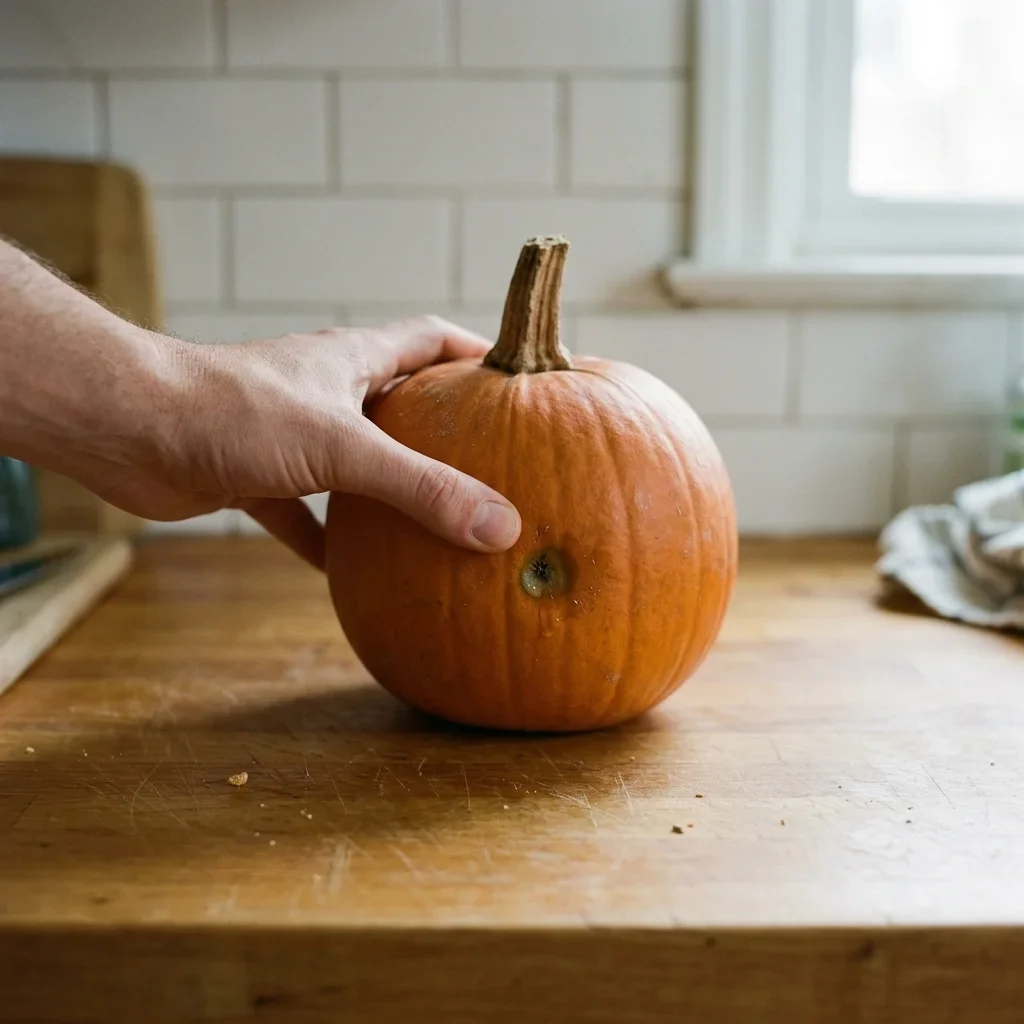
A pumpkin with a soft, wet spot
Soft means the flesh under it has broken down, so the firm-produce rule stops applying. The same FSIS chart instead puts soft, high-moisture fruits and vegetables in the discard column. They can be contaminated below the surface, it explains. Iowa State University Extension says the same thing for a stored crop, too. Promptly remove and discard any pumpkins that show signs of decay, it tells growers. Then check the ones sitting beside it.
Verdict: throw it out and check the pile
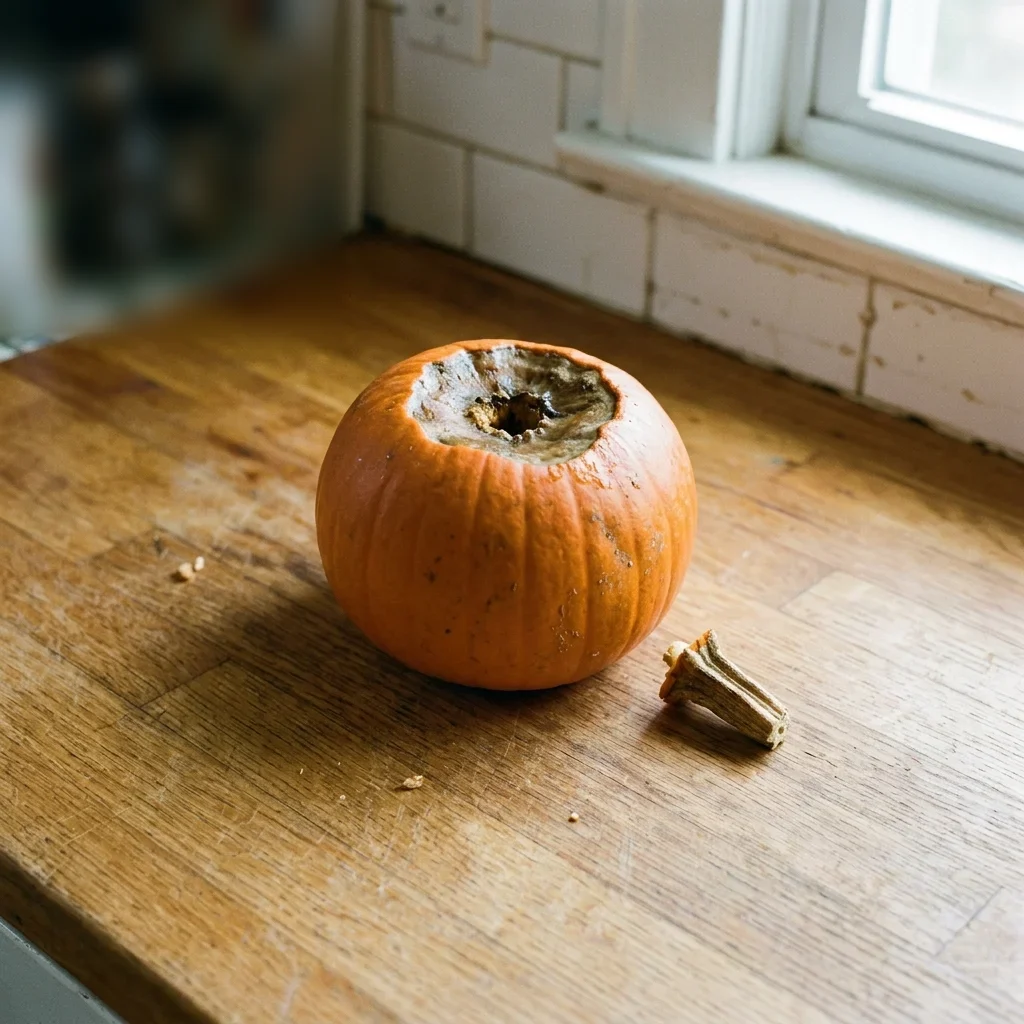
A pumpkin going mushy at the stem
The stem end is where most of them fail. University of Minnesota Extension warns that a pumpkin loses shelf life when the stem detaches from the fruit. Iowa State University Extension explains why one bad fruit matters. Good air circulation retards the growth of decay fungi and bacteria, it says. Piles, on the other hand, generate unwanted heat which may result in the rotting of some fruit. So take the soft one out, clean the shelf and space the rest.
Can you store pumpkin after you carve it?
Not for eating, and not for long. A carved pumpkin is cut flesh left at room temperature. That is exactly what Illinois Extension sends to the refrigerator for food safety. None of the sources here gives a figure for a jack-o'-lantern, because it is a decoration rather than food. So carve the big one, and keep a sugar pumpkin for the pie. If you want the carved one to last on the step, cool, dry and out of the sun is still the rule. The pie wants allspice as well, since McCormick lists it as one of the four spices in its pumpkin pie spice.
Pumpkin substitutes
Out of pumpkin, or did the one on the step go soft? Then these will do the same jobs.
Substitute
Works best in
What changes
Butternut squash
Pies, soups and roasting
Sweeter and smoother, and it keeps just as long.
Canned pumpkin
Baking
Already pureed, although an open tin gets 3 days.
Kabocha or Hubbard squash
Roasting and curries
Drier, so it holds its shape better.
Sweet potato
Pies and mash
Sweeter and starchier than pumpkin.
Mistakes people make when they store pumpkin
These are the ways people store pumpkin that cost them the most, and each one still has an easy fix.
Carrying it by the stem. University of Minnesota Extension says a pumpkin loses shelf life once the stem comes off, so lift it from underneath.
Putting a whole one in the fridge. Oregon State Extension says pumpkins deteriorate rapidly below 50°F, so use a cool room instead.
Stacking them in a crate. Iowa State Extension warns that piles generate heat and rot, so stand them apart in a single layer.
Keeping them beside the apples. Ethylene from apples and pears yellows squash and shortens its storage life, says Illinois Extension, so keep them apart.
Canning the puree. Oregon State Extension says safe processing times have not been determined for mashed squash, so freeze it instead.
Leaving the seeds in a jar on the counter. They go rancid at room temperature, so keep them in the fridge or the freezer.
Cutting round a soft, wet spot. The 1-inch rule is for firm, low-moisture food, so a soft spot means the pumpkin goes.
Sources
Preserving pumpkins and winter squash, Nellie Oehler and Jared Hibbard-Swanson, Oregon State University Extension publication SP 50-767, revised November 2024, on sugar and pie varieties, curing at 80 to 85°F for 5 to 7 days, storage at 50 to 55°F and 50 to 70% humidity, apples and pears, canning cubes only, freezing puree and drying and roasting seeds.
Preserving Pumpkin, Illinois Extension, University of Illinois, on up to 6 months at 50 to 55°F, sliced pumpkin in the refrigerator, puree or butter within three to four days, the 1989 withdrawal of USDA puree canning directions, half an inch of headspace, and drying and roasting seeds.
What is the proper way to store pumpkins?, Richard Jauron, Iowa State University Extension and Outreach Yard and Garden, updated March 2024, on curing at 80 to 85°F and 80% humidity for 10 days, storing at 50 to 55°F in a single layer, air circulation and decay fungi, heat in piles, and discarding fruit that shows decay.
Harvesting and storing melons, squash and pumpkins, Natalie Hoidal, University of Minnesota Extension, on curing and the rind-hardening fingernail test, storage at 50 to 55°F and about 50% humidity, 1 to 6 months by variety, and shelf life falling when the stem detaches.
Preserving Pumpkin and Winter Squash, Kayla Wells-Moses, Washington State University Extension fact sheet FS303E, on winter squash forming the hard rind that allows cold-weather storage, sugar and pie varieties for preserving, and safe processing times not being determined for pureed squash.
Molds on Food: Are They Dangerous?, USDA Food Safety and Inspection Service, slightly revised September 2005, hosted by UC Davis Food Safety, on cutting 1 inch around and below mold on firm fruits and vegetables, keeping the knife out of the mold, and discarding soft high-moisture produce.
Safe Handling of Canned Goods, Pamela Schmutz and E.H. Hoyle, Clemson Cooperative Extension factsheet HGIC 3505, updated June 2024, on moving leftovers into a covered glass or plastic container in the refrigerator and giving canned vegetables 3 days.
Safety of Stored Foods, Pamela Schmutz and E.H. Hoyle, Clemson Cooperative Extension factsheet HGIC 3520, revised April 2020, on keeping refrigerated food at 40°F or lower.
Food Storage Guide, Julie Garden-Robinson, NDSU Extension publication FN579, reviewed January 2023, on winter squash at 2 to 6 weeks in a pantry, 1 to 3 months at 32 to 40°F and 10 to 12 months at 0°F, and on pumpkin pies at 3 to 4 days in the fridge.
Refrigerator and Freezer Storage Chart, U.S. Food and Drug Administration, March 2018, on freezing at 0°F keeping food safe indefinitely so freezer times are for quality only.
Storage times and safety advice on this page come from the sources above. Food safety depends on conditions I cannot see, so read the Disclaimer, and if in doubt, throw it out.
Other ingredient guides
Browse all guides

Share this guide
Never miss a guide
New ingredient guides when they go up, plus one storage tip worth knowing. Anything sponsored is labelled.

Emilly White